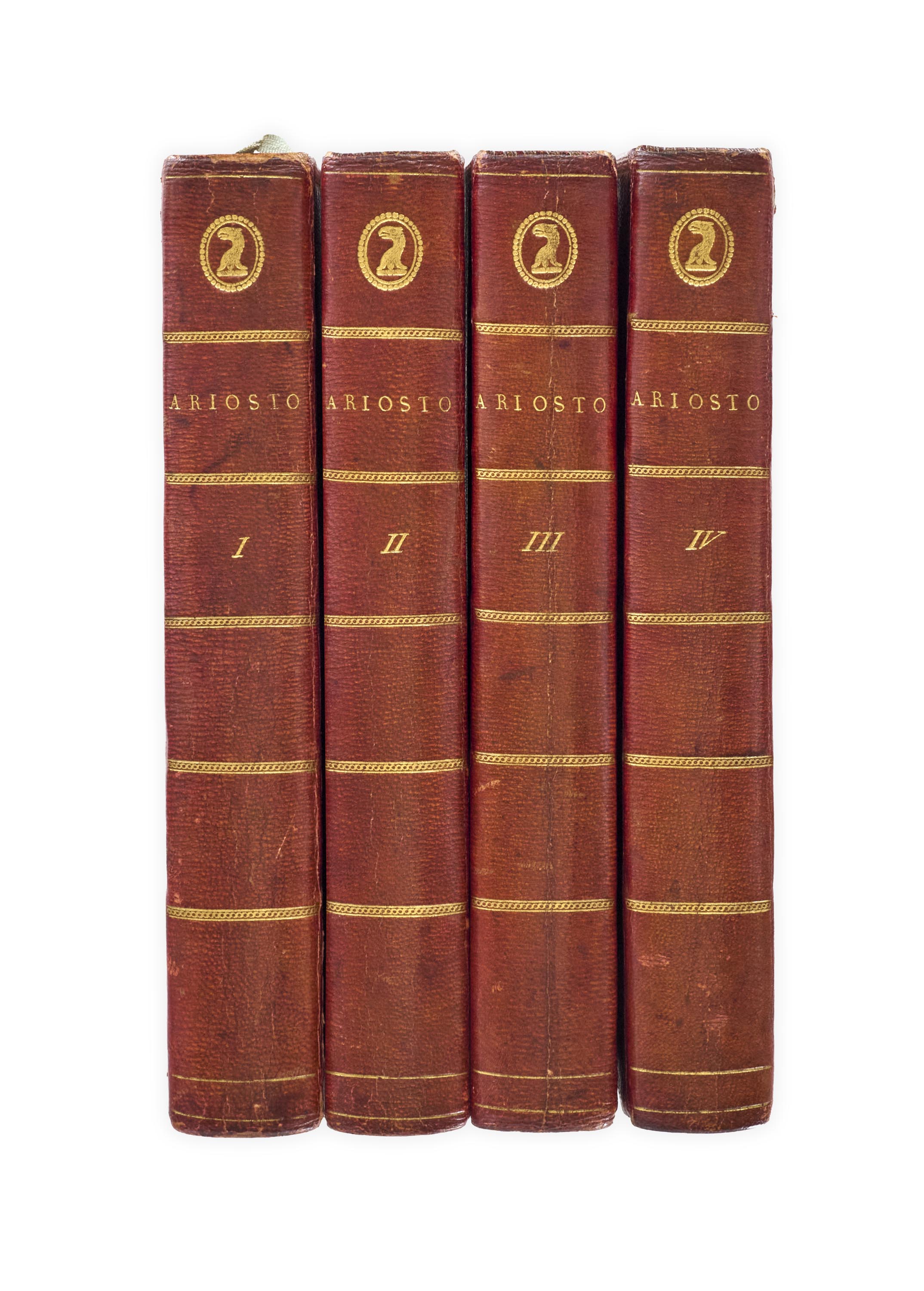
A Subscriber’s Copy
ARIOSTO, Ludovico.
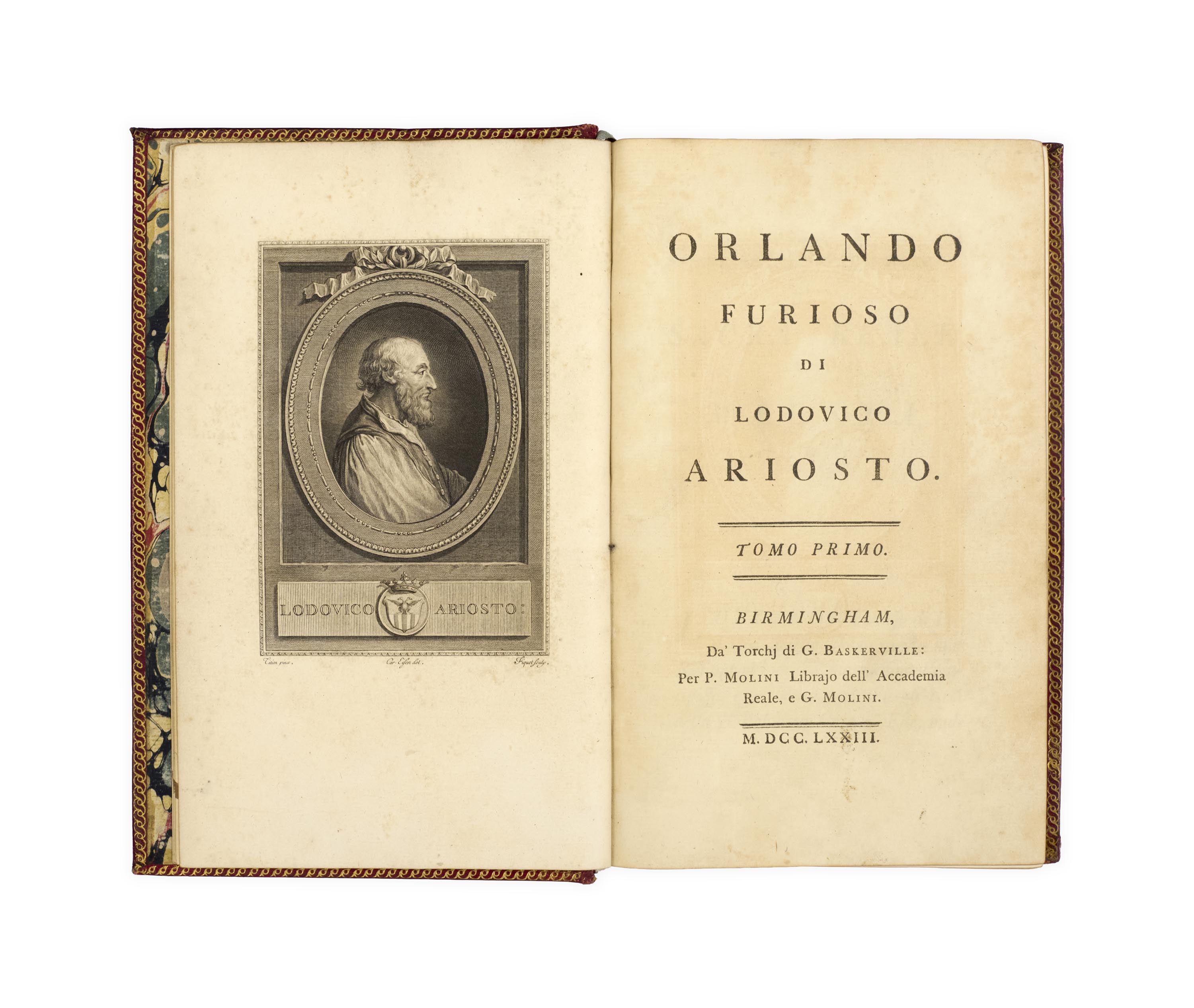
Orlando furioso. Birmingham, John Baskerville for Pietro Molini and Giovanni Molini, 1773.
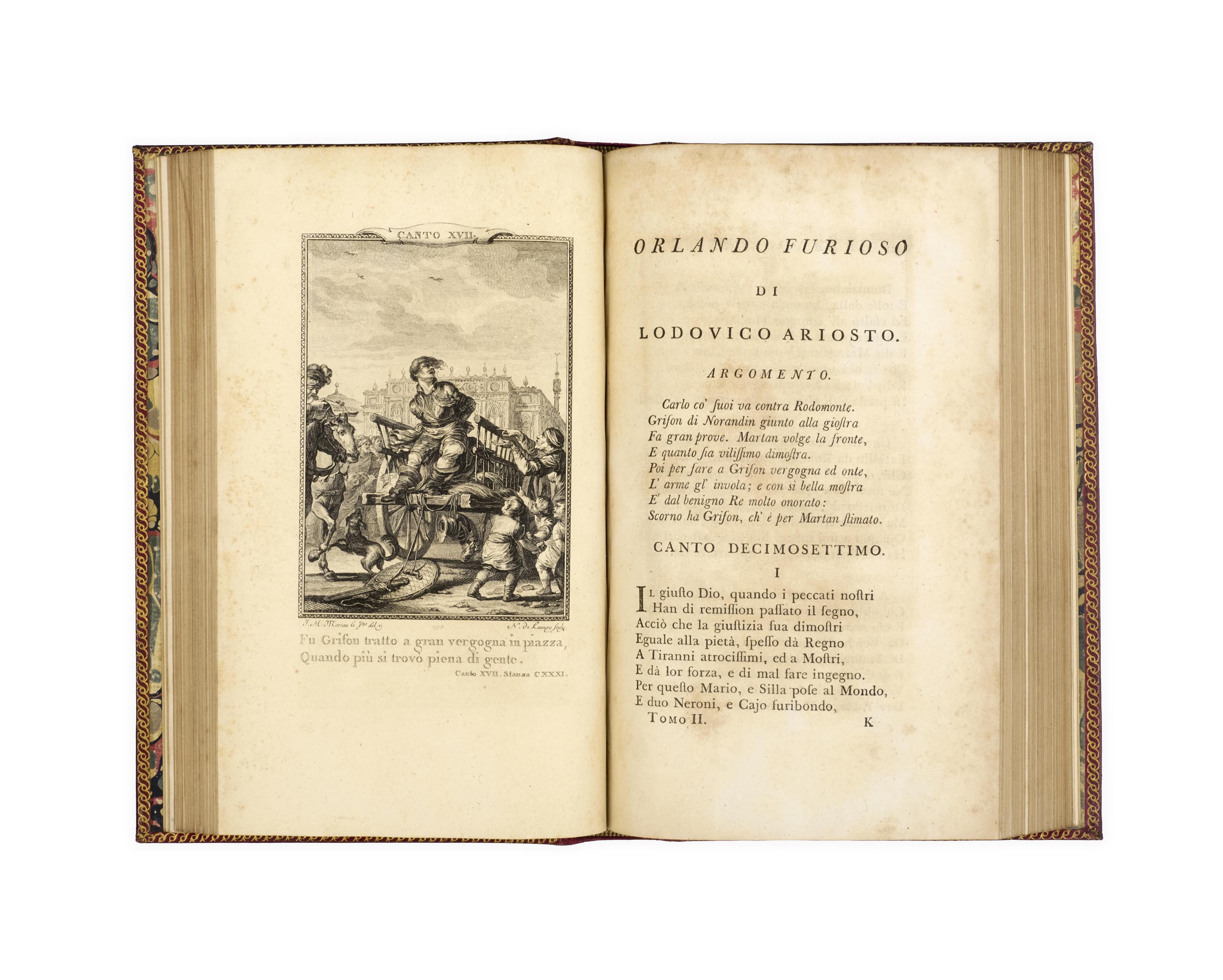
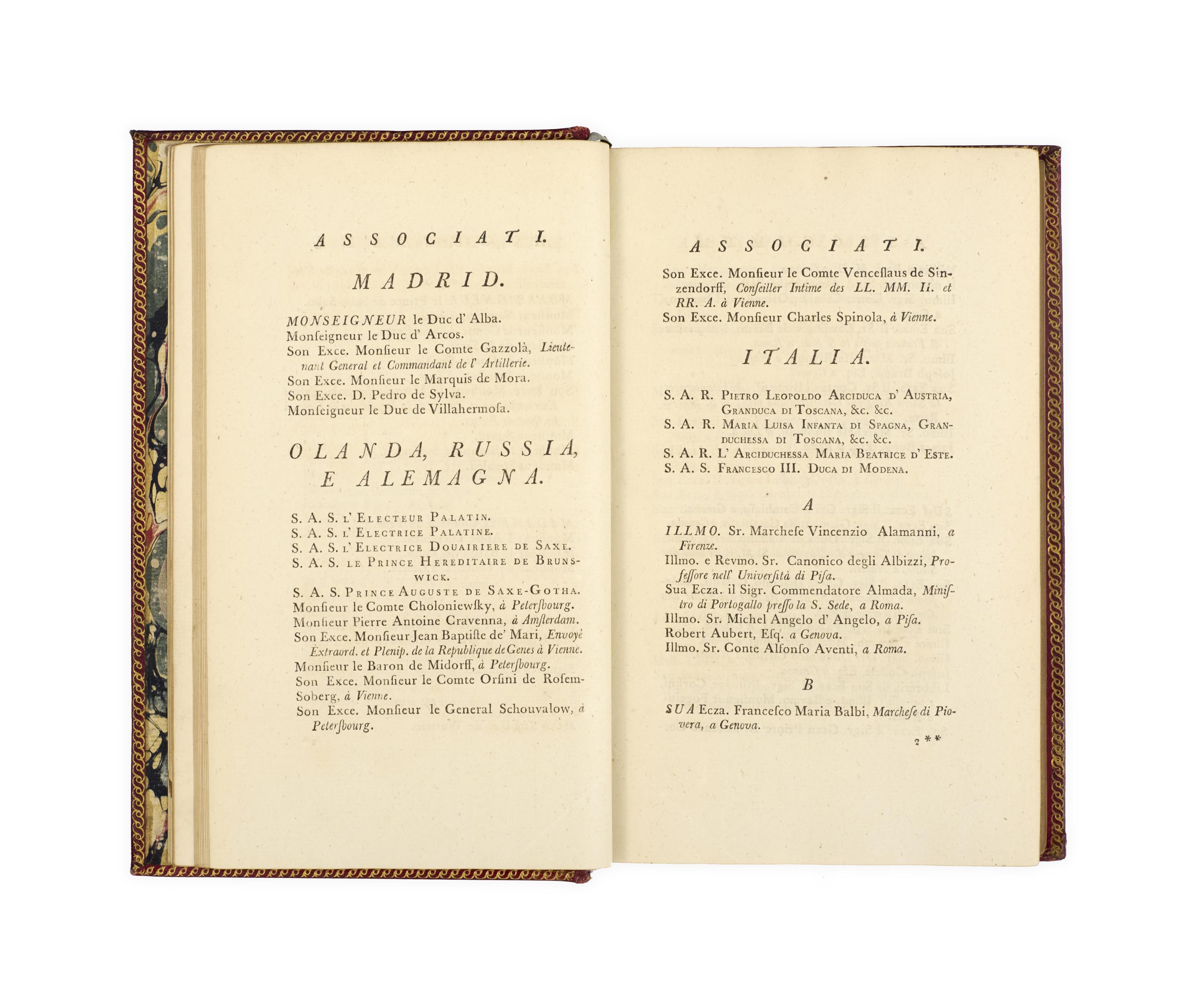
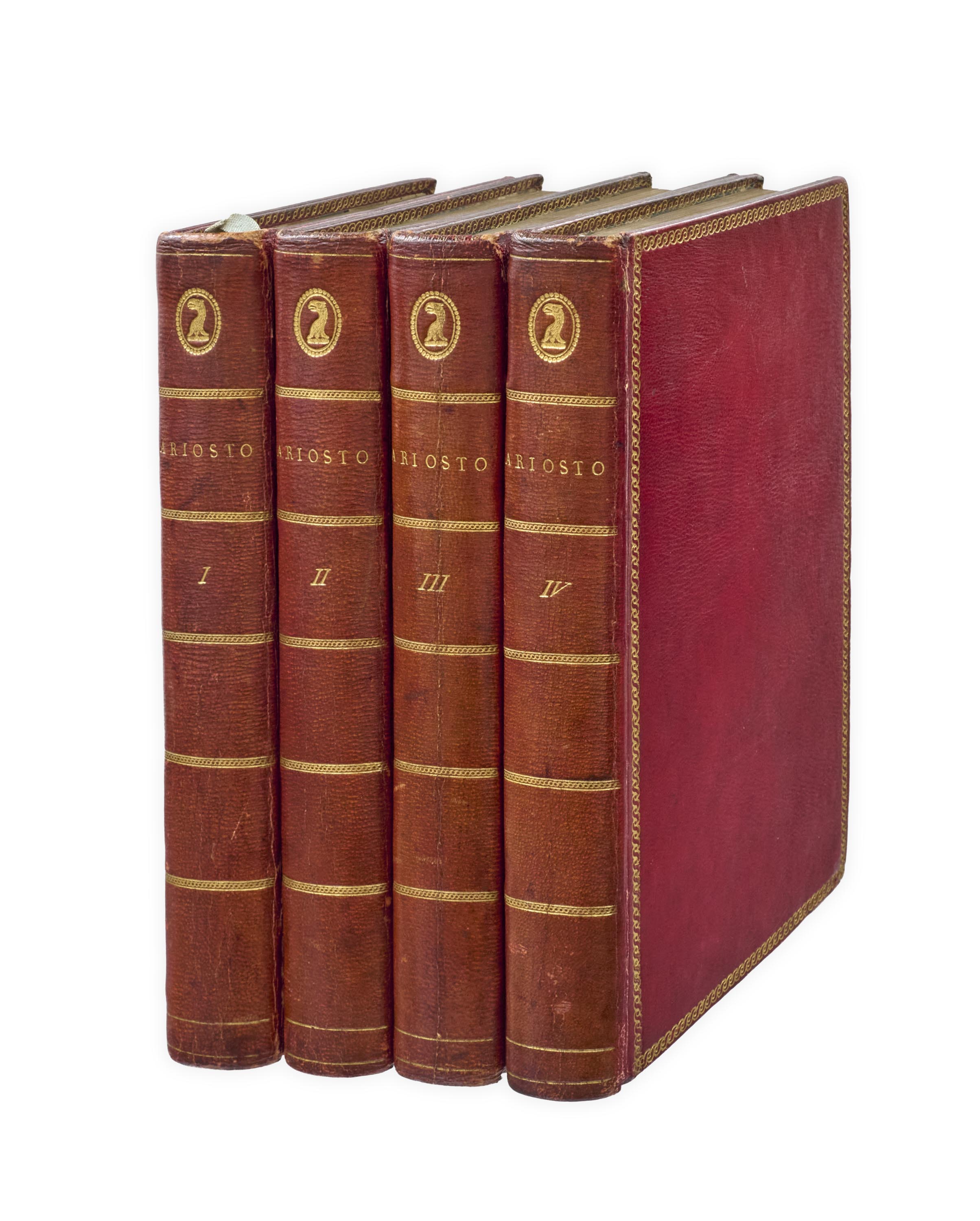
Four vols, 8vo, I: pp. [6], [28 (subscribers)], lviii, 362, [2 (blank)], copper-engraved frontispiece portrait of Ariosto by Fiquet after Eisen based on Titian, 12 engraved plates, II: pp. [ii], 450, [2 (blank)], 11 engraved plates, III: pp. [ii], 446, [2 (blank)], 12 engraved plates, IV: pp. [ii], 446, [2 (blank)], A8 and S2 cancels and signed with an asterisk, 11 engraved plates; light foxing throughout with minor offsetting from plates, but a very good set; bound in near-contemporary straight-grained red morocco, gilt border, flat spines gilt in compartments and lettered directly in gilt with eagle’s head crest of Sir Richard Hoare, 2nd Baronet (BAB Stamp 13), turn-ins roll-tooled in gilt, edges gilt, marbled endpapers, blue silk placemarkers; extremities very lightly rubbed; bookplates of Mary Schell Collins (1864–1948, of Philadelphia), location ’14 South R.’ written on verso of front free endleaves, twentieth-century bookplate ‘The Robin Collection’ to first volume.
A handsomely bound set of the attractive and influential Baskerville edition of Orlando furioso, illustrated with plates by notable eighteenth-century artists, and with an extensive list of prominent subscribers.
Details of the international nature of the production are recorded in the surviving French Prospectus for printing (1772, Gaskell xv). Baskerville produced the text on commission for the Molini bookselling brothers, to be sold at their shops in London, Paris, and Florence, in both octavo and quarto format. The plates, positioned at the opening of each of the forty-six books, are engraved by Bartolozzi, de Launay, de Longueil, Prevost, and others after designs by Eisen, Moreau, Cochin, Cipriani, Monnet, and Gruize, and the Prospectus similarly lauds the engravers as well as the artists, indicating that the plates were to be the primary selling point. The influence of this illustrative cycle resulted in their being copied for subsequent editions of Orlando furioso in Livorno, Venice, and elsewhere.
The extensive list of subscribers is arranged by location, starting with the King and Queen in London and ending with Count Wilczek in Naples, by way of Paris, Madrid, Amsterdam, St Petersburg, Vienna, and several parts of Italy. Among the notable subscribers are Baretti, Burke, Charles Burney, Baker & Leigh, Prince Czartoryski, Garrick, Goldsmith, Sir William Hamilton, the duc de Noailles, the Elector and Electress Palatine, General Shuvalov, Piranesi, Luigi Vanvitelli, and Watelet.
The present, octavo issue contains just a couple of cancel leaves in the fourth volume, and a list of errata for all four volumes bound at the end of the preliminaries to the first volume. The quarto issue (Gaskell 48(b)), printed from the same setting, contains numerous cancels but no errata leaf.
Provenance:
1. Sir Richard Hoare, 1st Baronet (1735–1787), of the eponymous banking family, created a baronet in 1786 and listed as a subscriber here as ‘Richard Hoare, Esq.’. By descent to his son,
2. Sir Richard Hoare, 2nd Baronet (1758–1838), antiquary and archaeologist, with his crest gilt-stamped to each spine.
ESTC T133620; Gaskell 48(a); Cohen–De Ricci, cols 95–7 (‘Très belle édition’).