Featured
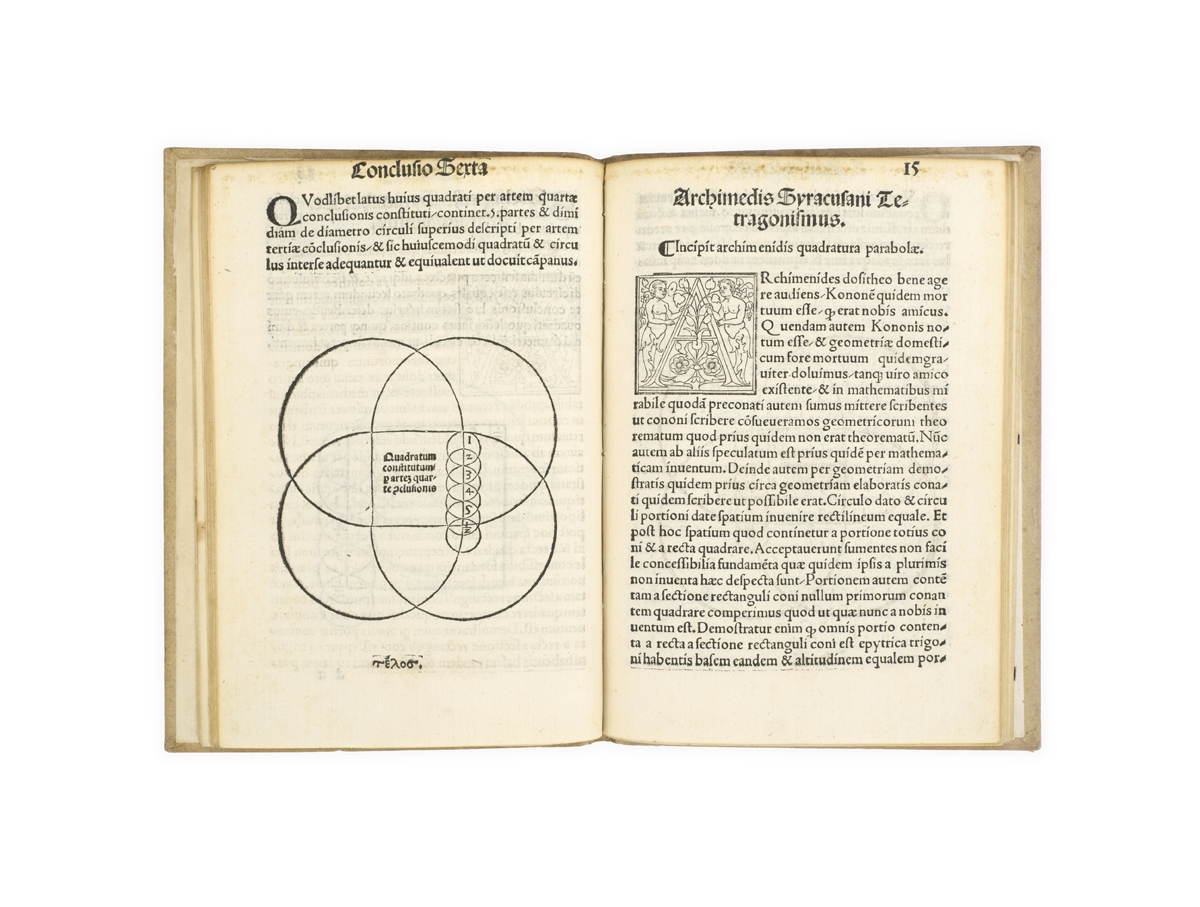
The First Archimedes
ARCHIMEDES, BOETHIUS, and CAMPANO da Novara; Luca GAURICO, editor.
Tetragonismus id est circuli quadratura per Campanum Archimedem Syracusanum atque Boetium mathematicae perspicacissimos adinventa.
The first appearance in print of any complete work by Archimedes, ‘generally regarded as one of the greatest mathematicians the world has ever known’ (PMM), including one of the earliest approximations of the value of π.

From the First Venetian Press
LACTANTIUS.
Opera.
Magnificent incunable edition of the works of Lactantius, a fine product of the first Venetian press, established in 1469 by Johannes de Spira and continued by his brother Vindelinus from 1470 until 1473. This was the fifth impression of the works of Lactantius, the hugely successful North African early Christian writer.

The Last Judgement
[GRADUAL.]
Vast historiated initial ‘A’ cut from a Gradual.
A spectacular initial on the scale of a small panel painting. The verso includes the text ‘[neque] irrideant me inimici mei […] [un]iversi qui te expectant’ and the versicle ‘Vias tuas domine de[monstras]’, indicating that the initial would have introduced the introit ‘Ad te levavi animam meam’ (‘Unto thee I lift up my soul’) for the first Sunday in Advent (and thus the very first text of the liturgical year). As for the corresponding text for that day in the Antiphonal (‘Aspiciens a longe …’, ‘Seeing from afar, behold the power of God coming …’) the initial ‘A’ was often given lavish treatment by the illuminators of Italian choirbooks, and in both cases the iconography sometimes combined Christ in glory after the Ascension with the Last Judgment, as here. While the dead rising from their graves are sometimes depicted, our initial is unusual for its inclusion of tormented souls in Hell. The style may be compared to the oeuvres of the First Master of the Gubbio Choir Books and the Master of the Deruta-Salerno Missals. The decorated initials on the verso are characteristic of Umbrian illumination in the last quarter of the thirteenth century.

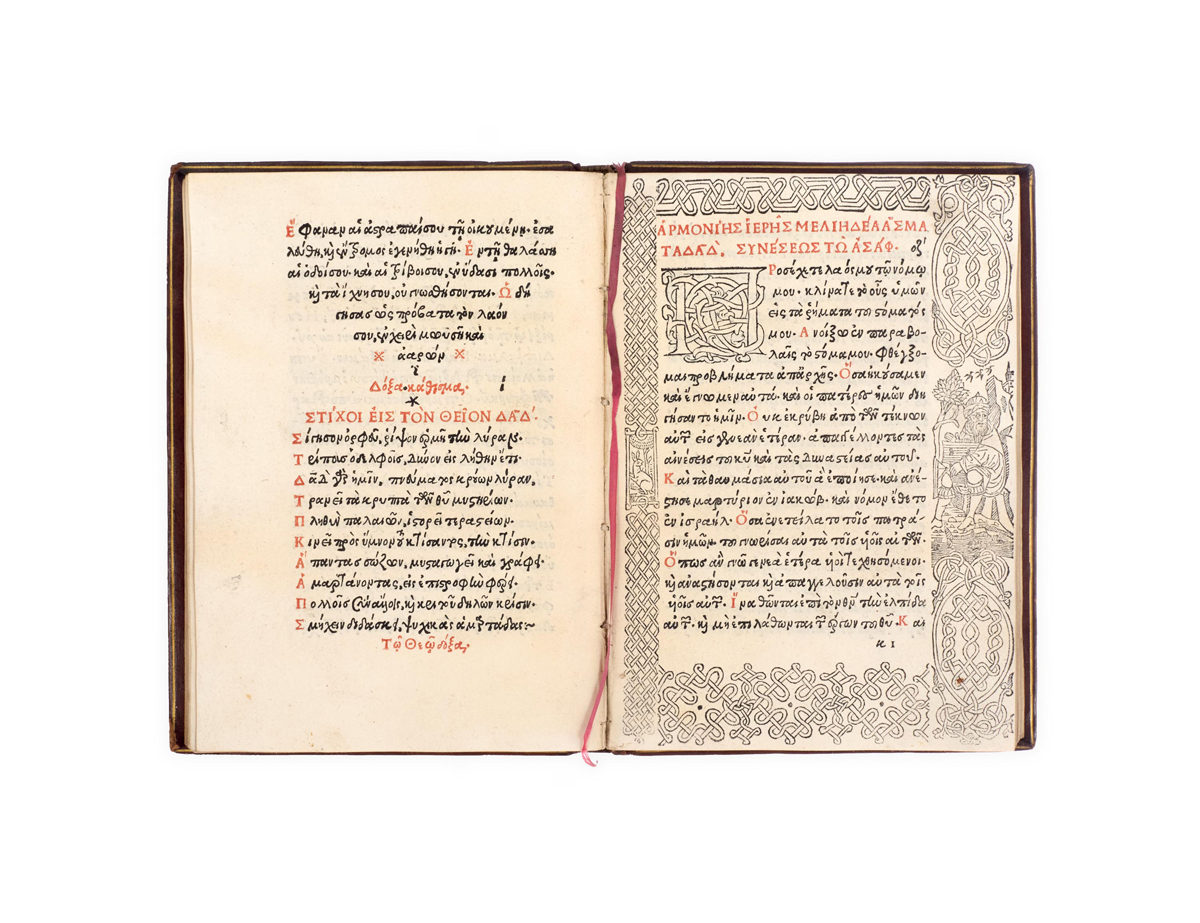
The Aldine Greek Psalter
[PSALTER.] Justinus DECADYUS, editor.
Ψαλτηριον.
The elegant first Aldine printing of the Greek Psalter, following two earlier and plainer editions of 1481 and 1486, which had employed much simpler Greek typefaces with fewer ligatures and contractions.
![Le vergier dhonneur nouvellement imprime a Paris. De lentreprise et voyage de Napples. Auquel est compris commant le roy Charles huitiesme de ce nom a banyere desployee passa et rapassa de iournee en iournee depuis Lyon iusques a napples et de napples iusques a Lyon. E[n]semble plusieurs aultres choses faictes et composees par reverend pere en dieu monsigneur octovie[n] de sainct Gelais evesque da[n]golesme et par Maistre Andry de la vigne secretaire de monsieur le duc de Savoye avec aultres.](https://prd.assets.books.quaritch.com/images/G2700_03.JPG)
Chivalry Illuminated: a Royal Commission?
[LA VIGNE, André de, and Octavien de SAINT-GELAIS.]
Le vergier dhonneur nouvellement imprime a Paris. De lentreprise et voyage de Napples. Auquel est compris commant le roy Charles huitiesme de ce nom a banyere desployee passa et rapassa de iournee en iournee depuis Lyon iusques a napples et de napples iusques a Lyon. E[n]semble plusieurs aultres choses faictes et composees par reverend pere en dieu monsigneur octovie[n] de sainct Gelais evesque da[n]golesme et par Maistre Andry de la vigne secretaire de monsieur le duc de Savoye avec aultres.
Extremely rare first edition of the Vergier d’Honneur, a celebration of the expedition of Charles VIII to Italy; a remarkable copy preceded by three leaves of illuminated manuscript containing unrecorded verse and a spectacular miniature of a knight on horseback.
![[Edited by Janus Lascaris.]](https://prd.assets.books.quaritch.com/images/GJ80_03.JPG)
Editio Princeps of 1500 Years of Greek Poetry
[ANTHOLOGIA GRAECA PLANUDEA.]
[Edited by Janus Lascaris.]
Editio princeps, a beautiful printing in elegant epigraphic type, of the Planudean Anthology, a substantial collection of classical Greek verse which influenced artists, poets, and scholars. ‘The Greek Anthology is one of the great books of European literature, a garden containing the flowers and weeds of fifteen hundred years of Greek poetry, from the most humdrum doggerel to the purest poetry’ (Oxford Classical Dictionary).
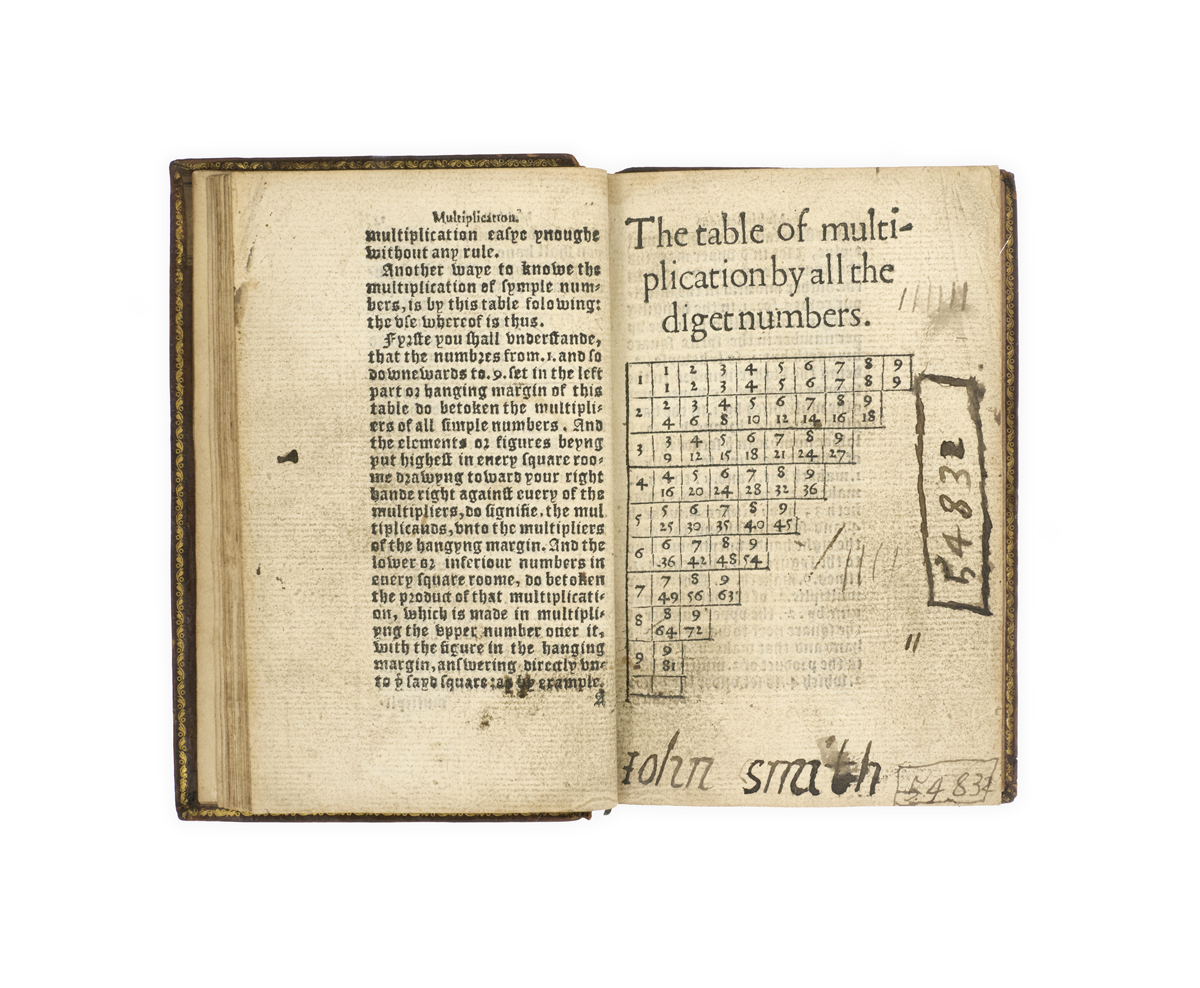
Mercantile Arithmetic and Mathematical Games
BAKER, Humfrey.
The Well Sprynge of Sciences which teacheth the perfect Worke and Practise of Arithmeticke bothe in whole Numbers and Fractions, with such easye and compendious Instruction into the sayde Arte, as hathe not heretofore been by any set out nor laboured. Beawtified with most necessarye Rules and Questions, not onely profitable for Marchaunts, but also for all Artificers, as in the Table doth partlye appeare …
The extremely rare first edition (one of two copies in ESTC) of a very popular guide to arithmetic by the London schoolteacher and almanack-maker Humfrey Baker (fl. 1557–87).
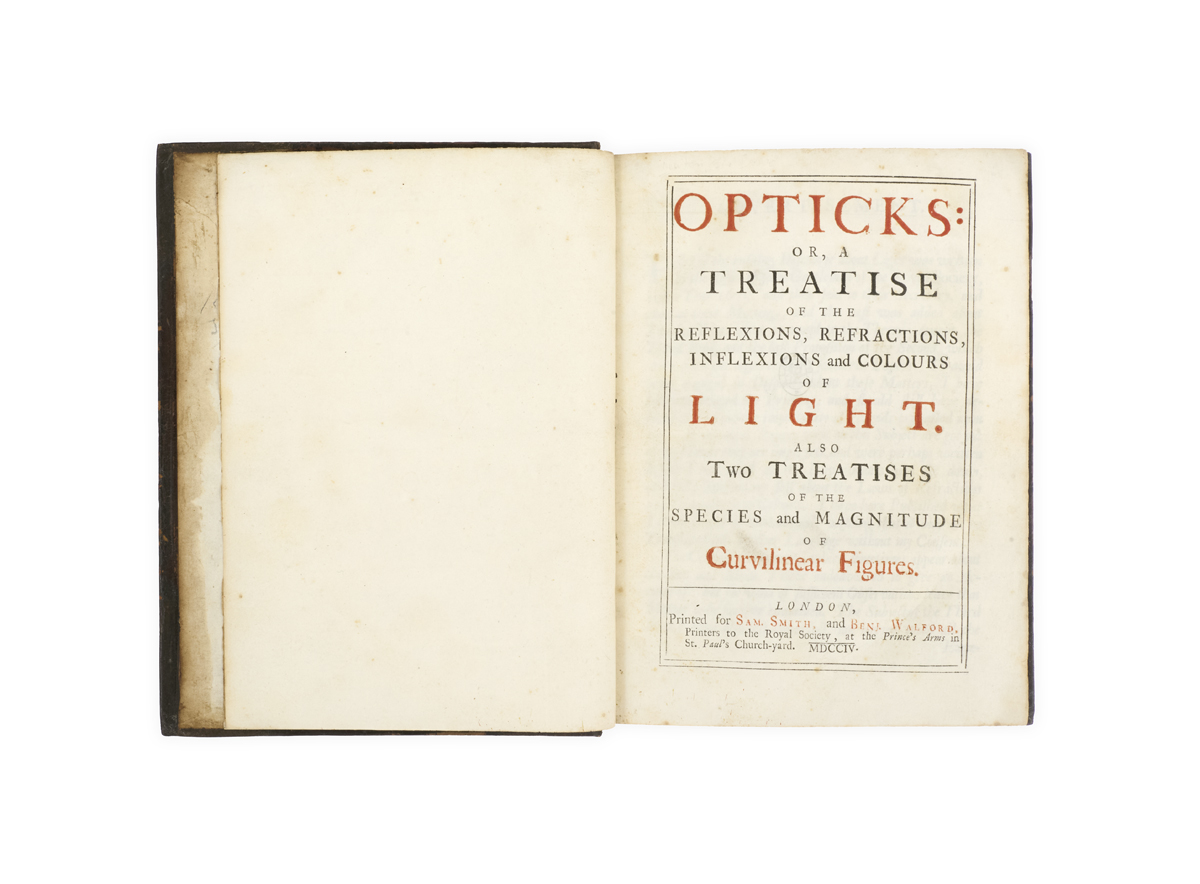
Newton on Colour
NEWTON, Isaac.
Opticks: or, a Treatise of the Reflexions, Refractions, Inflexions, and Colours of Light. Also two treatises of the species and magnitude of curvilinear figures.
First edition of Newton’s Opticks, ‘which did for light what his Principia had done for gravitation, namely, placed it on a scientific basis’, and ‘expounds Newton’s corpuscular or emission theory of light, and first contains his important optical discoveries in a collected form’ (Babson), also discussing rainbows and Newton’s Rings.

Contemporary Calf, with the World Map
HAKLUYT, Richard.
The Principall Navigations, Voiages and Discoveries of the English Nation, made by Sea or over Land, to the most remote and farthest distant Quarters of the Earth at any Time within the Compasse of these 1500 Yeeres.
First edition, a fine copy, with the world map, in a strictly contemporary London binding, of the first collection of English voyages.
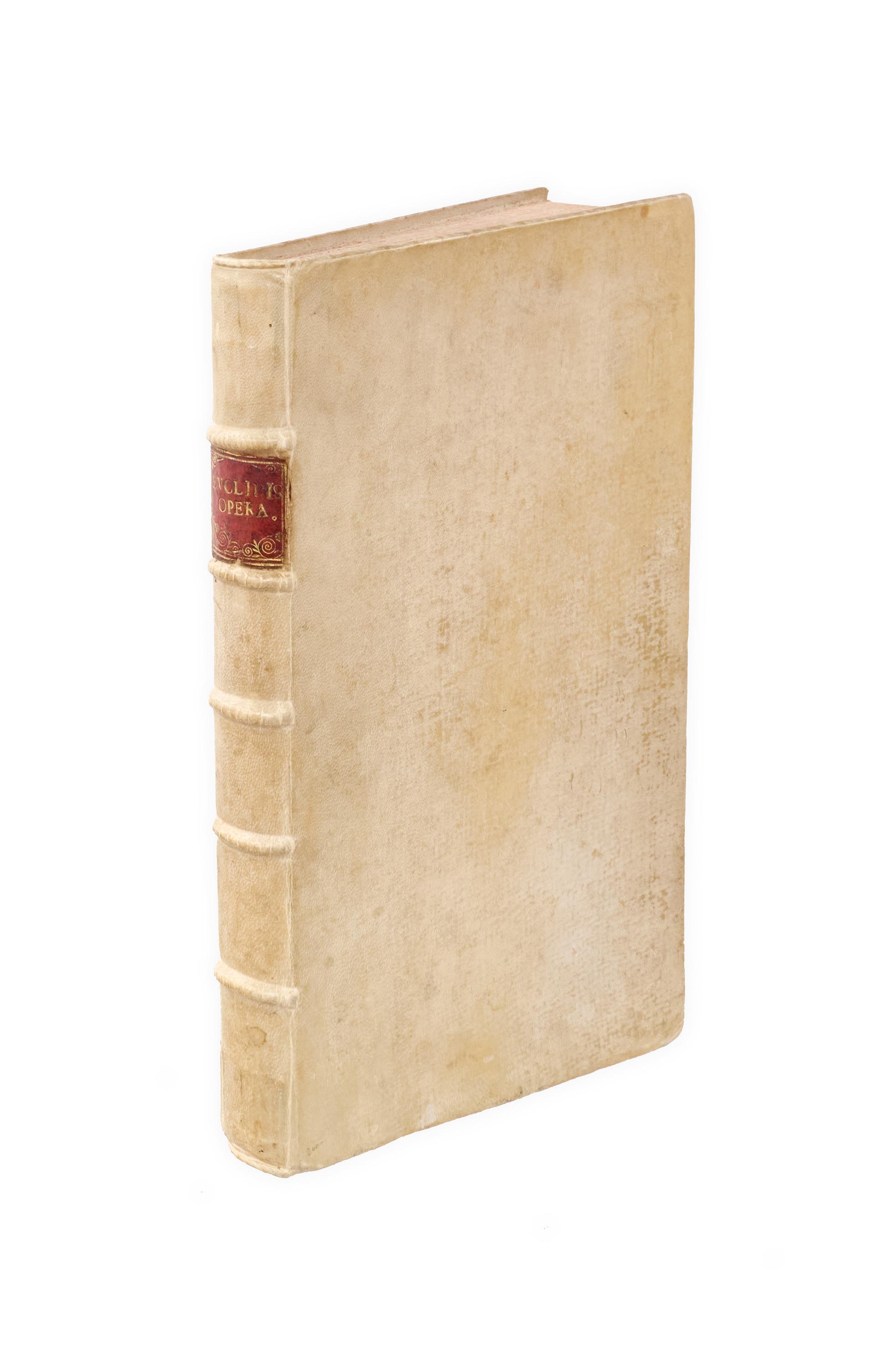
Editio Princeps
The Oldest Mathematical Textbook Still in Use
EUCLID.
Στοιχειων βιβλ. ιε εκ των θεωνος συνουσιων. Εις του αυτου του πρωτον, εξηγηματων Προκλου βιβλ. δ. Adiecta praefatiuncula in qua de disciplinis Mathematicis nonnihil.
Editio princeps of Euclid, the ‘oldest mathematical textbook still in common use today’ (PMM), a work which ‘has exercised an influence upon the human mind greater than that of any other work except the Bible’ (DSB).
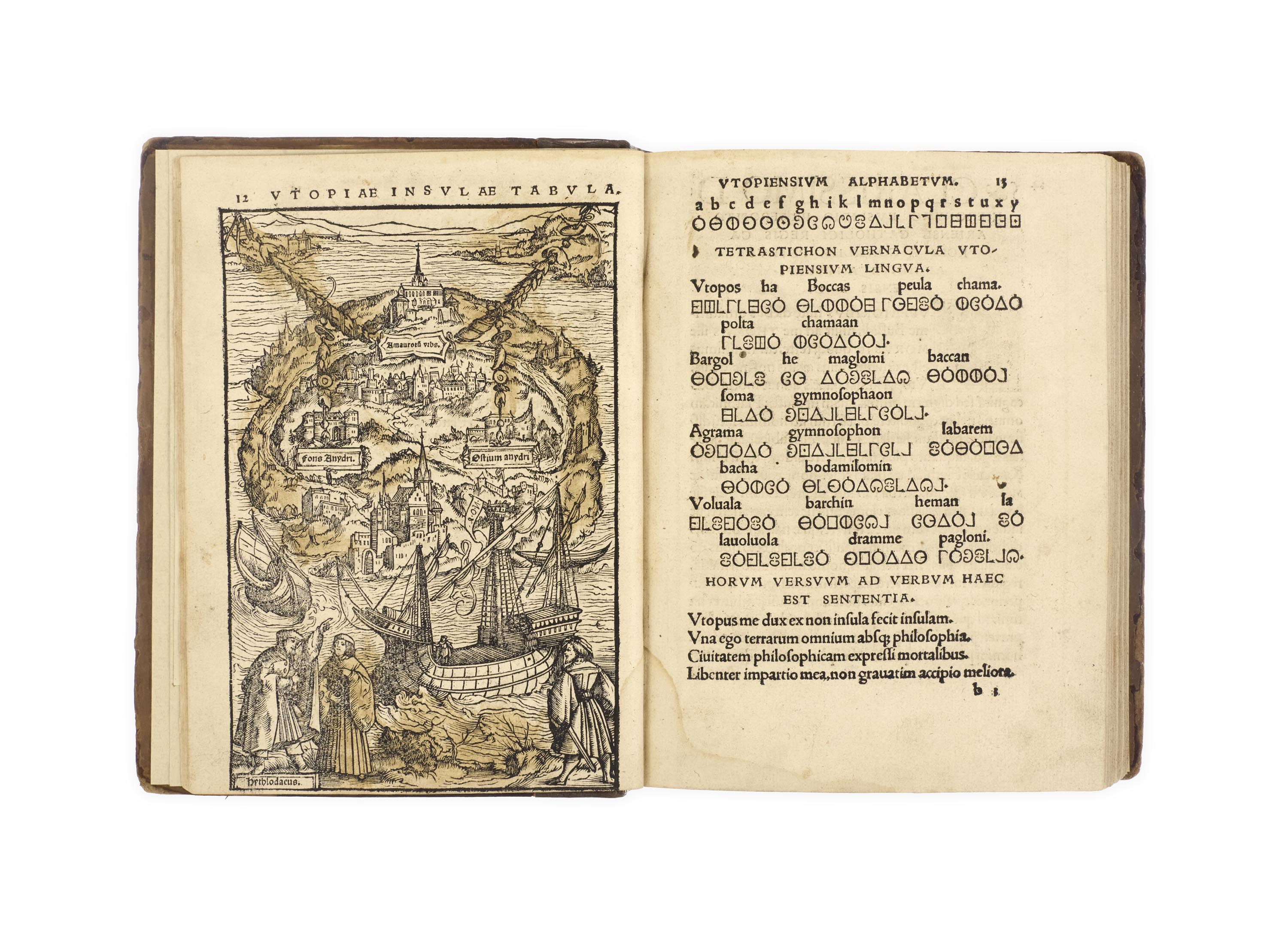
The Third and Best Utopia
MORE, Thomas, Sir.
De optimo reip. statu deque nova insula Utopia libellus vere aureus, nec minus salutaris quam festivus … Epigrammata clarissimi disertissimique viri Thomae Mori, pleraque e Graecis versa. Epigrammata Des. Erasmi Roterodami.
Third edition of More’s Utopia, including his revisions and corrections and adding his and Erasmus’s Epigrammata for the first time; this is the culmination of the text as it evolved from More’s hand with the intercession of Erasmus. As the last edition in which More is likely to have been directly involved, it was used by the Yale editors as the basis for their modern critical edition.
![[Summe le roy of des conincs summe.]](https://prd.assets.books.quaritch.com/images/GJ70_02.JPG)
Dutch Devotion: Morality for the Layman in the Vernacular
[LAURENTIUS, Frater; Jan van BREDERODE, translator.]
[Summe le roy of des conincs summe.]
Rare early edition in Dutch (first Delft 1478), preceding the first edition of the original French text, of what is perhaps the most significant treatise on Christian morality for the laity from the later thirteenth century. This edition was produced in the first printshop in Haarlem.
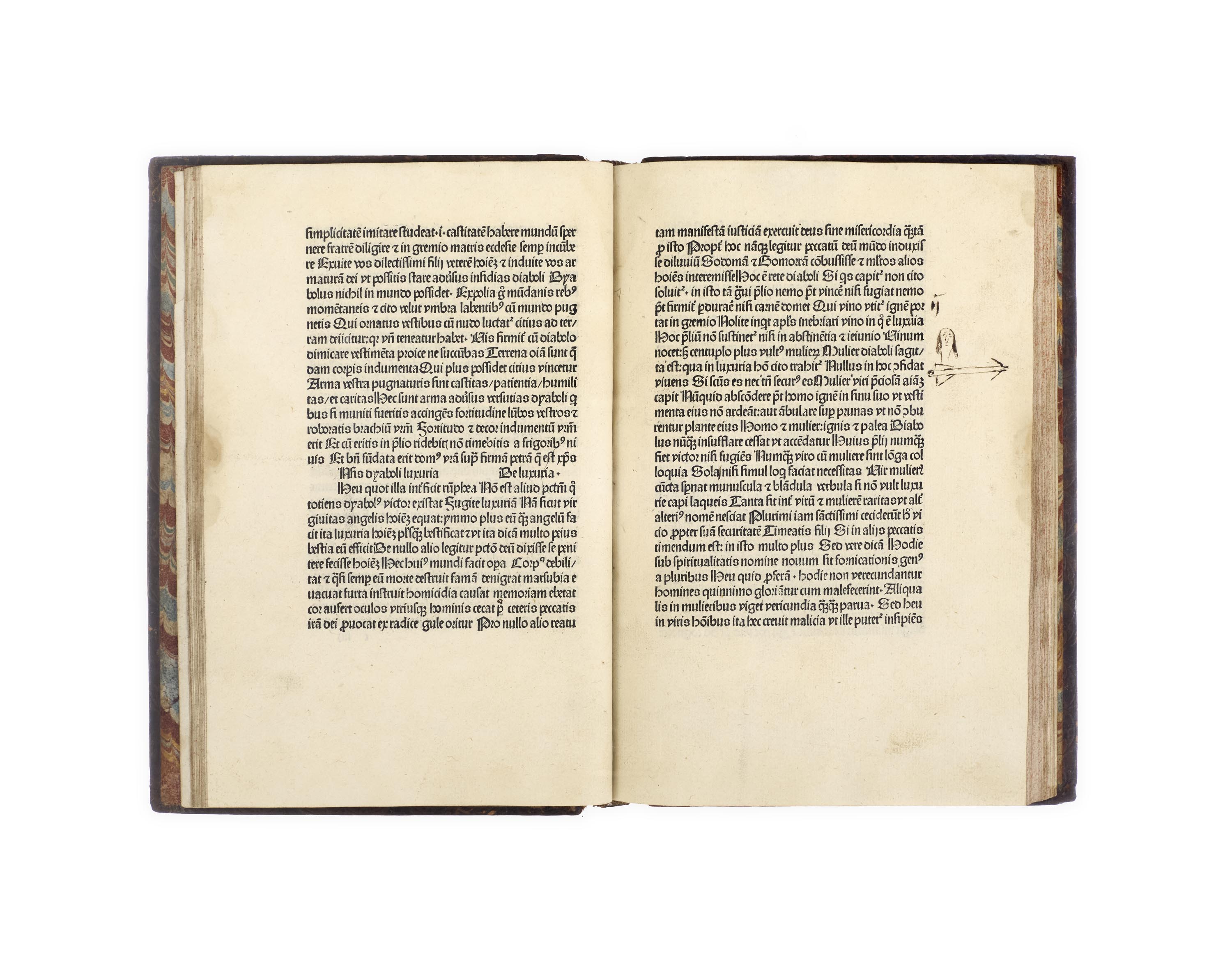
The First Delft Printshop: Reading Jerome in England
[JEROME, Saint.]
Obitus beati iheromini.
Rare incunable edition (first printed in Cologne, 1470), from the first printshop in Delft, of a devotional account of the life of St Jerome; a copy with early English provenance.

Presentation Copy to W. B. Tegetmeier
DARWIN, Charles.
The Variation of Animals and Plants under Domestication.
First edition, first issue, an important presentation copy to the naturalist and journalist William Bernhardt Tegetmeier, who provided Darwin with detailed information on poultry breeding and other subjects and who arranged for artists to produce some of the book’s illustrations.

Erwin Schrödinger and His Milieu
The Collection of Schrödinger’s Assistant
SCHRÖDINGER, Erwin, et al.
A collection of offprints and papers from the library of Nándor Balázs.
A remarkable collection of offprints and papers from the library of Hungarian-American physicist Nándor Balázs, laboratory assistant in the early 1950s to the Nobel Prize-winning Austrian physicist Erwin Schrödinger, comprising an exceptionally strong core of Schrödinger’s works – many of which stamped for presentation by the author or from his own library – as well as a notable complement of articles by the likes of Heisenberg, Dirac, Hilbert, Carathéodory, and Levi-Civita.
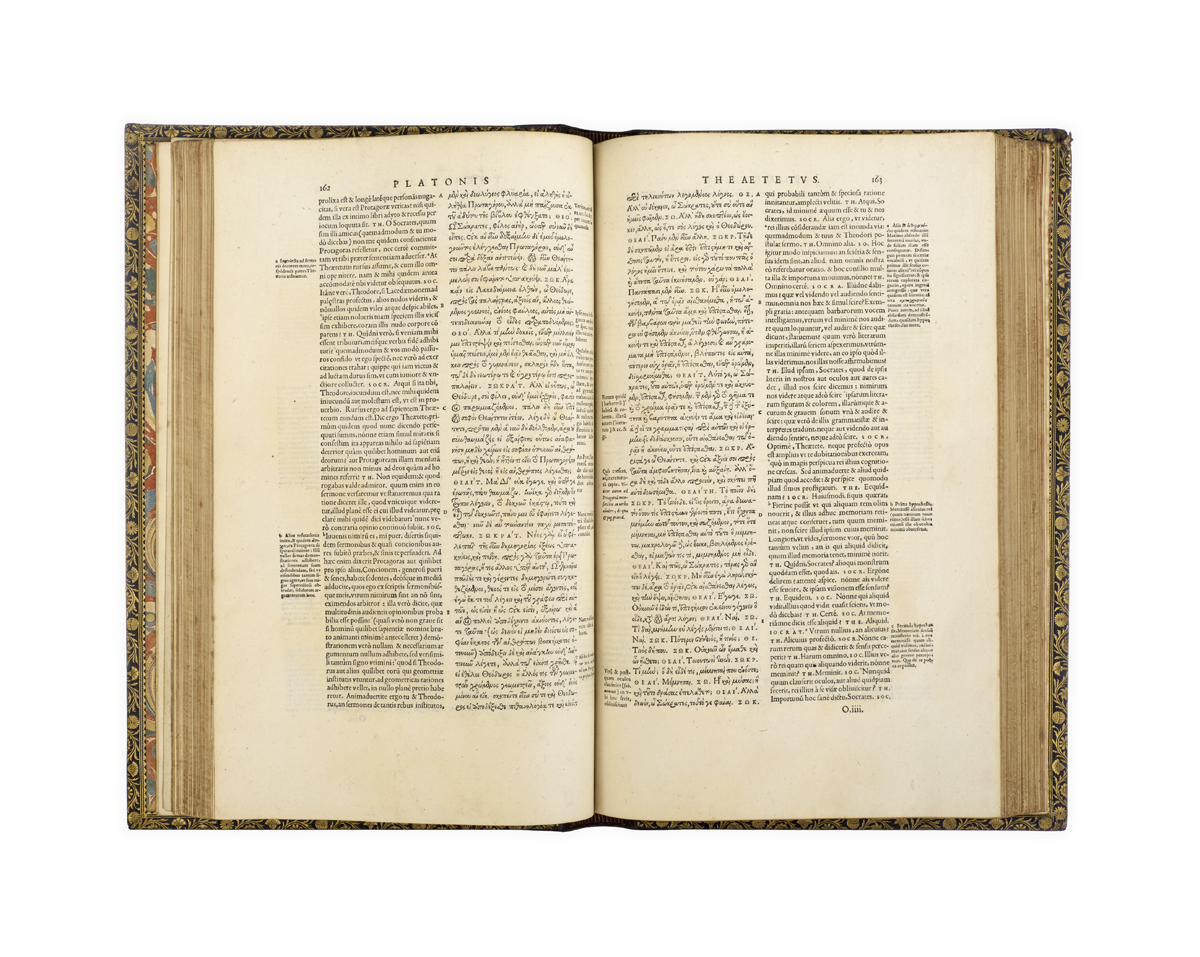
The First Complete Plato
PLATO; Jean DE SERRES, translator and commentator; Henri ESTIENNE, editor.
Απαντα τα σωζομενα … Opera quae extant omnia …
A magnificent large-paper copy of the first complete edition of Plato’s corpus, edited by Henri Estienne and accompanied by a new parallel translation by Jean de Serres.

Editio Princeps
It’s All Greek to Me
GAZA, Theodorus.
Grammatica introductiva; De mensibus; Apollonius Dyscolus: De constructione; Herodianus: De numeris.
A beautiful example of early Greek printing, containing the editio princeps of the grammar of Theodorus Gaza, and one of the first texts to be printed entirely in Greek.

An Excellent Copy in Contemporary Dutch Vellum
[MONTESQUIEU, Charles Louis de Secondat.]
De l’esprit des loix, ou du rapport que les loix doivent avoir avec la constitution de chaque gouvernement, les moeurs, le climat, la religion, le commerce, &c. à quoi l’auteur a ajouté des recherches nouvelles sur les loix romaines touchant les successions, sur les loix françoises, & sur les loix féodales.
First edition, first issue of Montesquieu’s masterpiece of political theory asserting the principle of the separation of a government’s powers as a means to prevent tyranny: a principle which formed the ideological basis of the French and American revolutions and became the cornerstone of the United States Constitution.

Missionary Martyrs in Japan
SICARDO, José.
Christiandad del Japon, y dilatada persecucion que padecio. Memorias sacras, de los martyres de las ilustres religiones de Santo Domingo, San Francisco, Compañia de Jesus, y crecido numero de seglares, y con especialidad, de los religiosos del orden de N.P.S. Augustin …
Rare first edition of this important and comprehensive account of Christian missions to Japan by the Spanish Augustinian José Sicardo (1643–1715).


An Influence on Schubert
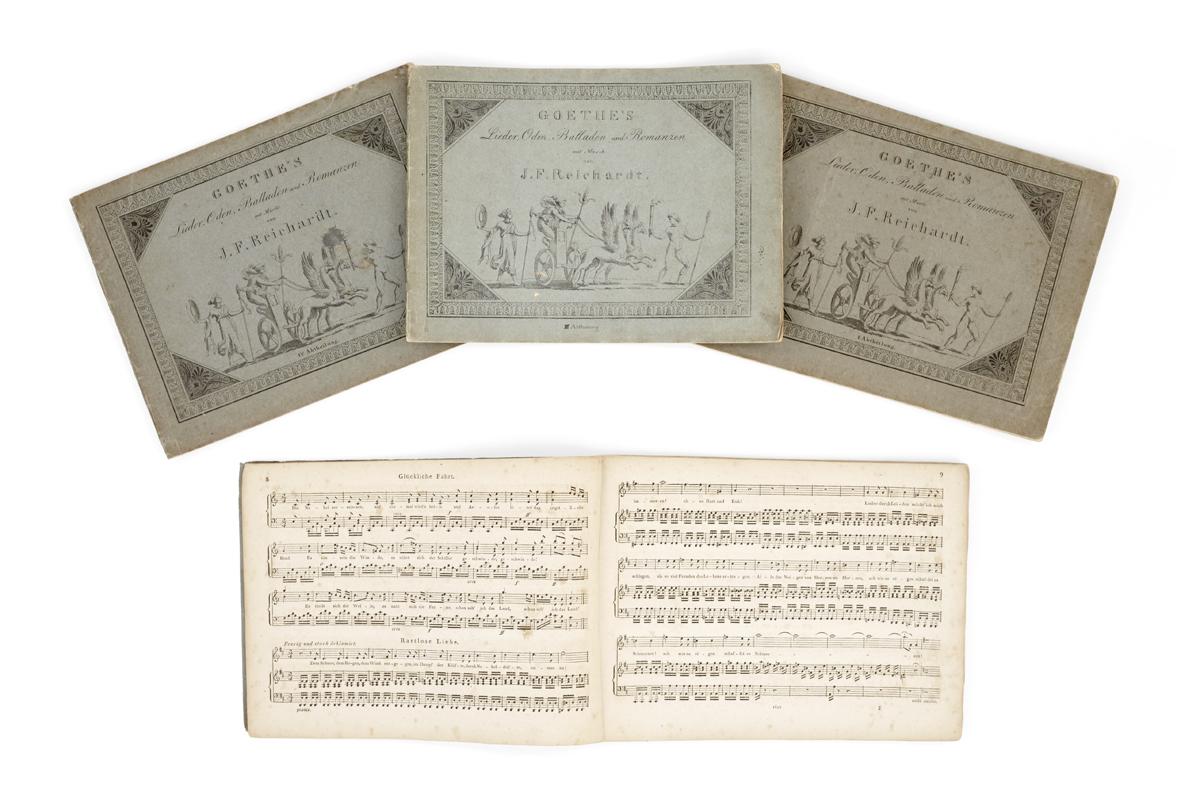
[GOETHE.] REICHARDT, Johann Friedrich.
Goethe’s Lieder, Oden, Balladen und Romanzen mit Musik von J.F. Reichardt. Erste [– Vierte] Abtheilung.
Very rare first complete edition of Reichardt’s musical settings of Goethe’s poetry, comprising 128 settings of which thirty-nine appear here for the first time.

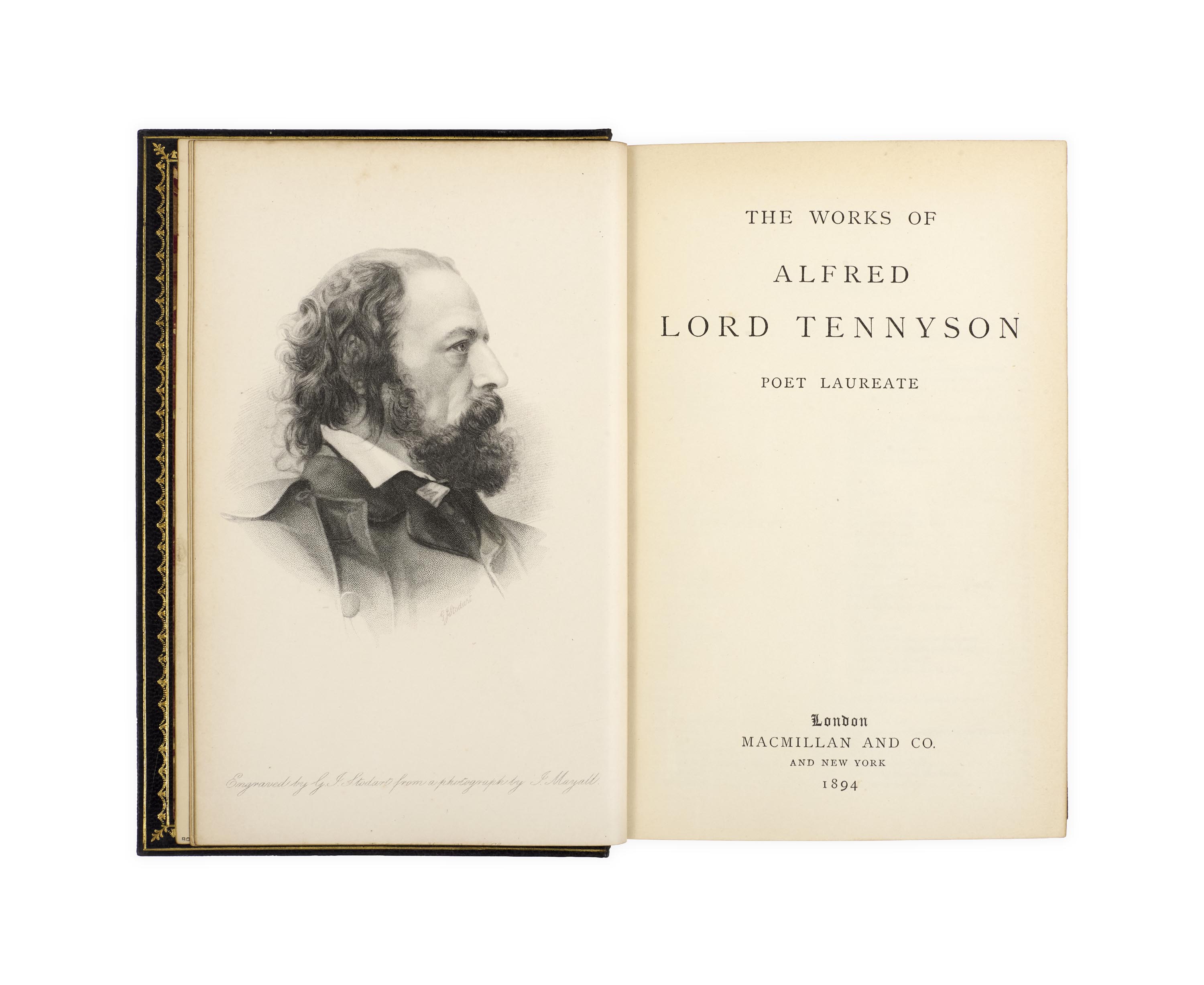
Titchmarsh’s Tennyson
TENNYSON, Alfred, Lord.
The Works of Alfred, Lord Tennyson, Poet Laureate.
An exceptionally attractive turn-of-the-century binding, with floral and foliate tooling in gilt and blind, later in the library of Alan Titchmarsh.