Neapolitan Sermons in a Florentine Binding
URSINIS, Bartholomaeus de.
[Quadragesimale quod dicitur Gratia Dei.] [Naples, Francesco del Tuppo for Bernardinus Geraldinus, not before 1478.]
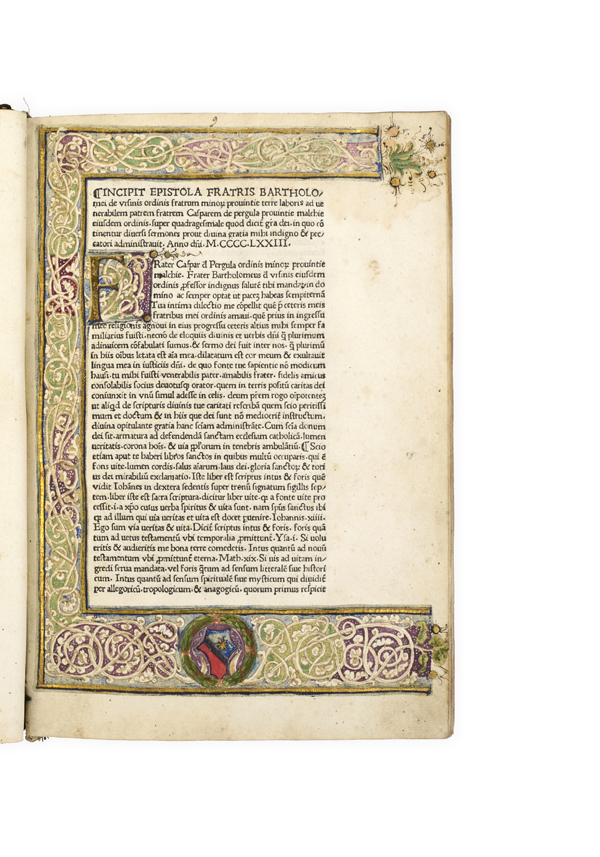
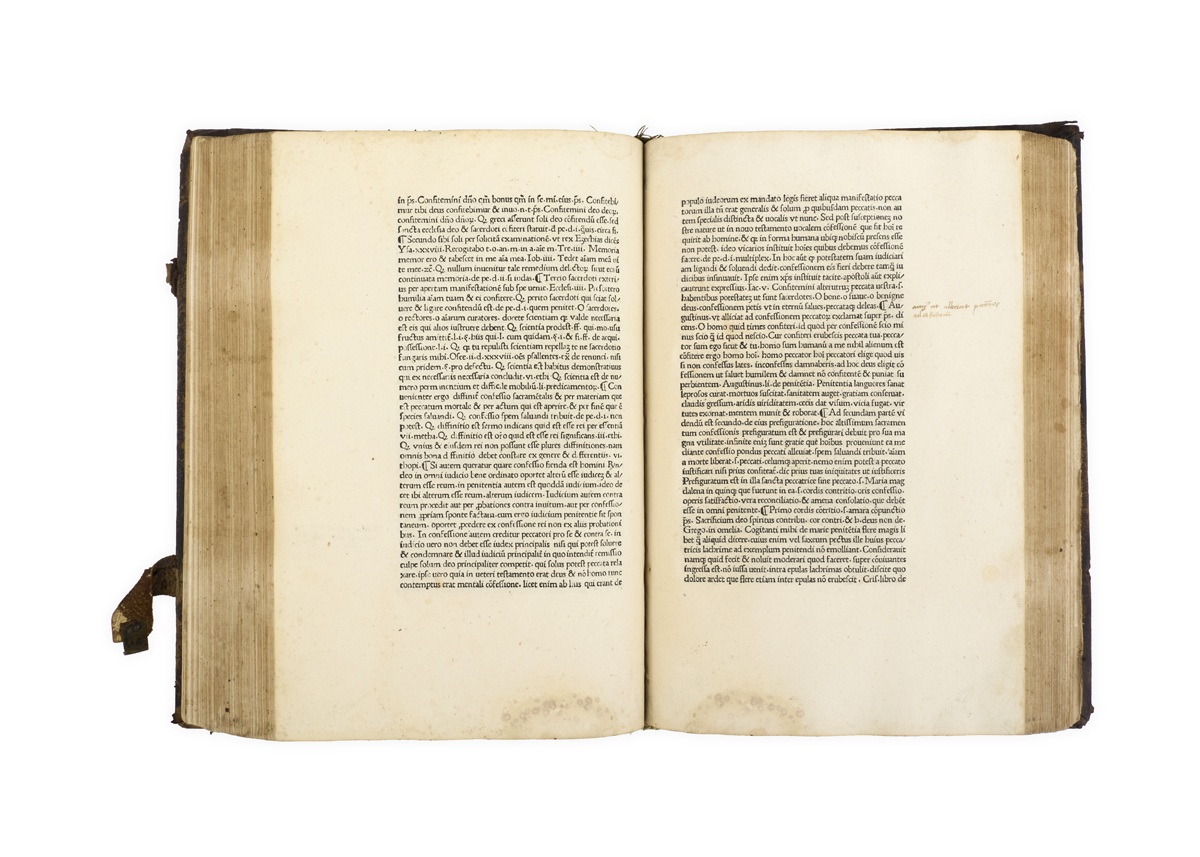
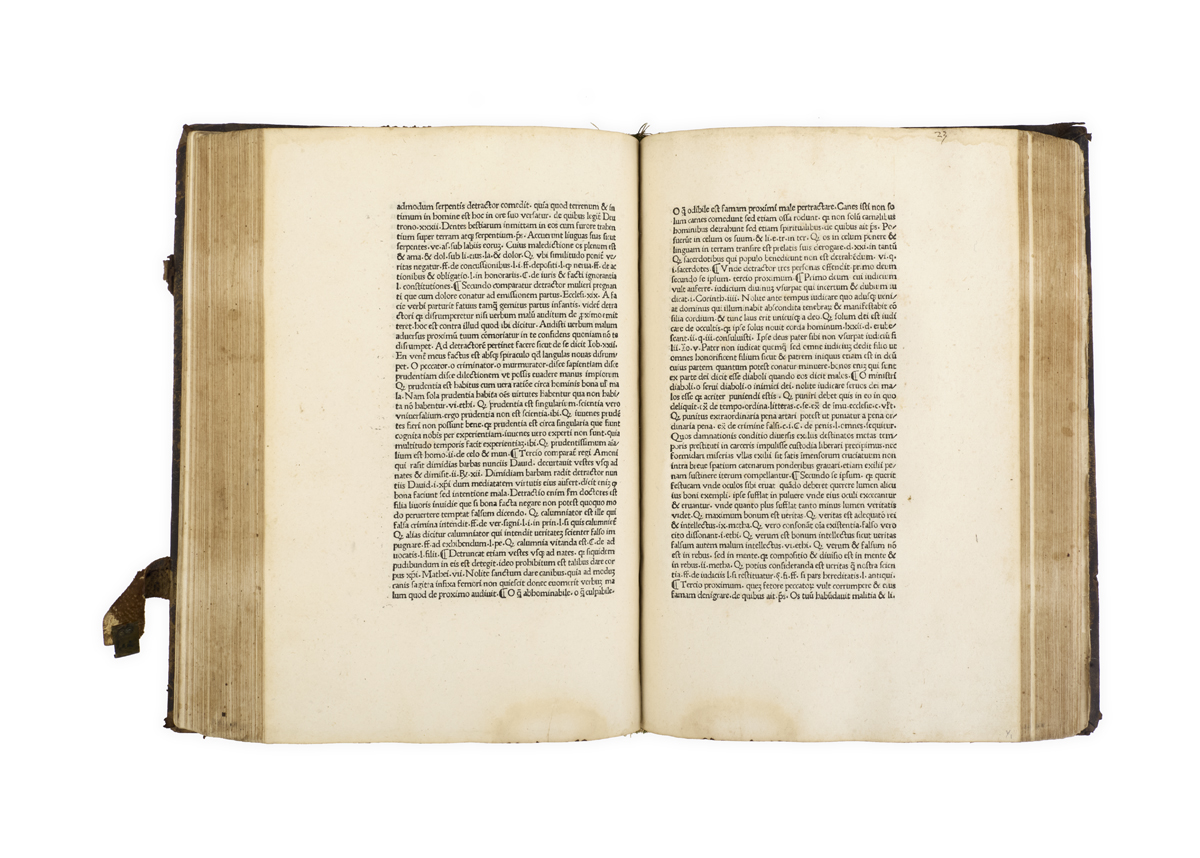
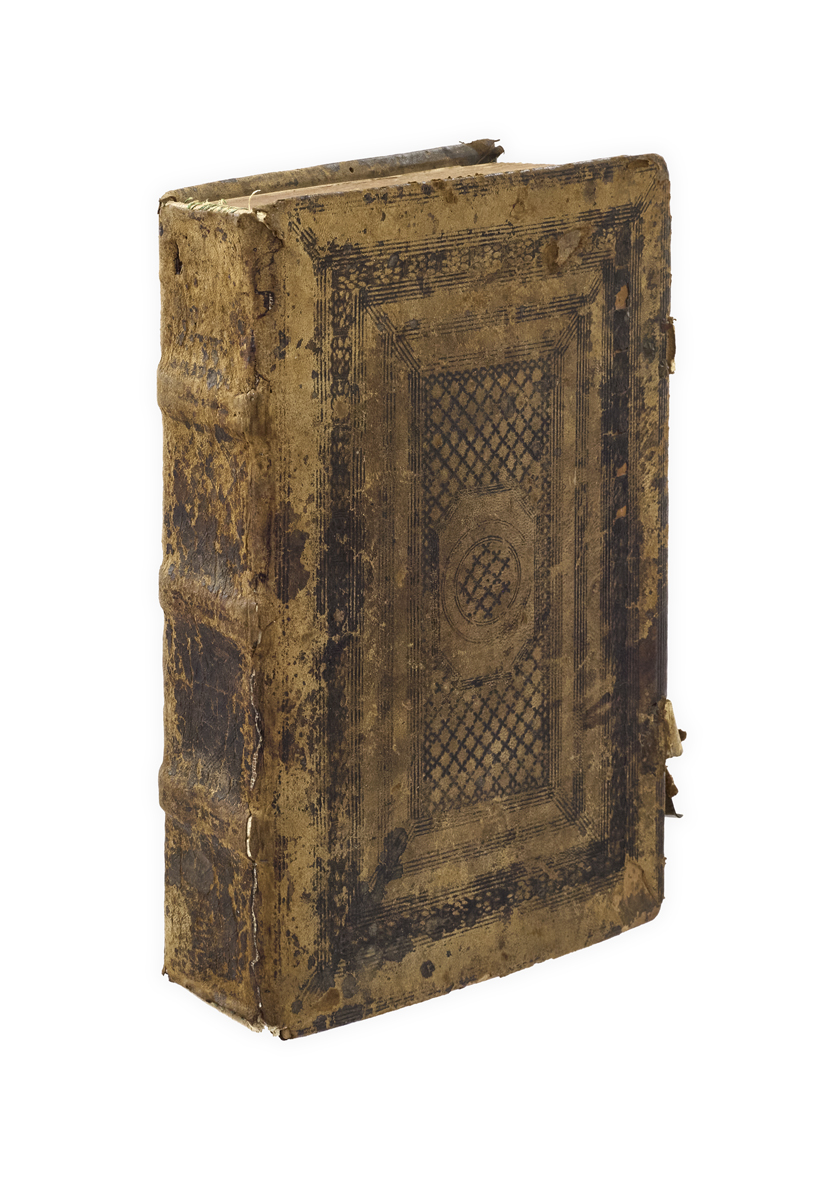
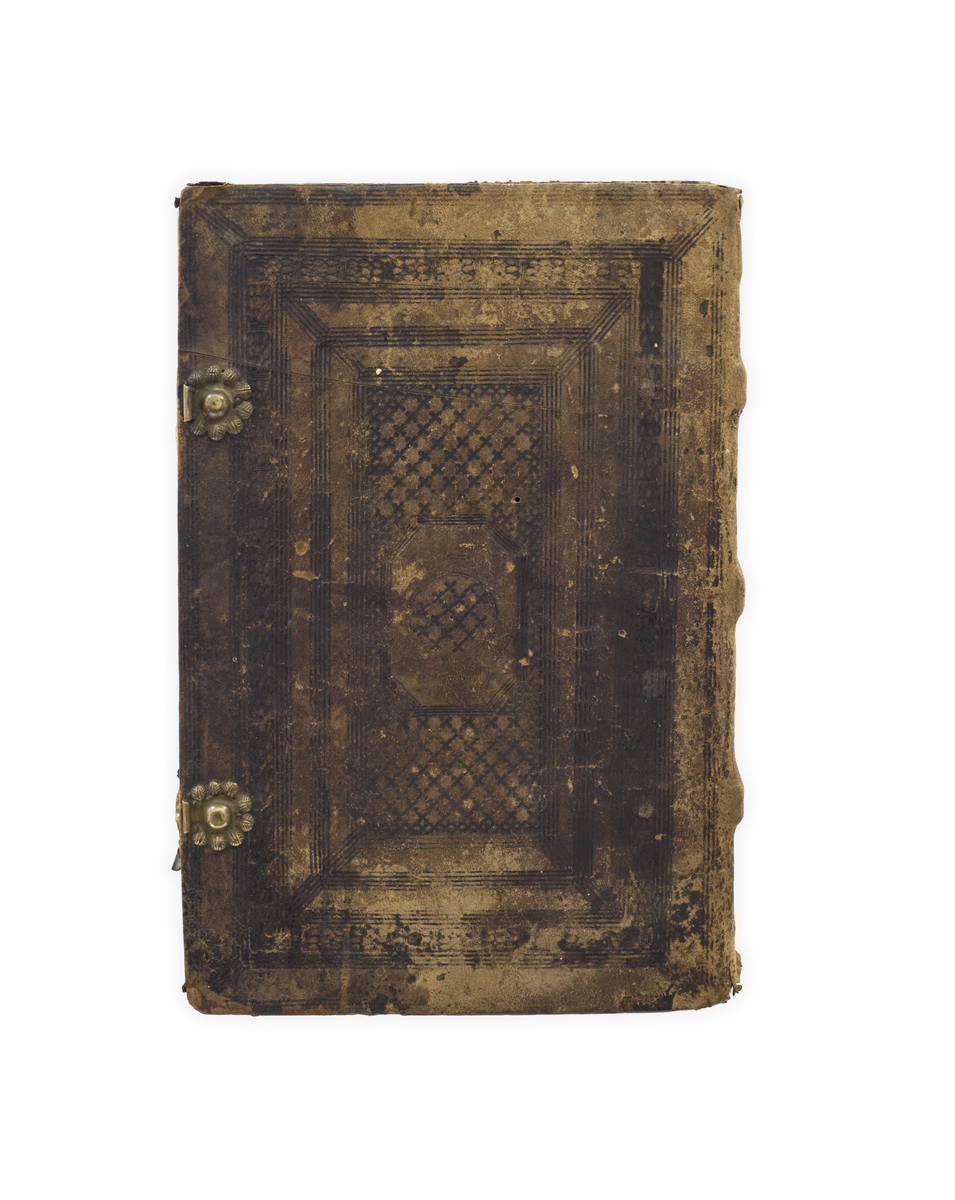
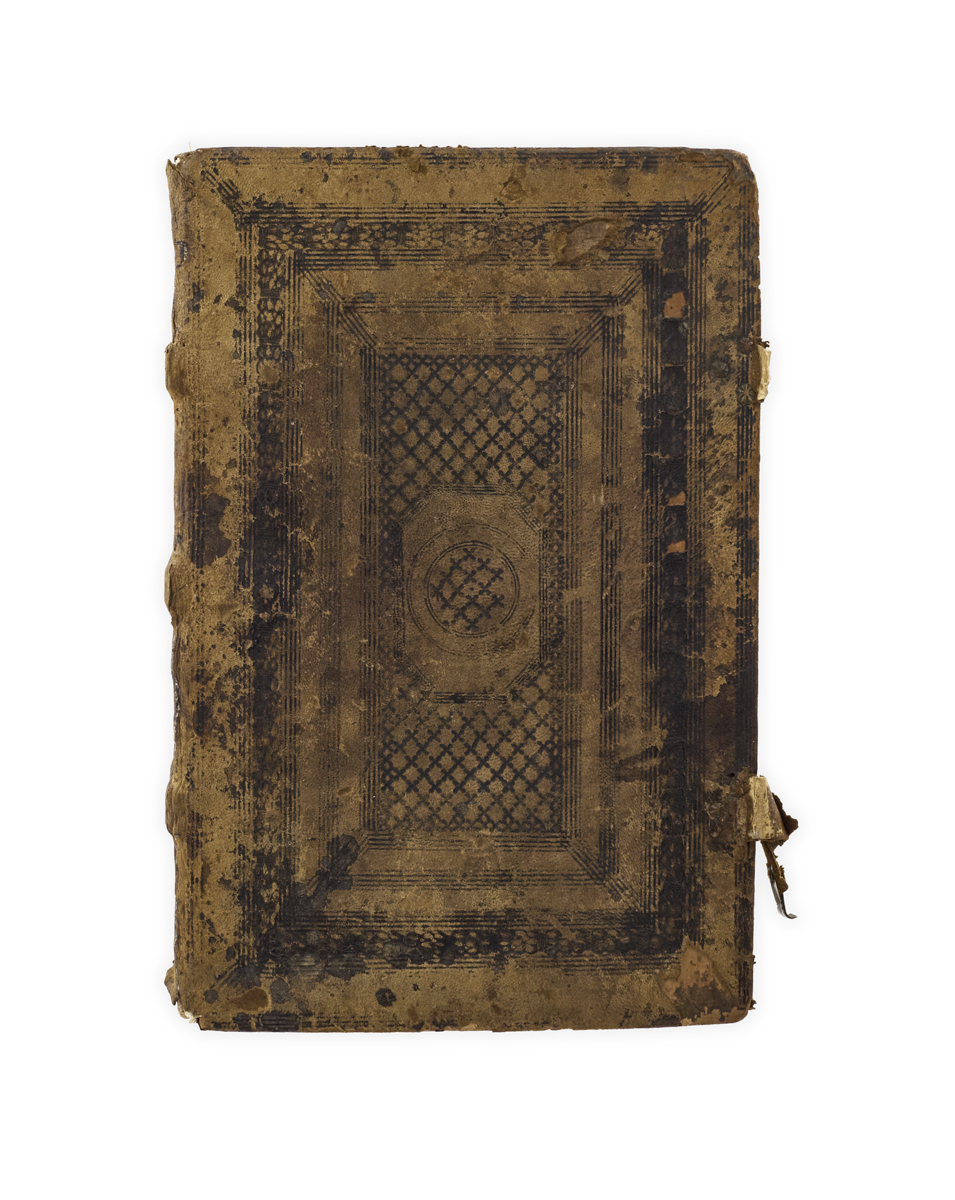
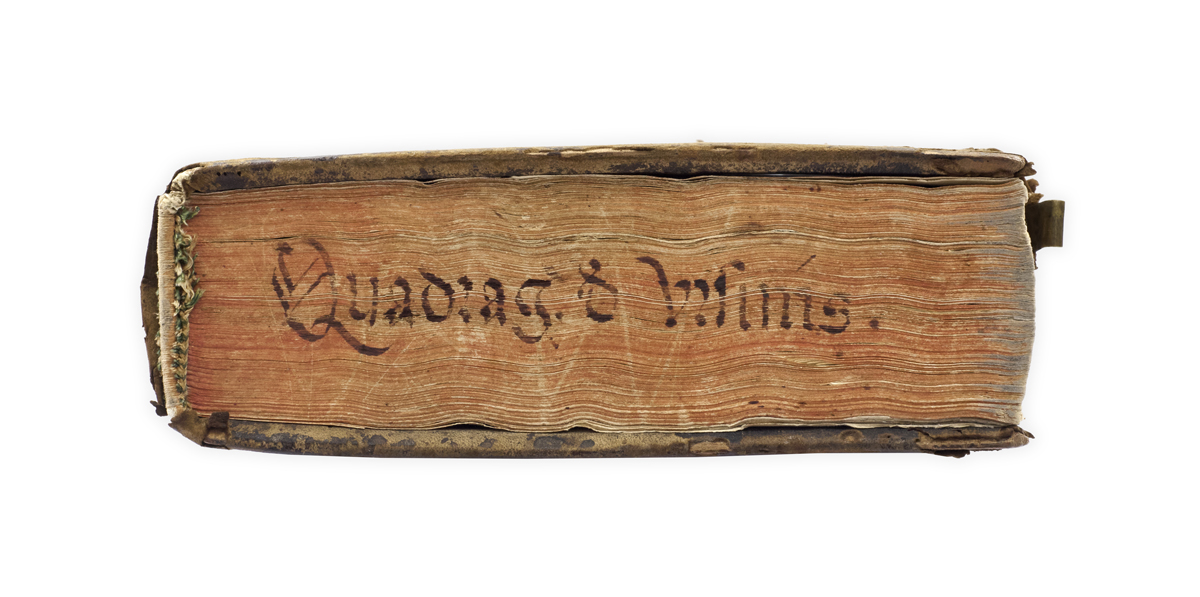
Chancery folio, ff. [336]; [a6 b-p8 q12 r–z8 A–S8 T6], with preliminary blank [a]1 and final blank [T]6; bifolium [a]1.6 inverted; [b]1r with a 6-line gold initial F and a three-part illuminated border (most likely contemporary Neapolitan illumination), all with white vine stem decoration on a green, red, and blue ground, the lower border incorporating a laurel wreath containing an as yet unidentified coat of arms (added soon after), other initials supplied in red or blue, some traces of early quire numbering to upper margins; some light dampstaining (slightly heavier to first and last quires), mostly marginal, final quire resewn and a little worn at edges, lower corner of final blank [T]6 torn away, but a very good copy; bound in contemporary Florentine blind-stamped sheep over bevelled wooden boards, boards panelled in blind with central fields of a small repeated x tool, spine diapered in blind, two brass clasps to fore-edge on vellum-lined leather straps (one lacking), each affixed with three star-headed brass nails, flower-shaped catchplates, edges stained red, tail-edge lettered in ink (‘Quadrag. d Ursinis.’), vellum pastedowns (partially torn); worn and rather rubbed with a few small scuffs and losses, front board neatly rejointed; a few pages with marginal numbering or underlining, early annotations (the longest repeating the text) to 3 pp., ink inventory number ‘23’ to top-edge, old ink shelfmark ‘2.7.9.’ to front pastedown.
First and only edition, a handsome, wide-margined copy of Bartholomaeus de Ursinis’s sermons, printed and illuminated in Naples, in a contemporary Florentine binding.
This volume contains eighty model sermons, gathered and arranged by Bartholomaeus de Ursinis (or de filiis Ursi, as his name appears at the end of his preface), a Franciscan from the province of Terra di Lavoro between Rome and Naples; this is the only work associated with him to appear in print. Bartholomaeus’s preface, addressed to his fellow friar Caspar de Pergula, explains that these sermons all issue from God and the Holy Spirit, and that he, Bartholomaeus, is just the instrument through which their inspiration passes.
Previously attributed to Sixtus Riessinger, the prototypographer of Naples, and dated to 1473 on the basis of the date given in the preface, this edition is in fact one of the first works published by the printer Francesco del Tuppo (1443–c. 1501), who had worked with Riessinger before establishing his own press in 1478; he went on to be the most prolific printer in fifteenth-century Naples, continuing to print until 1498. The prefatory letter by del Tuppo on [a]6v (in some copies blank) is addressed to Ferdinand of Aragon, King of Naples, and explains that the royal counsellor Bernardino Geraldini of Amelia financed this and six other works from del Tuppo; Geraldini’s brother Angelo, a senior figure in the Papal Curia, was at this time Bishop of Terra di Lavoro.
Plausibly bound by Hobson’s ‘Florentine Palmette and Cornucopia’ shop, which made similar bindings with numerous concentric panels of multiple blind fillets and with grounds of a repeated small x stamp, on books printed between 1483 and 1514. Similar flower-shaped catchplates are found on a 1491 Venice Boethius attributed to this shop (Hobson, fig. 96) and on a 1481 edition of Dante bound in Florence (De Marinis 1093). The illumination of the first leaf of text, however, is most likely Neapolitan, although the armorial in the lower border was added soon after, possibly at the time the volume was bound in Florence.
ISTC records four copies in the US (BYU, Harvard, Huntington, Walters), two in the UK (BL, Rylands). We have not been able to locate another complete copy offered at auction.
HR 2532; BMC VI 869; GW M48945; Goff U69; ISTC iu00069000; see Hobson, Decorated Bookbindings of Renaissance Italy, pp. 248-253.