Land Speculation, Coal, and Railroads in Pennsylvania;
Lynching and the Spectre of Civil War
[BARCLAY FAMILY.]
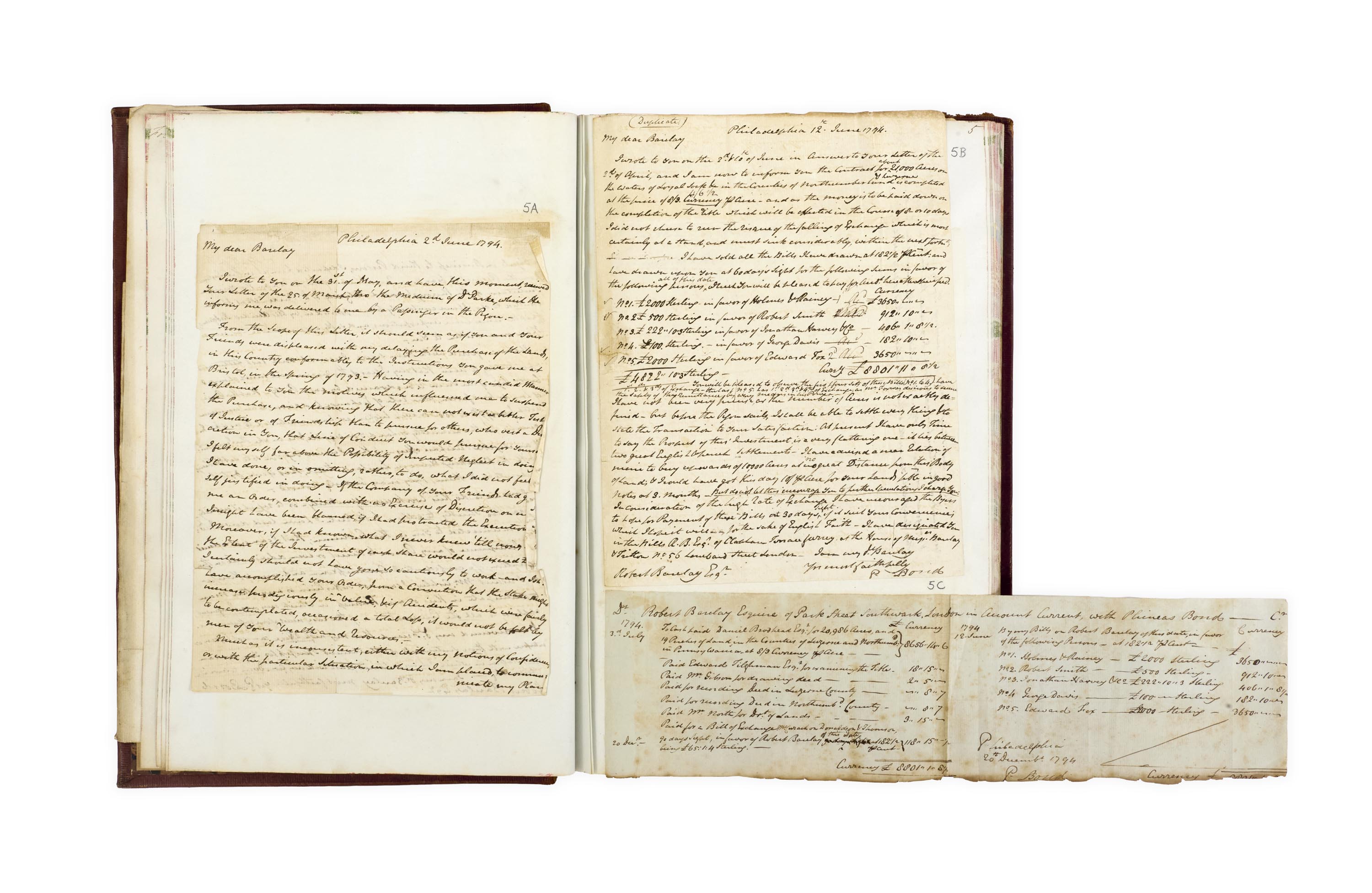
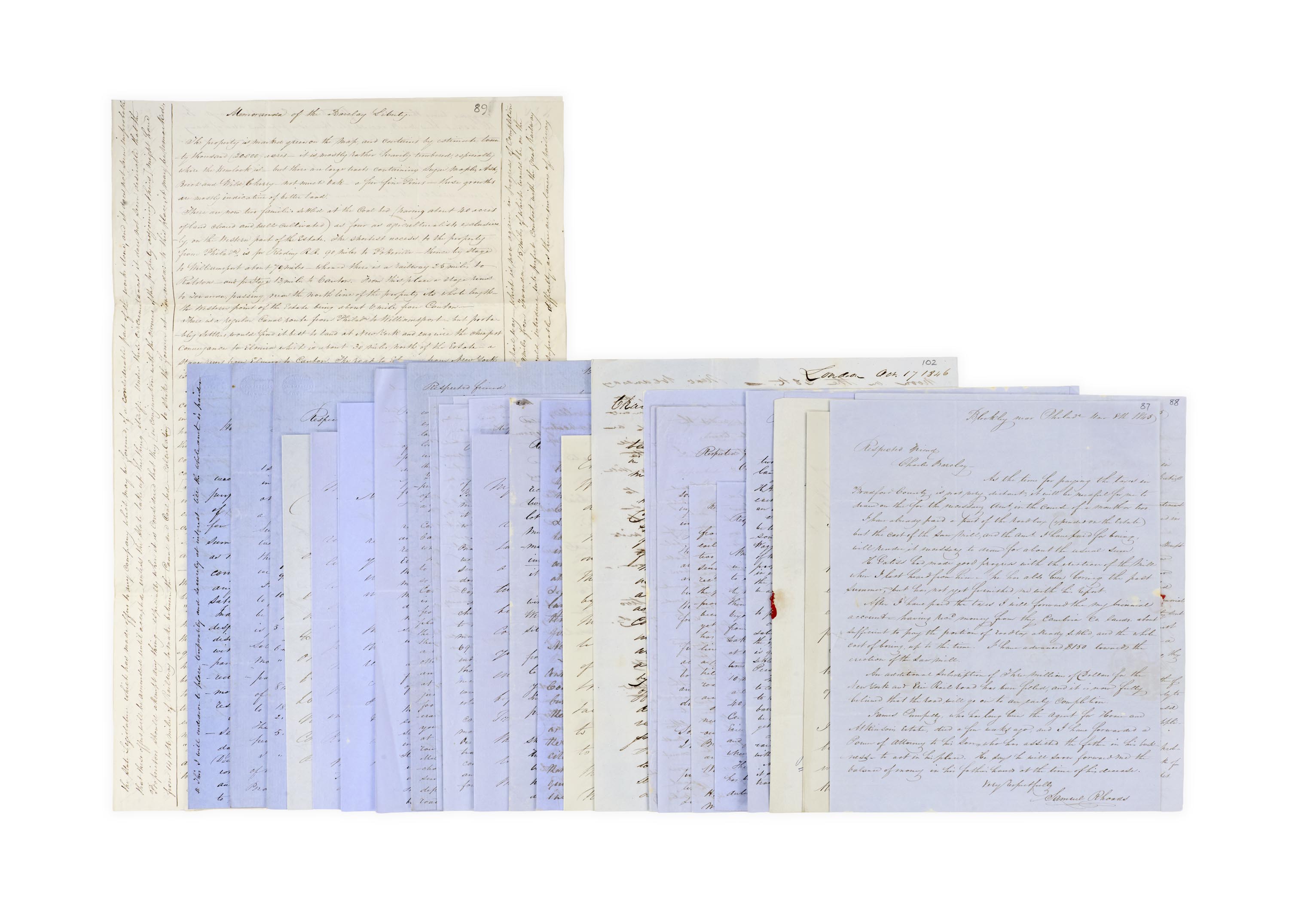
Album of letters, maps, accounts, and reports sent to Robert and later Charles Barclay (and some to the railway pioneer Joseph Pease), with copies of outgoing letters, largely relating to land in Bradford County, Pennsylvania; along with additional loose correspondence. Mostly Philadelphia and London, 1794–1854.
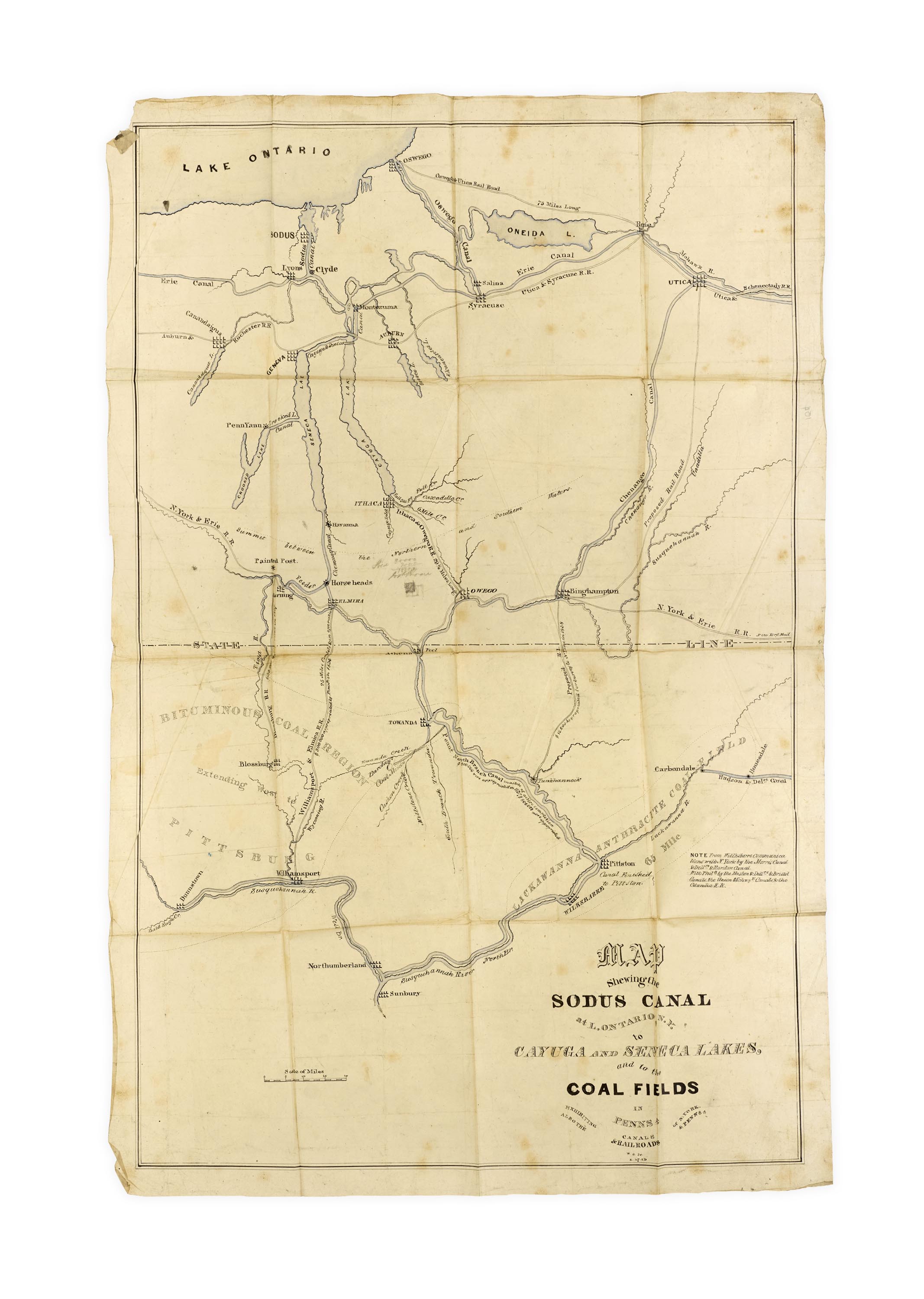
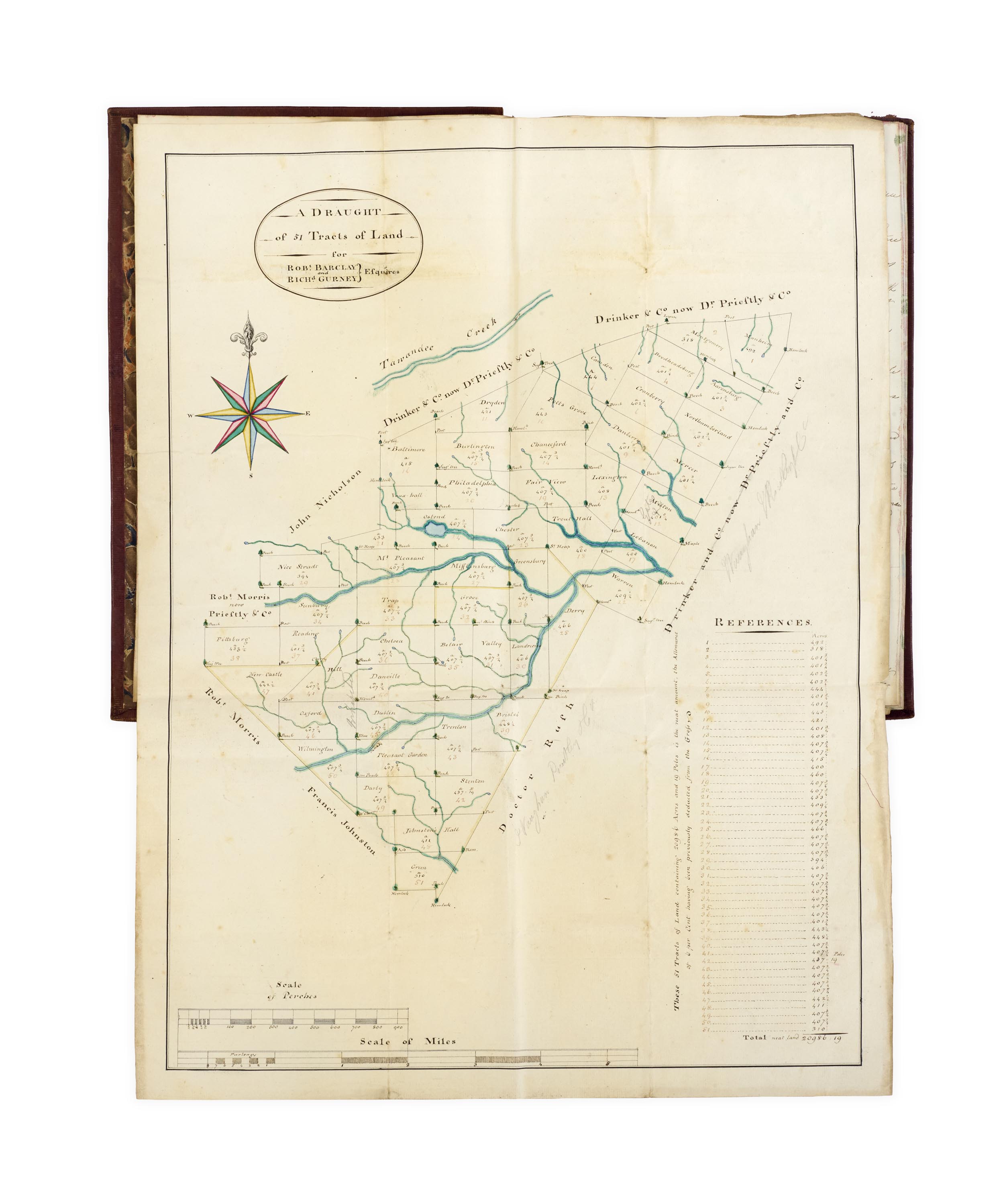
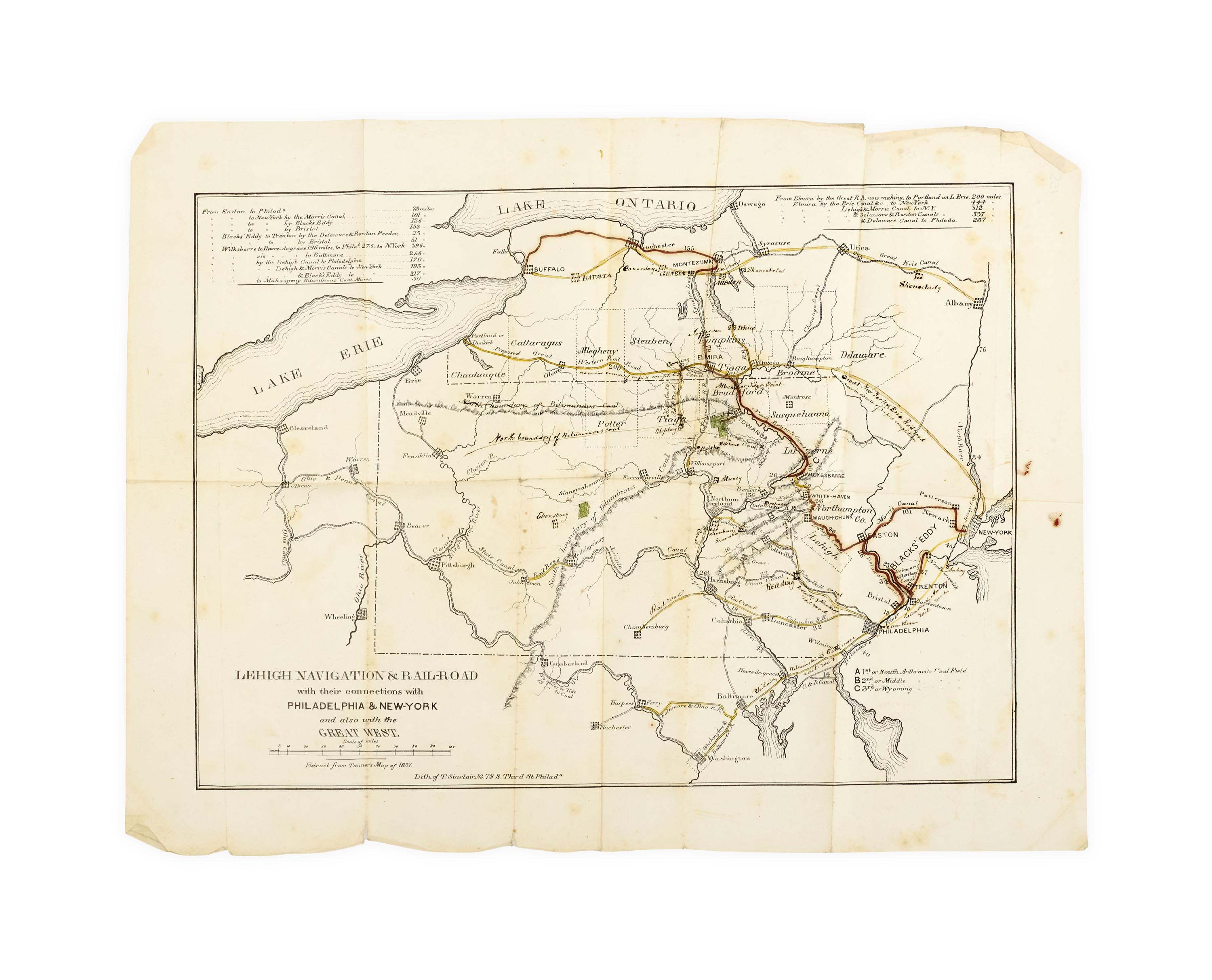
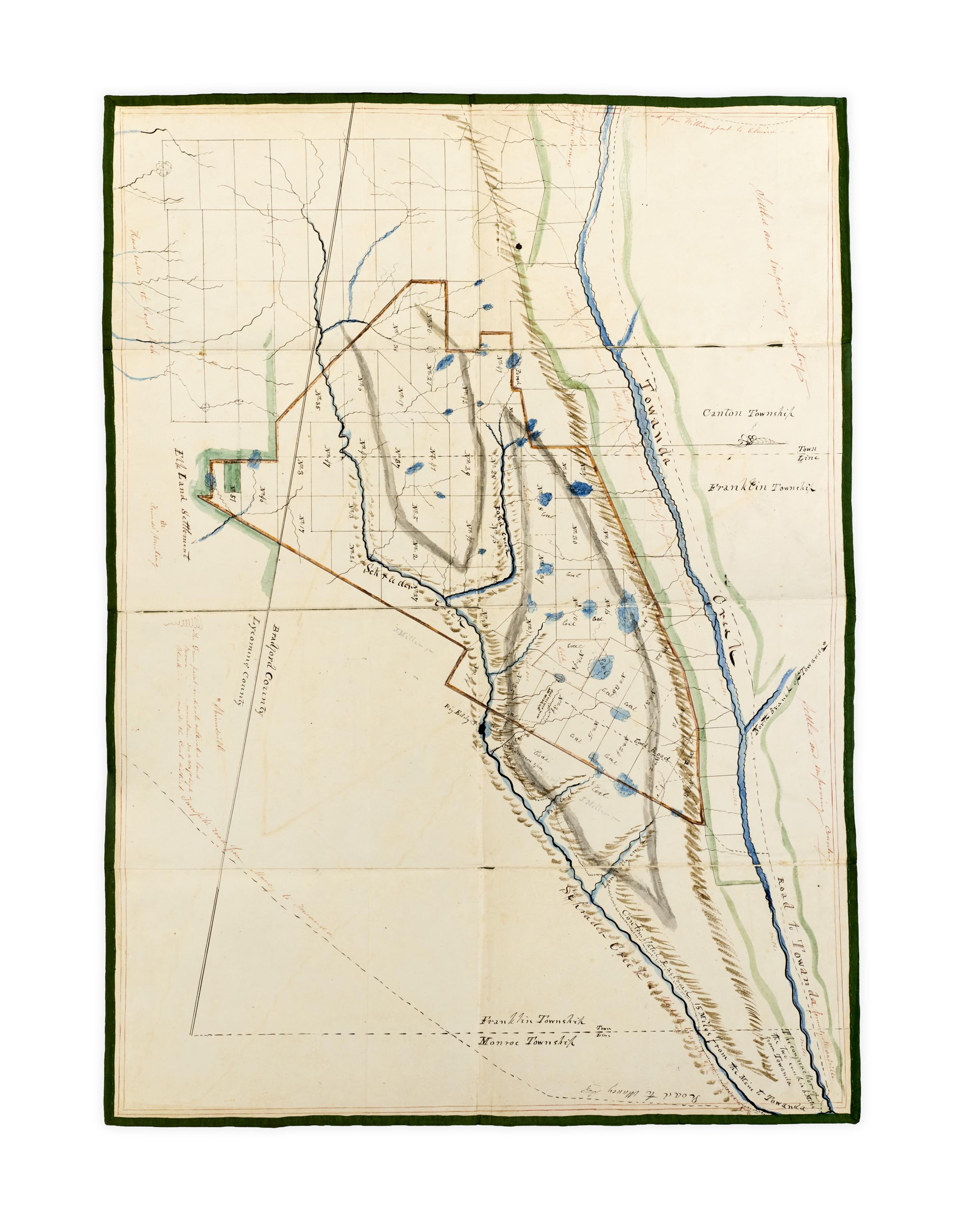
Folio album, the autograph and copy letters (quarto and folio) tipped in, plus some additional loose correspondence, as well as four large folding maps (one in the album, three loose): ‘Draught of 51 Tracts of Land for Robt Barclay and Richd Gurney Esquires’, 5 July 1794 (605 x 465 mm, ink on paper, hand-coloured); large map of the Barclay estate showing the coal lands, 1830s? (510 x 690 mm, ink-on paper, hand-coloured, mounted on green linen), Lehigh Navigation & Rail-Road, Philadelphia, T. Sinclair, [1840s?] (320 x 430 mm, lithograph, with road and railway lines hand-coloured, and additions in manuscript), ‘Map shewing the Sodus Canal at L. Ontario N. Y. to Cayuga and Seneca Lakes and to the Coal Fields in Pennsylvania. W. S. Jr 4.17.40’ (740 x 490mm, pen on tissue paper, rivers and roads coloured); in total in excess of 200 letters and documents, comprising many hundreds of pages, creased where once folded, some letters annotated by the recipients, generally in excellent condition; loose in folders, or in a nineteenth-century album of diced morocco over wooden boards by N. Muggeridge, partial manuscript index at the front.
Added to your basket:
Album of letters, maps, accounts, and reports sent to Robert and later Charles Barclay (and some to the railway pioneer Joseph Pease), with copies of outgoing letters, largely relating to land in Bradford County, Pennsylvania; along with additional loose correspondence.
A large and coherent archive relating to a tract of 21,000 acres of coal-rich land in Pennsylvania, later known as Barclay Mountain, from its purchase in 1794 by the London brewer and merchant Robert Barclay (1751–1830) until its sale in 1853 by his son Charles Barclay (1780–1855). It takes in the discovery of coal in northern Pennsylvania and the sudden industrialisation and rapid settlement of the region.
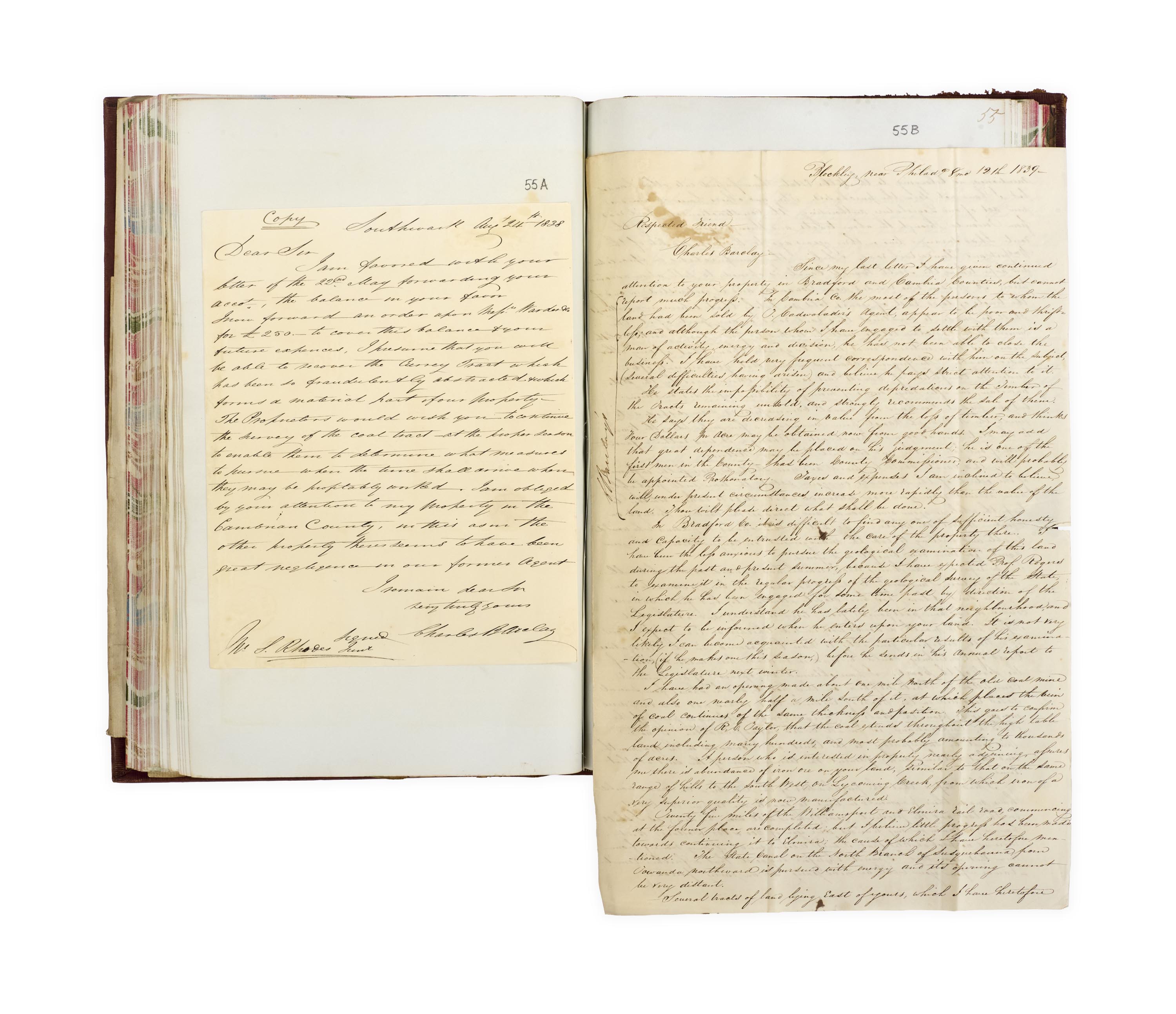
The Barclays’ American correspondents include: the British consul to the middle and southern states Phineas Bond (1749–1815) (16 letters); the physician (and director of the Library Company of Philadelphia) Dr Thomas Parke (1749–1835) (4 letters); Bond’s nephew Thomas Cadwalader (1779–1841), the son of a Revolutionary War general (33 letters); and the Quaker lawyer and anti-slavery campaigner Samuel Rhoads Jr (1806–1868) (55 letters).
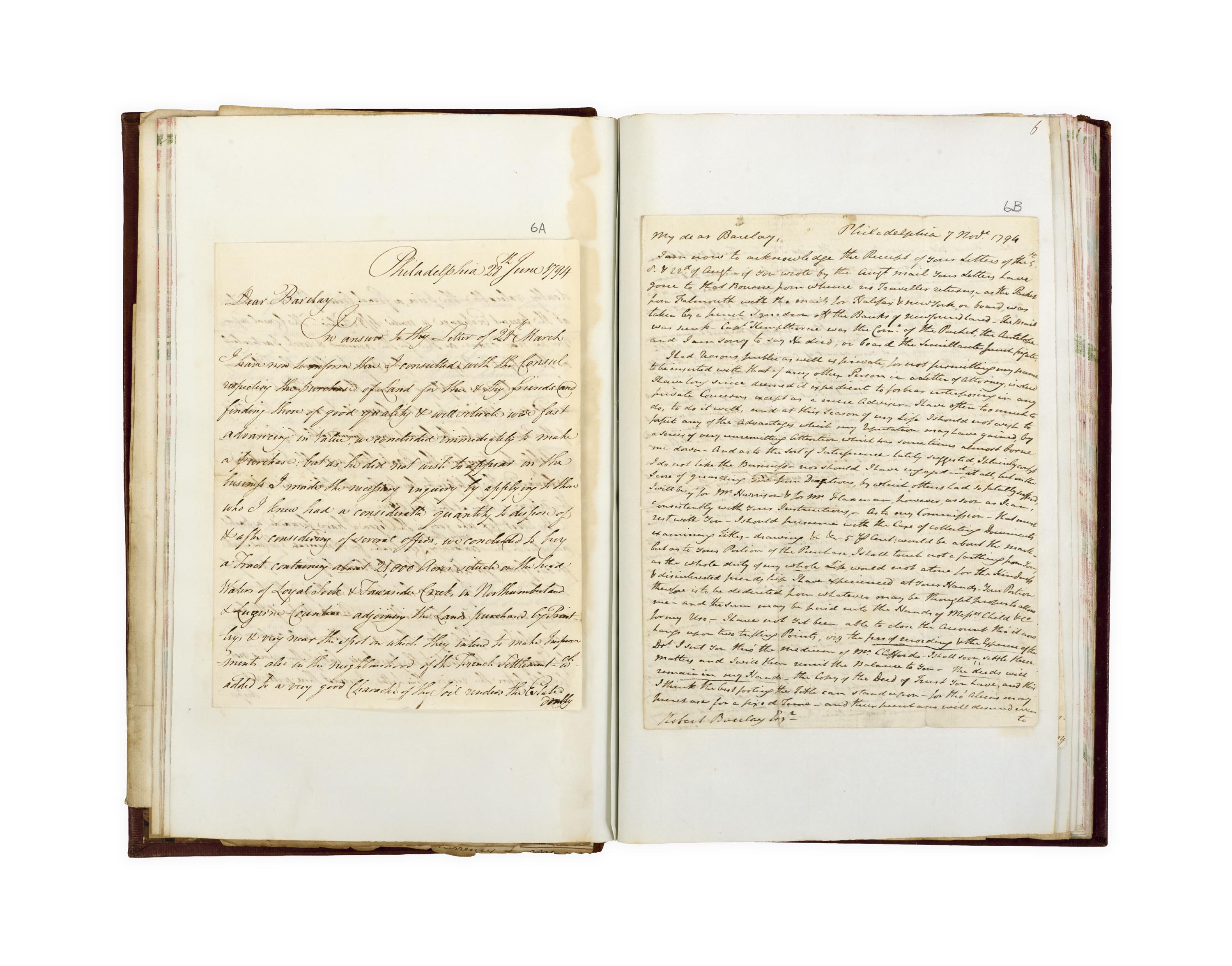
Robert Barclay had been born in Philadelphia and educated in England, returning to America for several years shortly before the Revolutionary War to represent the interests of his family’s substantial mercantile business, when he had first met Thomas Parke and other local notables. In 1794 Barclay, along with a consortium including his uncle David Barclay (the banker and friend of Benjamin Franklin and John Dickinson), Silvanus Bevan, Joseph Gurney, and Charles Lloyd, purchased a tract of just under 21,000 acres from General Daniel Brodhead (1736–1809) ‘on the head water of Loyal Sock and Tawandee [Towanda] Creek, in Northumberland and Luzerne Counties adjoining the land purchased by Priestley’ (Parke to R Barclay 28 June 1794). The philosopher and radical Joseph Priestley (1733–1804), an outspoken supporter of the American and French Revolutions, had moved to America in 1794, where his son Joseph Priestley Jr (from whom there is one letter here), had been part of a consortium that purchased 300,000 acres between the forks of Loyalsock Creek. A large folding map here shows the Barclay purchase, surrounded on three sides by the lands of Priestley & Co. ‘The Philosopher however does not seem to relish a new settlement, and thinks perhaps his electrical apparatus may suffer, from the insurrection of Bears, Wolves & Panthers, the discipline it once induced in the more polished vicarage at Birmingham’ (Bond to R. Barclay, 7 November 1794, referring to the Birmingham riots of 1791 in which Priestley’s house was burnt down).
But land speculation was rife in the mid-1790s, and Bond warns Barclay of opportunistic ‘land-jobbing’ based on emigration from Europe, from which people ‘look to this Western World as an asylum where no danger threatens’. ‘But the Bubble must break, & with it many must be blown up … You will hear very soon, of an immense scheme of portioning out above 5,000,000 of acres situated between New Hampshire & Georgia, in shares, which originates with [Robert] Morris’ (the ‘Financier of the Revolution’) – i.e. the North American Land Company. The bubble did indeed burst, in the Panic of 1796–7, and Morris was left bankrupt.
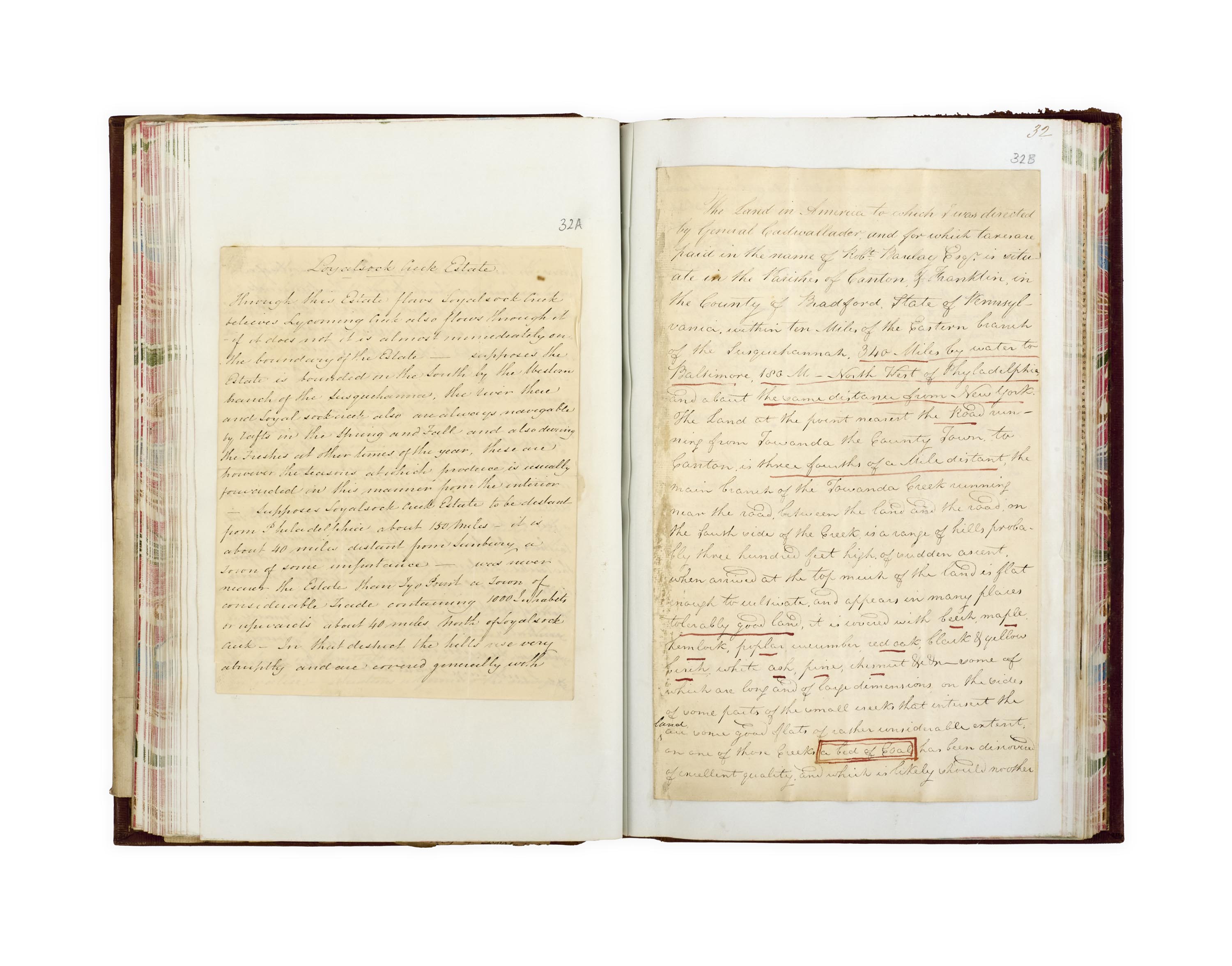
The majority of the archive deals with successive attempts to survey and assess the land, which was heavily wooded with sugar maple, birch, wild cherry and hemlock, the soil in the lowlands a rich chocolate brown, but very inaccessible; to encourage settlement and improvement; and to deal with squatters, and illegal land sales. In 1797 Joseph Priestley Jr writes to suggest they jointly construct a road, and provide land cheap or gratis to those who will set up a mill, smithy, school, and church. But this evidently did not happen, and the land remained largely unoccupied and undeveloped through to the War of 1812 and after. In 1816, Thomas Cadwalader succeeded his uncle as Barclay’s agent in Philadelphia, writing that ‘the Loyalsock Lands are not saleable at present’ and further lands bought at Tioga are ‘worthless’. Without the personal connection of his uncle, Cadwalader’s correspondence is more workmanlike, confined largely to the payment of taxes and the remittance of annual accounts, with statements on the current status of the Barclay lands, which he seems loath to visit. The return letters are soon taken over by Charles Barclay and in 1823 when Charles requested an update, Cadwalader’s reply is shakily signed with his left hand after he was injured in a duel: though ‘gradually improving’, the only sales have been small parcels to subsistence farmers who often abandon plots and squat; ‘though I should by no means covet the possession of such property, I should be equally unwilling to abandon it’. English emigrants, however, are entirely ‘unfitted’ as pioneers in new settlements. But new potential soon surfaces when a report of 1823 by Benjamin Youngman makes the first mention of the discovery of ‘a bed of coal … of excellent quality’ and suggests more may yet be discovered, though bringing it to market is difficult. In late 1828 Cadwalader provides a survey conducted by Zephon Flower (1765–1855), ‘esteemed the best and most faithful surveyor we have’, which again points out the lack of roads, rails and canals as an issue discouraging settlement and development.
In around 1835, evidently unsatisfied with Cadwalader’s services, Charles Barclay employed in his stead Samuel Rhoads Jr, who also acted for Joseph Pease (1799–1872), manager of the Stockton and Darlington Railway Company, the first Quaker MP and a brother-in-law of Barclay. A number of Rhoads’s letters to Pease are present here in the original (sent on to Barclay) or in copies, among them an extract of a letter of 27 August 1835 reporting that ’The South is almost in arms and quite in a rage at the “Northern Fanatics” as they call the abolitionists … So greatly are the people in the South exasperated that they cannot await the slow operations of the law against those who excite the slaves to rebel, but hang them with little ceremony … We are beginning to experience the inevitable effects of universal suffrage, when the people are greatly wanting in virtue and easily led by the declamations of mercenary demagogues’. He blames the current ‘riots and anarchy’, and the priority of force over reason, on ‘the character and conduct of our President’, Andrew Jackson. ‘The probability daily increases that this Union will be severed and that the S. States and Texas will form a Republic whose interests will be less injuriously affected and better promoted … my opinion is that such a step will eventually involve the Southern States in Anarchy and with reference to the coloured populace in bloody civil wars’. Rhoads, grandson of a mayor of Philadelphia, was a correspondent of Frederick Douglass, and was later heavily involved with the Free Produce Association, promoting the production by free labour of articles, particularly cotton, which were normally grown by slaves. He assisted the Philadelphia Vigilance Committee in aiding the passage of fleeing slaves, and in 1846–51 he was the editor of The Non-Slave Holder.
In another letter to Pease (original), Rhoads notes ‘I have taken the liberty of rolling up with the draft the 3rd No. of the Aboriginal Port Folio’ (by James Otto Lewis) – ‘It is an interesting work even now, and when this deeply injured and rapidly disappearing race shall have become extinct, it will be regarded with still greater interest and curiosity’.
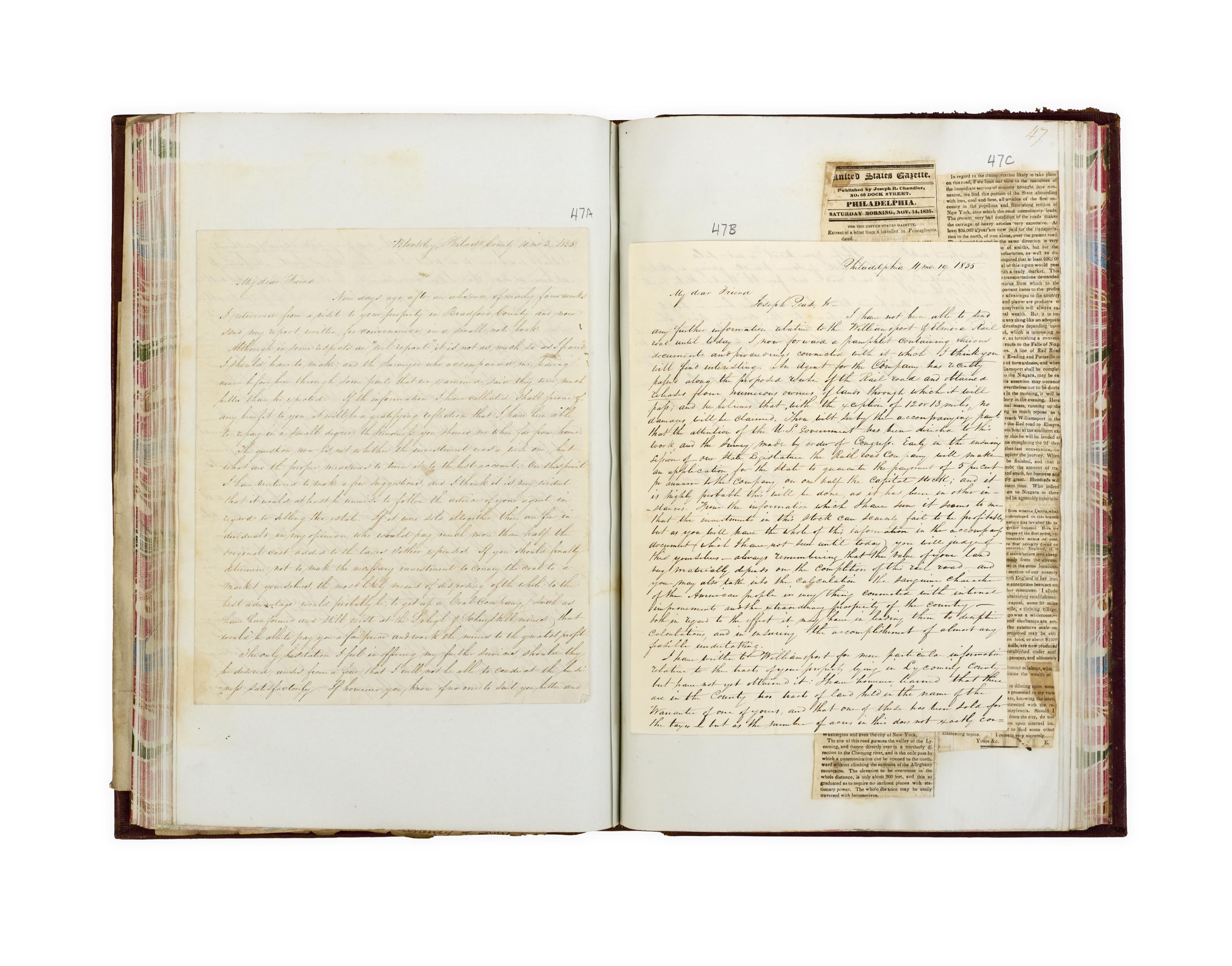
In his first letter to Barclay himself (3 May 1836), Rhoads, whose correspondence is much lengthier than Cadwalader’s, points to the potential presented by the Williamsport and Elmira railroad, of which the first section had opened in 1832 – a connection to it would make the Barclay lands much more valuable. On 27 May 1836 he reports that ‘very large quantities’ of coal have been procured from the Barclay mine that winter, and mentions a proposed ‘Towanda and Franklin Rail Road’ which would be even closer to hand. And a long letter of 29 November 1836 (12 pages) contains a detailed survey of the coal seam by the geologist Richard. C. Taylor, and explorations of possible routes for a rail link by Enoch Lewis (1776–1856, mathematician and surveyor). A fascinating manuscript map likely from this date shows the extent of the coal beds, marks the mine currently being worked, and shows the route of the ‘contemplated railroad … to Towanda’; it also shows iron ore, and a ‘Friends Meeting’ just south of their plot. Rhoads suggests either selling the estate (a price of $100,000 might be possible) or obtaining a charter for a railroad – the total capital required he estimates at least $200,000. ‘The Barclay coal is already extensively known and must always be equal if not superior to any in the market’, and there is long-term potential but only at great cost. Later, he is even more explicit: ‘it is evident that your estate is comparatively worthless until a rail road is constructed from it to Towanda’ (17 December 1840), but ‘perhaps thou mayest yet cross the Atlantic in one week in a New York or Philad[elphi]a steam ship supplied with “Barclay Coal”’.
However, financial constraints, wariness of railroad speculation, and the difficulty in getting consensus from all the joint investors, seem to have prevailed, and no further funds were invested. Finally in the early 1840s, Pease managed to procure two energetic emigrants, Henry Gatiss and Henry Waggot, to settle and improve some of the land and operate the mine; duly, with their encouragement a sawmill was constructed, and coal surveys continued over the rest of the land. Eventually though, the English proprietors, still unwilling to invest further in the necessary road and rail connections, decided to cut their losses, and sought a sale of the entire Barclay estate. Rhoads here reports early offers between $40,000 and $65,000, and he then achieves $80,000 (30 June 1853), ‘after five days of most anxious negotiation’, selling to a consortium of coal and railroad interests (receipts for the proceeds from all investors are included here).
The Barclays’ reticence was perhaps ill-considered. In 1854 the Barclay Railroad and Coal Company was incorporated; construction began 1855 and was completed just as the North Branch Canal opened in 1856. Seven thousand tons of coal was delivered to the canal in its first year. By the late 1860s the mine had come into the hands of the Erie Railroad, and production had increased to 200,000 tons by 1869: a large portion of the Railroad’s coal was taken from Barclay Mountain, and the settlement had a population of two thousand.