
Marriage and Matriarchs
BARBARO, Francesco.
De re uxoria libri duo, ut venustate sermonis praeclari, ita & praeceptis optimis & exemplis uberrimis ex omni Graeca Latinaque historia collectis redundantes ... Amsterdam, Jan Jansson, 1639.
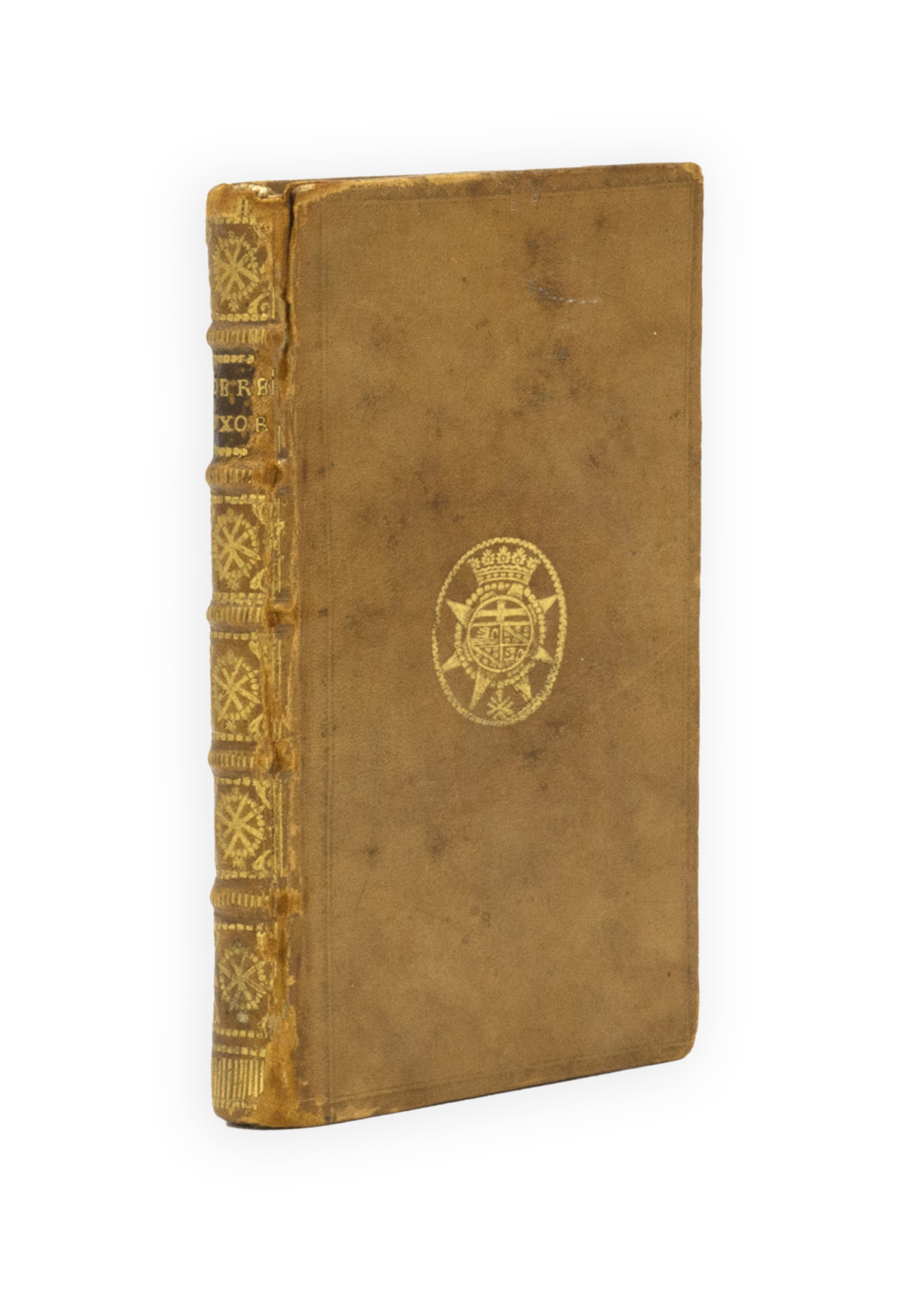
12mo, pp. 178, [8], [6 (blank)]; woodcut device to title, initials; a few small marks to title and elsewhere; very good in early eighteenth-century Dutch polished calf, spine gilt in compartments with gilt stained lettering panel, gilt board-edges, edges stained; short split to upper joint at head, headcap chipped, a little rubbed at extremities; arms of Auguste-Léon de Bullion, marquis de Bonnelles (1691–1769) blocked in gilt to each board.
Added to your basket:
De re uxoria libri duo, ut venustate sermonis praeclari, ita & praeceptis optimis & exemplis uberrimis ex omni Graeca Latinaque historia collectis redundantes ...
An attractive later edition of this famous treatise on marriage by the eminent Venetian humanist and politician Francesco Barbaro (1390–1454), arguing that the nobility, intellect, and virtue of brides-to-be are more significant than beauty or dowry.
The twenty-five-year-old Barbaro composed the De re uxoria in 1415 to celebrate the marriage of Lorenzo de’ Medici the Elder and Ginevra Cavalcanti, drawing upon Greek and Latin sources. First published in Paris by Josse Badius in 1513, the work is still studied on its own merits, as a notable contribution to early modern discussions of the education of women, and as a window onto fifteenth-century Italian attitudes towards marriage and family life. De re uxoria is ‘revolutionary because it identifies the mother … not [the family’s] patriarch … as the critical figure for the rearing of the young and, consequently, for the social and cultural reproduction of the noble family. It is the mother, not the father, Barbaro argues, who transmits her own mental and moral characteristics to her offspring in the processes of gestation and lactation’ (King, The Wealth of Wives (2015), p. 1). Divided into two books, the De re uxoria covers, for example, the benefits of marriage, dowries, the bride’s age, nobility, and wealth, a wife’s duties, conjugal affection, a wife’s clothing and diet, sex, domestic affairs, and bringing up children.
STCN 853139199; USTC 1032710.