All Fun and Games
[BARGAGLI, Girolamo] pseud. ‘Materiale INTRONATE’.
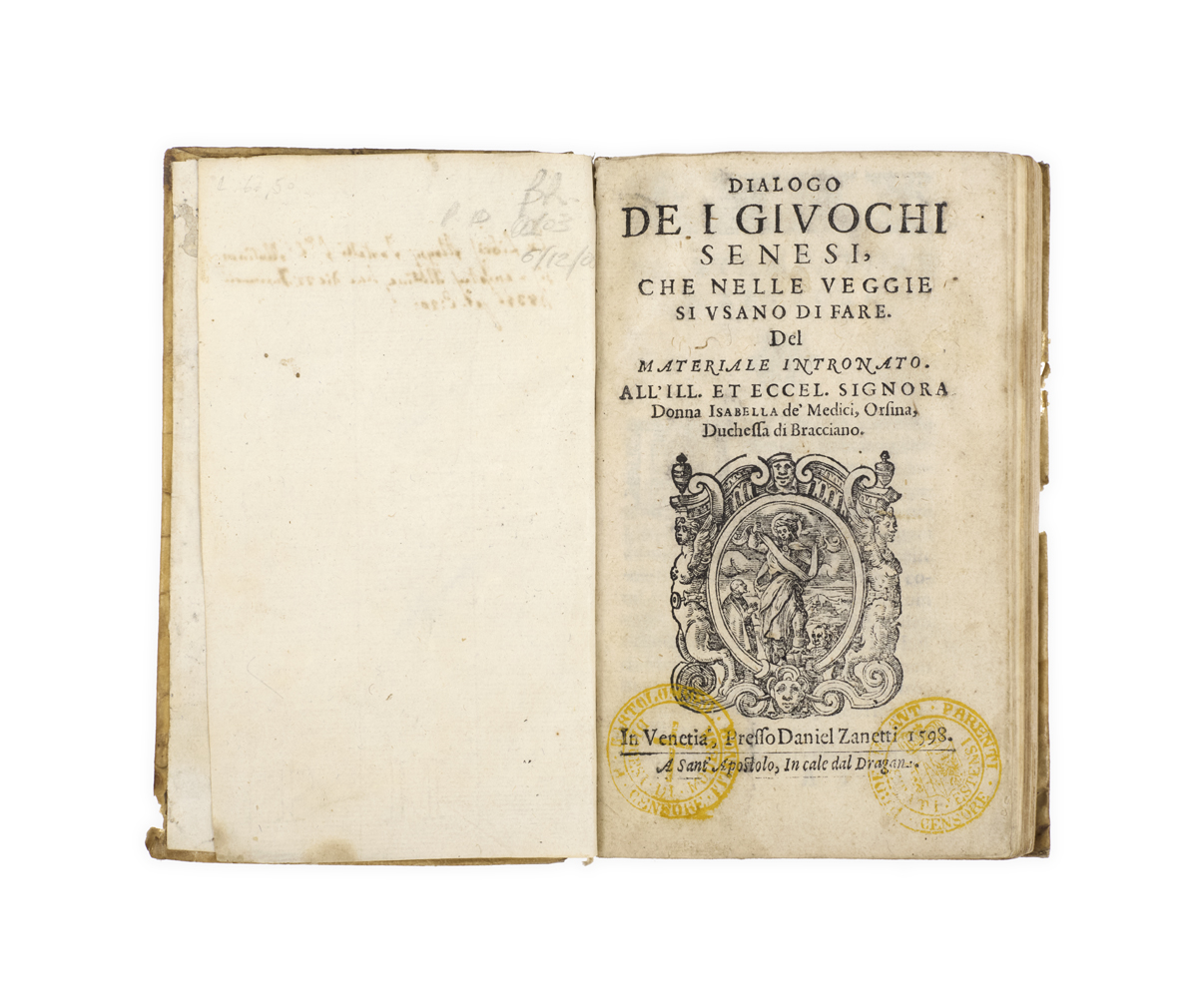
Dialogo de i giuochi senesi, che nelle veggie si usano di fare. Venice, Daniel Zanetti, 1598.
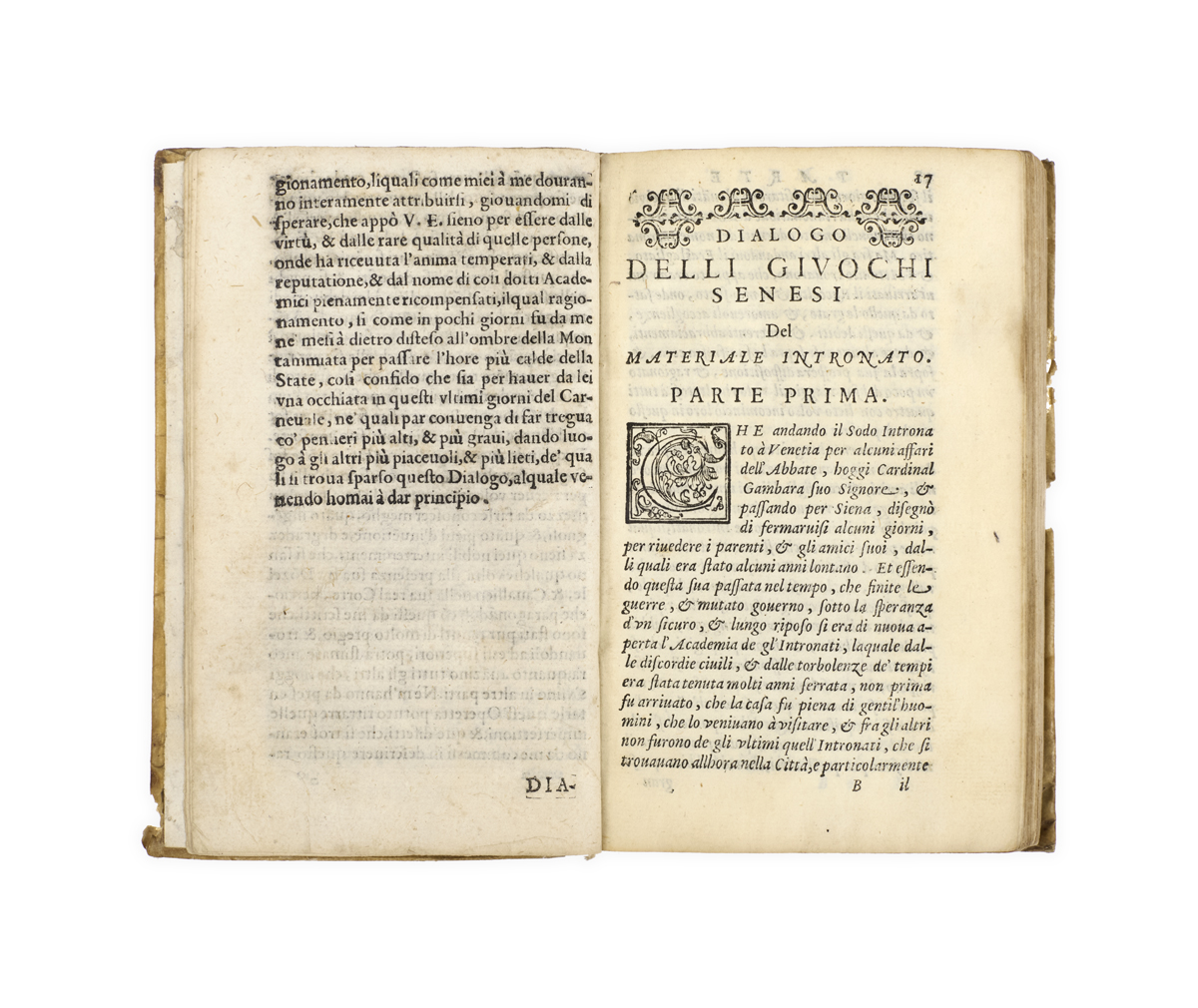
8vo, pp. 228; woodcut printer’s device to title-page, woodcut and typographic headpieces, woodcut initials; light marginal dampstaining, slightly toned (particularly quire G); else a very good copy; recased in contemporary vellum, title lettered to tail-edge in a contemporary hand, later manuscript lettering to spine; a few marks, a few wormholes to upper cover and small wormtracks to lower cover; purchase note to front free endpaper of Aloysius Tortelli, Diocese of Modena, dated 22 January 1835; yellow censorship stamps of the Stati Estensi to title and final verso.
Later edition (first 1572) of this extremely popular book of Sienese light entertainments by the lawyer and poet Girolamo Bargagli (1537–1586), the foremost exponent of Renaissance games.
The work was written by Bargagli, a member of the Sienese Accademia degli Intronati, after the city’s loss of independence in 1555. Into this atmosphere came Bargagli’s work, attempting to lift the spirits of the beleaguered population; he argued that Siena had the best games and illustrated his point with 130 examples. Each game has three parts: the proposal, the performance, and the satisfaction, ‘often consisting of penalties to be performed or questions to be answered’ (Haar). The games cover a vast range of scenarios, for example one in which the players are confronted by ‘a host of Amazons’ in warlike mood. ‘The distinction between games (of wit, jest, or pleasure) is … conditioned by a sort of “index of prohibited games”, which condemns those of obvious “filthiness”, especially those featuring friars and nuns’ (DBI, trans.). The work went through four editions before this one, although no attempts were made to alter Bargagli’s very successful text; all editions retain the original 1572 Sienese printer’s preface and Bargagli’s dedication to Isabella de’ Medici, despite her death in 1576, supposedly murdered by her husband.
EDIT16 CNCE 4202; USTC 812304; Adams B-202. This edition not in BM STC Italian (see p. 426). See Graesse I, p. 292; Haar, ‘On musical Games in the 16th Century’, in Journal of the American Musicological Society, 15:1 (1962), pp. 22–34.