The First ‘Protestant’ Greek Bible
[BIBLE – OLD TESTAMENT and APOCRYPHA, Greek; Johann LONITZER, editor.]
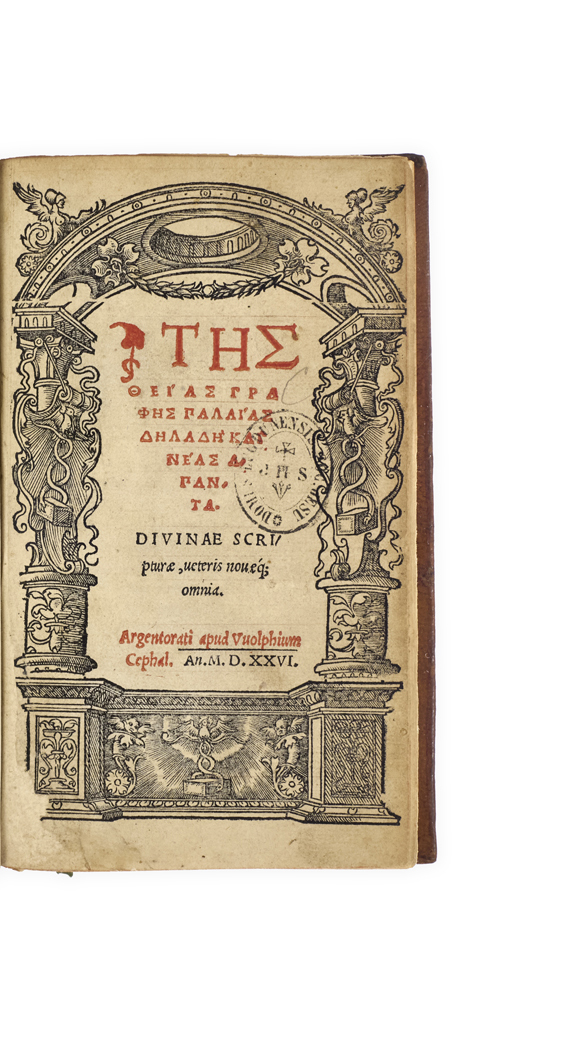
Της θειας γραφης παλαιας δηλαδη και νεας απαντα. Divinae scripturae, veteris noveque omnia. Strasbourg, Wolfgang Köpfel, 1526.
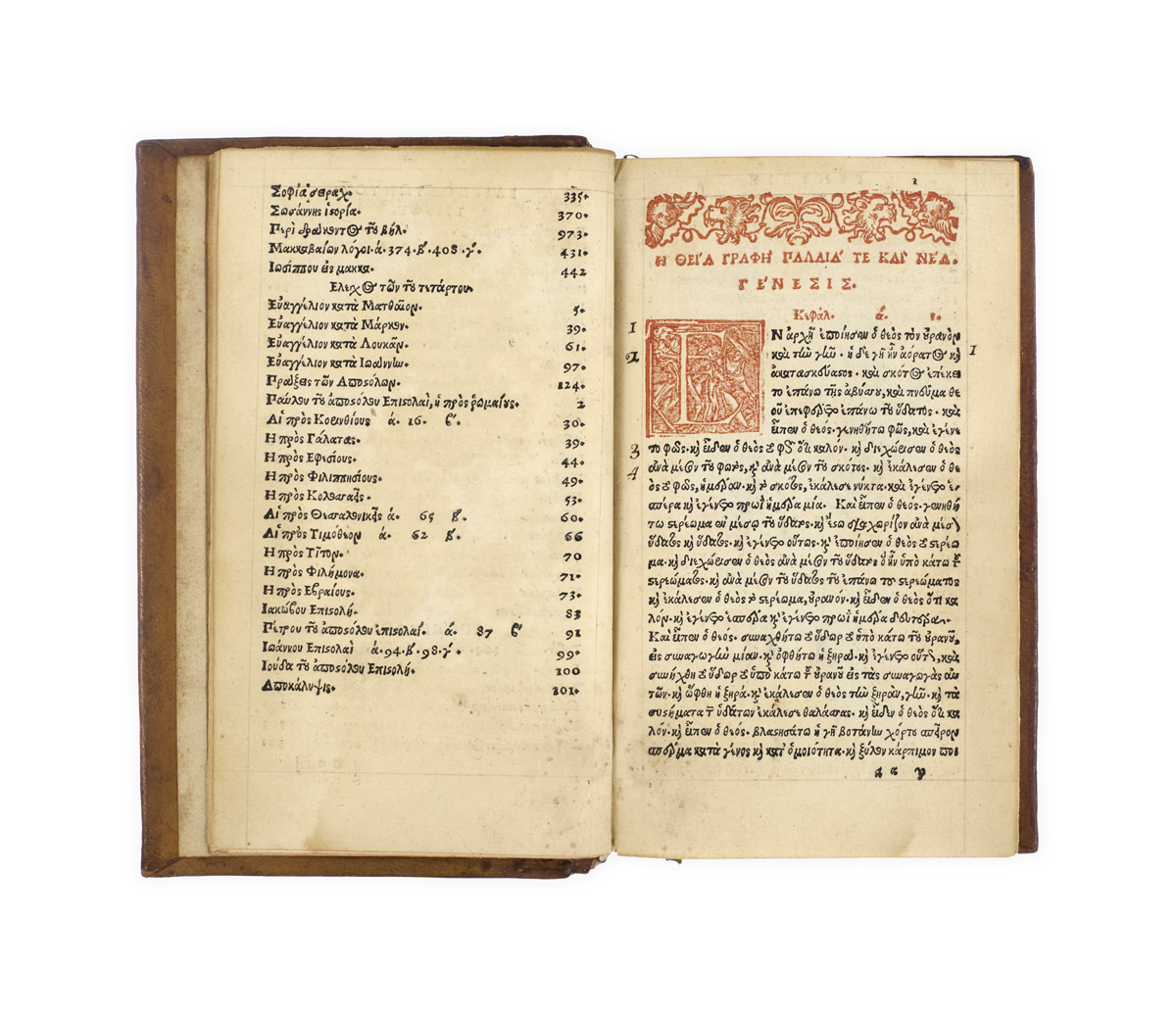
Three vols, 8vo, ff. I: [iv], 275, [1], II: 344, III: [1], 455; titles printed within woodcut borders by Hans Weiditz, vol. I title printed in red and black and f. 1 with woodcut headpiece and initial printed in red, ruled in red, woodcut initials and headpieces throughout, woodcut printer’s devices to titles of vols II and III, to final versos, and to vol. III f. 263v; occasional light marginal staining, minor wormhole to lower margin of quires I cγ-eε, small rust-hole to I AΑ1 (affecting a few characters without loss of sense), neat old repairs to vol. I title verso (with small loss to lower inner corner of border), nonetheless a very good set; bound in late eighteenth-century French marbled calf, spines gilt in compartments with gilt red paper lettering-pieces, edges stained red, green ribbon place-markers; skilful repairs to joints and extremities, very slightly rubbed; ink stamp to first and third title-pages of the Jesuits of Lyons.
Added to your basket:
Της θειας γραφης παλαιας δηλαδη και νεας απαντα. Divinae scripturae, veteris noveque omnia.
The first edition of the Old Testament in Greek to be printed in Germany, and the first aimed at a Protestant readership, with the Apocrypha separated along the lines of Luther’s German translation.
The prolific Protestant printer Wolfgang Köpfel established his own press in Strasbourg in 1523, printing a Greek Psalter and New Testament the following year and two volumes of Homer in 1525, all edited by Johann Lonitzer (or Lonicerus, c. 1499–1569) before his appointment as Professor of Greek (and later of Hebrew) at the newly founded University of Marburg in 1527.
Although basing the text on the Aldine Bible, Lonitzer’s arrangement of the books followed Luther’s German Bible which – following the Hebrew rather than the Septuagint – did not include the Apocrypha. ‘Lonicerus performed two novel pieces of surgery: he removed whole books designated as Apocrypha to a separate section of their own, and made cuts in books like Daniel and Esther to remove extra material contained in the Greek. In this, Lonicerus was following the lead of Luther, as he made clear in his “Ratio Partitionis”, which introduces the work’ (Grillo, p. 27). The relegation of the Apocrypha to a separate section enabled purchasers to have it bound separately or even not to acquire it at all; three of the six copies Adams records in Cambridge are bound without them.
This Protestant edition of the Septuagint is positioned at a significant moment in the early printing history of the Bible in Greek. It is the third printing overall, following the Complutensian Polyglot (Alcalá, 1514–1517) and the Aldine Greek Bible (Venice, 1518), both of which were issued alongside Erasmus’s controversial New Instrument (Basel, 1516), which sought to provide an alternative Latin version based on the Greek text rather than Jerome’s Vulgate.
‘The content and organization of the Greek Old Testament, in particular its relationship to what Luther and his followers determined were apocryphal texts, were subjects of intervention (whether on the part of editors in print or readers in manuscript annotation) from all sides in editions of the Septuagint that appeared from the mid-1520s onward. The majority of such interventions in print were the product of Protestant rejection of the Vulgate, rather than concern for the manuscript tradition’ (Mandelbrote).
Despite being placed on the Index of Prohibited Books as a work of Protestant origin, this copy was owned by the Jesuits of Lyons without suffering any mutilation (the preface by Lonitzer with its mention of Luther was often removed in Catholic settings).
USTC 696163 & 710172 (with New Testament); VD16 B 2575 (with New Testament); Adams B 977; Darlow & Moule 4602 (with New Testament); Delaveau & Hillard, Bibles imprimées 91 (with New Testament); Muller, Bibliographie Strasbourgeoise, Köpfel 81 (with New Testament). See Grillo, ‘Out of print: Excising and preserving the Daniel tradition in early printed Greek Bibles’, in The Journal of Theological Studies 73 (2022), pp. 22–42; Mandelbrote, ‘The Septuagint in Early Modern Europe’, in The T&T Clark Handbook of Septuagint Research (2021), pp. 299–310.