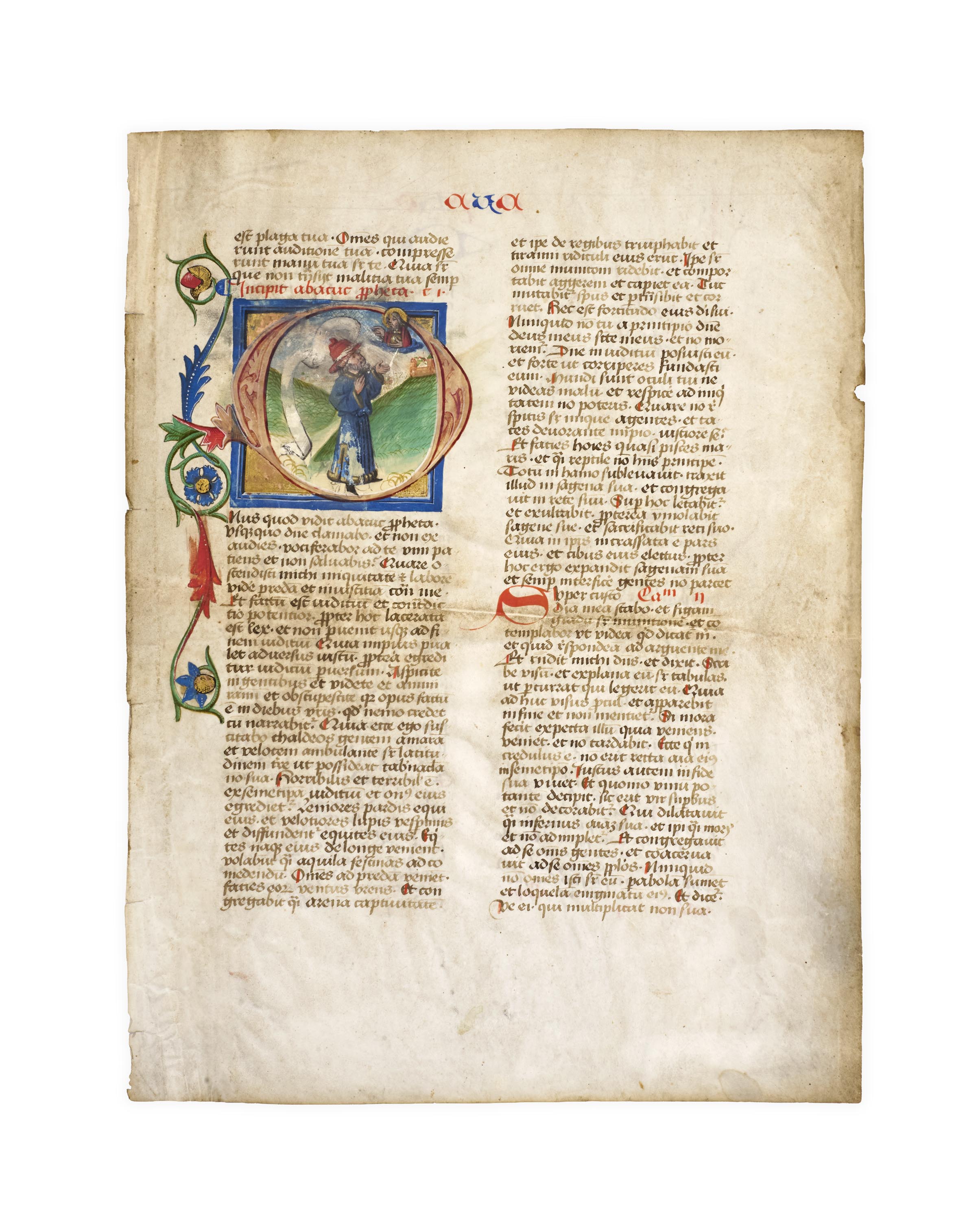
A Prophet in Conversation with God
BIBLE.
Book of Habakkuk 1–3. Southern Germany?, c. 1475?
A complete vellum leaf (c. 390 x 295 mm, text area c. 275 x 210 mm), double columns of 50 lines written in brown ink in a neat, slightly slanting Cursiva; one sixteen-line historiated initial ‘O’ (Onus) to recto, in pink with foliate infill, enclosing a bearded Habakkuk (in blue dress and red hat, with a blank white scroll beside him) in a green, hilly landscape, looking up at God in a cloud (with red cloak and gilt halo, holding an orb and pointing), a city in the background, foliate tendrils terminating in three flowers extending from the initial into the border, in blue, green, red, and gold; two three-line initials alternately in red and blue, capitals touched in red, rubrics, headlines in alternating red and blue letters (‘[Haba]cuc’, ‘Sopho[nias]’); historiated initial rubbed and with areas of loss to paint, smudge to border, central horizontal crease from folding, some small tears (without loss) to inner margin, small chip to outer margin, some light marginal staining, slight cockling; in good condition.
A leaf from a large Latin Bible, professionally produced for a lay and noble market, with a large historiated initial depicting the prophet Habakkuk, dressed in contemporary Jewish clothing, in conversation with God.
The eighth book of the Minor Prophets, the Book of Habakkuk opens with the prophet lamenting the current reign of oppression and lawlessness, and God’s answer that punishment is coming in the form of a Chaldean invasion. The first two chapters ‘are written in the form of a dialogue of great power and beauty between Yahweh and His prophet. Their central message is that, while the Chaldean is filled with pride, “the just shall live by his faith” (2:4) ... This passage has played an important part in Christian thought ... as the starting point of the theological concept of faith’ (Oxford Dictionary of the Christian Church).
Habakkuk is here shown in the dress of a fifteenth-century German Jew, with a fur-trimmed blue tunic, fashionably pointed shoes, and the red pileus cornutus worn by Jews in late medieval Germany.