Plagiarising Plato
[CAJOT, Jean-Joseph.]
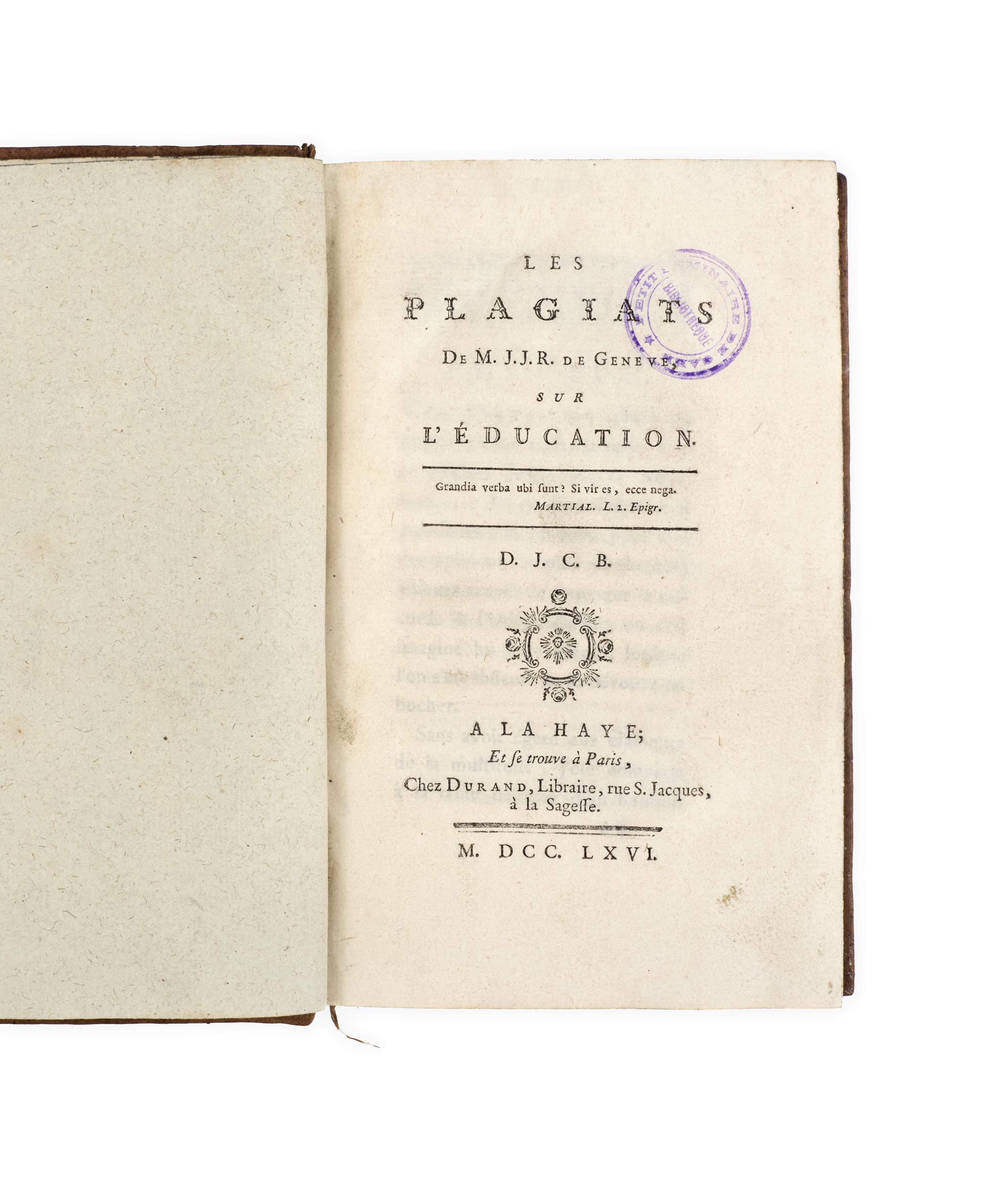
Les plagiats de M. J.J.R. de Genève sur l’éducation … D. J. C. B. The Hague and Paris, Durand, 1766.
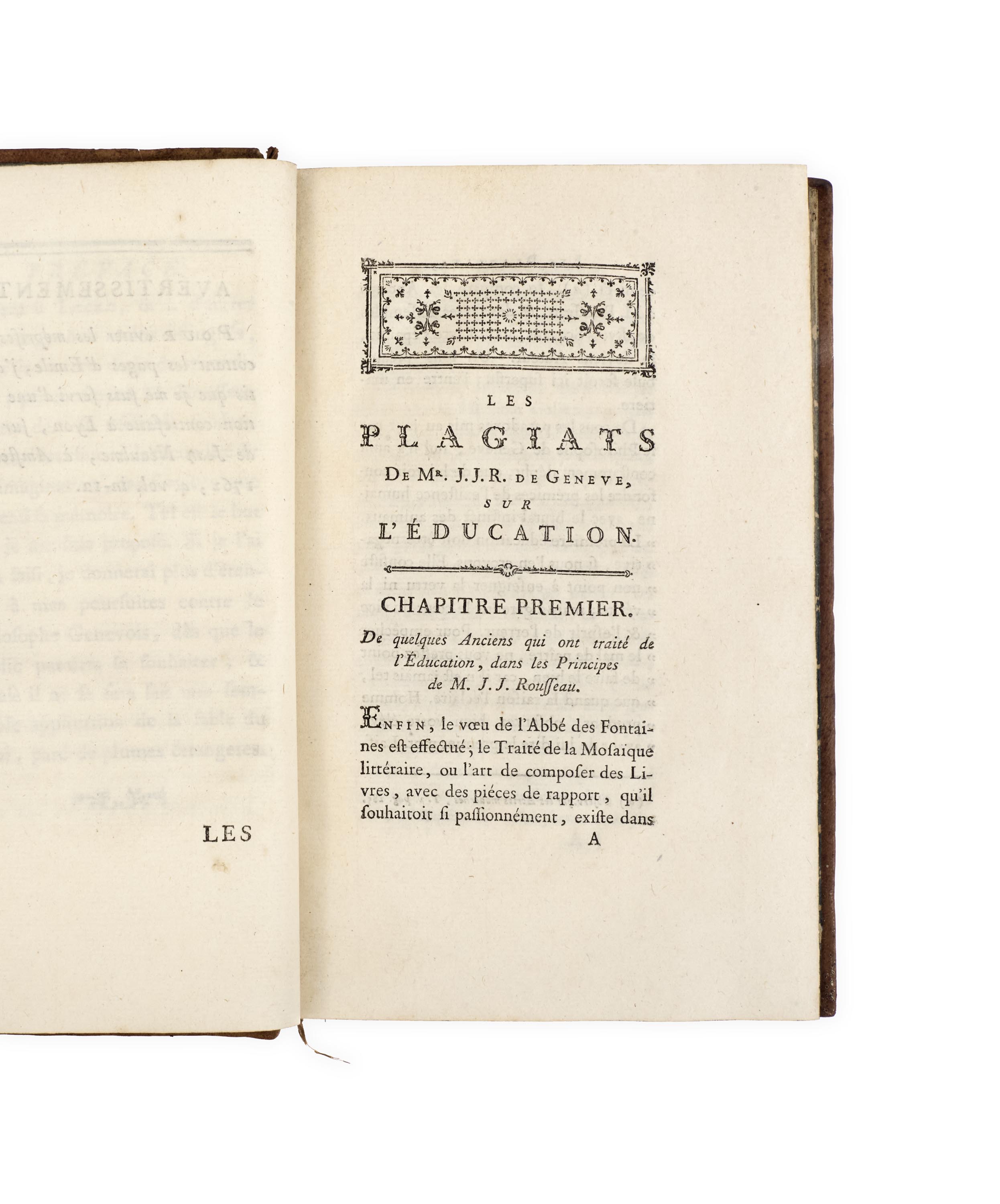
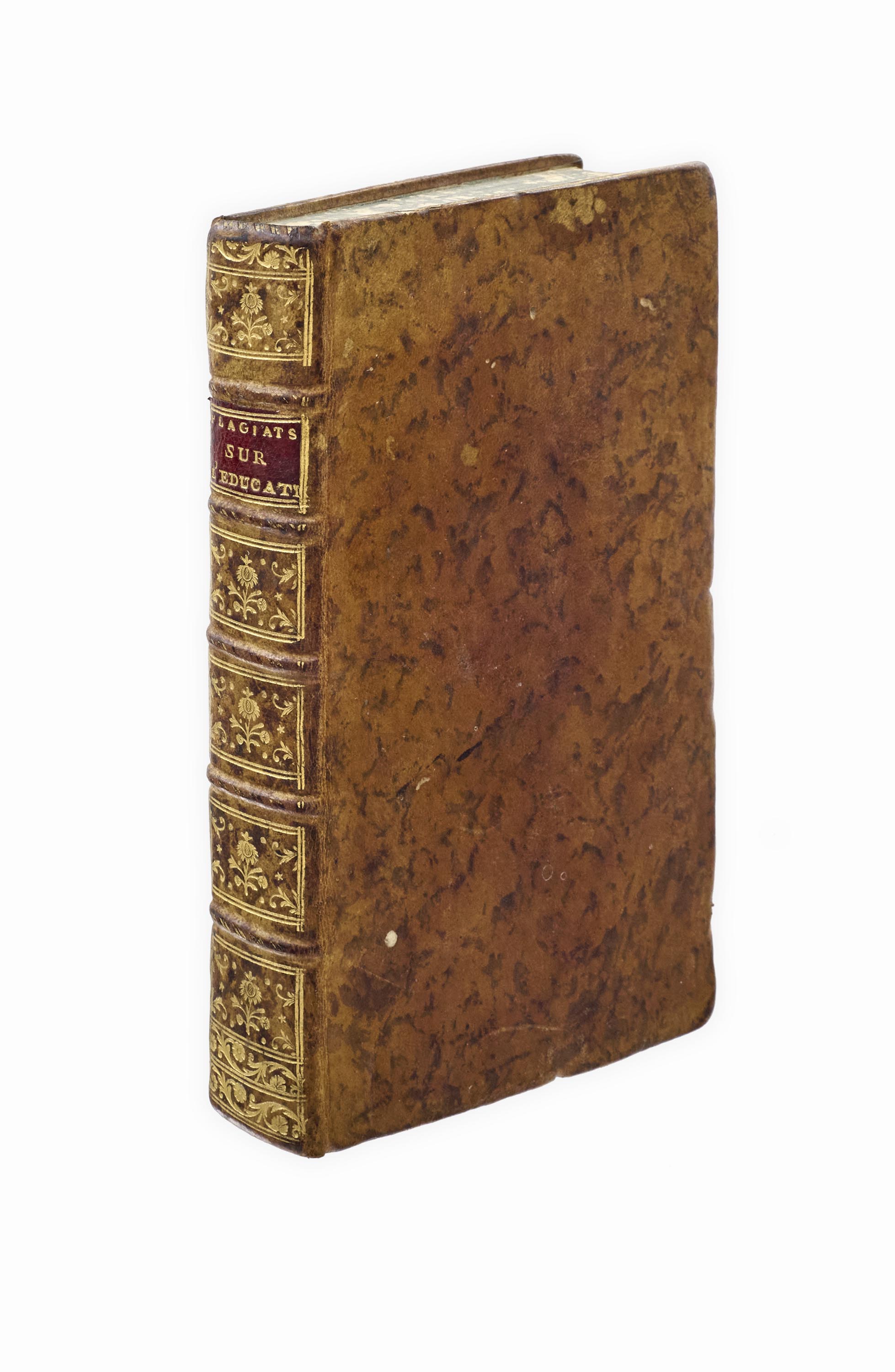
8vo, pp. xxii, [2], 378, 6 (advertisements); small woodcut ornament to title-page, typographic head- and tailpieces throughout; a few very slight marks, but very good copy; in contemporary mottled sheep, spine gilt in compartments with gilt red morocco lettering-piece, pink silk page-marker, edges speckled blue, marbled endpapers; lightly rubbed in places with a few small bumps at extremities, slight sunning; ink stamp of Bibliothèque Petit Séminaire de Caen to title-page.
Added to your basket:
Les plagiats de M. J.J.R. de Genève sur l’éducation … D. J. C. B.
First edition of this scathing critique of Rousseau, accusing the philosopher of plagiarism, by the Benedictine monk Dom Joseph Cajot.
Dom Joseph Cajot (1726–1779), a Benedictine monk with the Congregation of Sainte-Vanne and Saint-Hydulphe in Lorraine, wrote the ‘Observations touchant le discours […] Sur le rétablissement des sciences & des Arts’ in 1765, publishing it for the first time the following year together with his more extensive treatise, principally targeting Rousseau’s Émile.
Cajot accuses Rousseau of stealing from Plato, Seneca, Plutarch, Malebranche, and Locke, among numerous other philosophers, in his writings on education. The ‘Genevois’ allegedly draws above all on Montaigne’s Essais, whose ideas not only pervade Émile but also form the basis of the First Discourse (Discours sur les sciences et les arts). ‘What perfidy on the part of Mr R. to dare to dress up Montaigne’s philosophy in modern colours, to claim the credit for himself!’ (p. 121, trans.). Elsewhere, he prefers sarcasm: Rousseau ought to be thanked for rendering Seneca accessible to a French readership. Cajot is meticulous in his efforts to expose plagiarism throughout Émile, for instance juxtaposing passages from Rousseau’s book on the education of Sophie with the strikingly similar reflections of the Renaissance humanist scholar Juan Luis Vives (1493–1540) on women’s education.
Cajot was in fact not the first to highlight Rousseau’s apparent failure to attribute some of his ideas to Seneca, with Joseph Gautier having done so in 1751. According to Robert Wokler, ‘Dom Joseph Cajot’s imputations of plagiarism in his “Observations touchant le [premier] Discours de Rousseau” may have been unduly severe overall and incorrect in specific instances, but it is a disconcerting fact that the Discours sur les sciences et les arts is the only one of Rousseau’s major writings to warrant such suspicions’ (Wokler, p. 157).
Conlon 376. See Brooke, ‘Rousseau’s Second Discourse: between Epicureanism and Stoicism’, in Rousseau and Freedom (2010), pp. 44–57 (p. 45 and 55); Wokler, ‘The Discours sur les sciences et les arts and its offspring: Rousseau in reply to his critics’, in Jean-Jacques Rousseau: Critical Assessments of Leading Political Philosophers, Volume II: Human Nature and History (2006), pp. 152–77 (p. 157 and 174).