‘African American’ Songbooks
‘CHAFF, Gumbo’ [pseud. Elias HOWE].
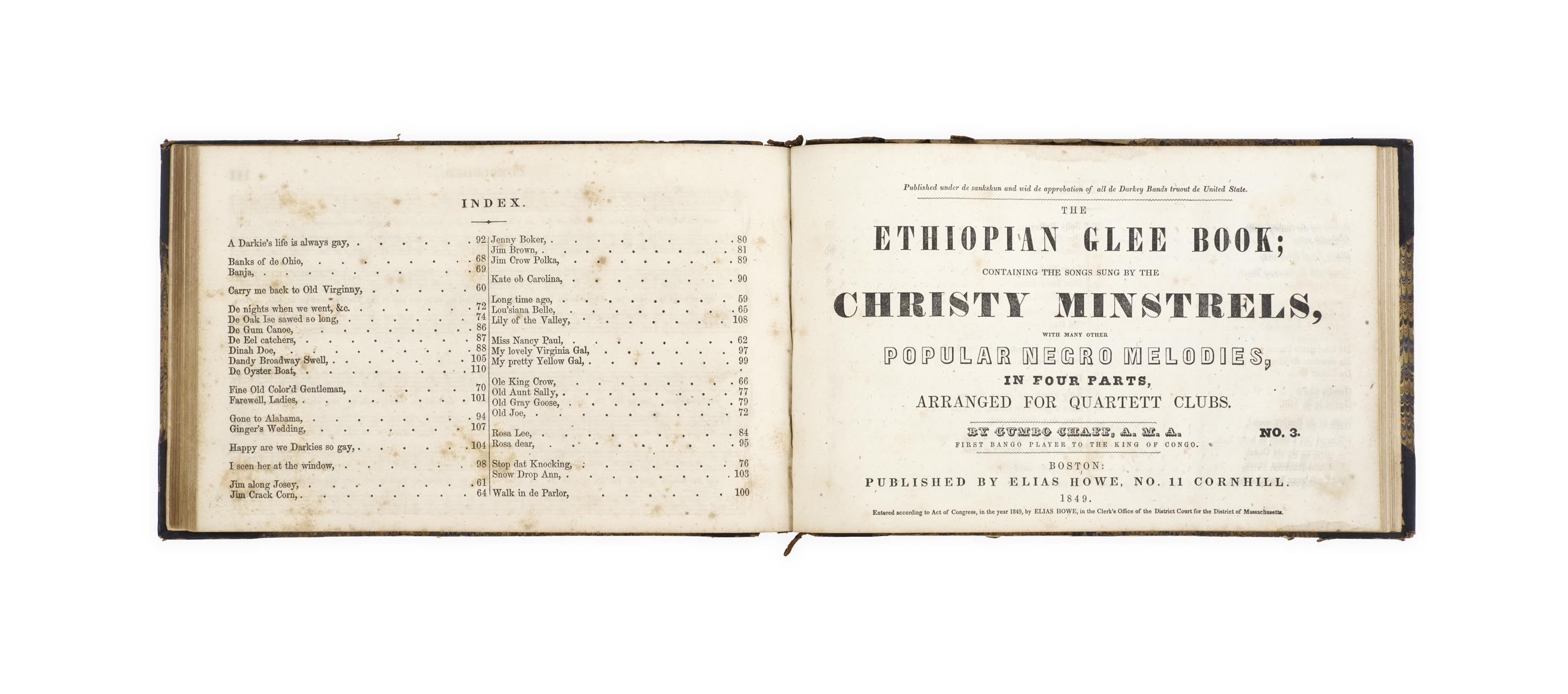
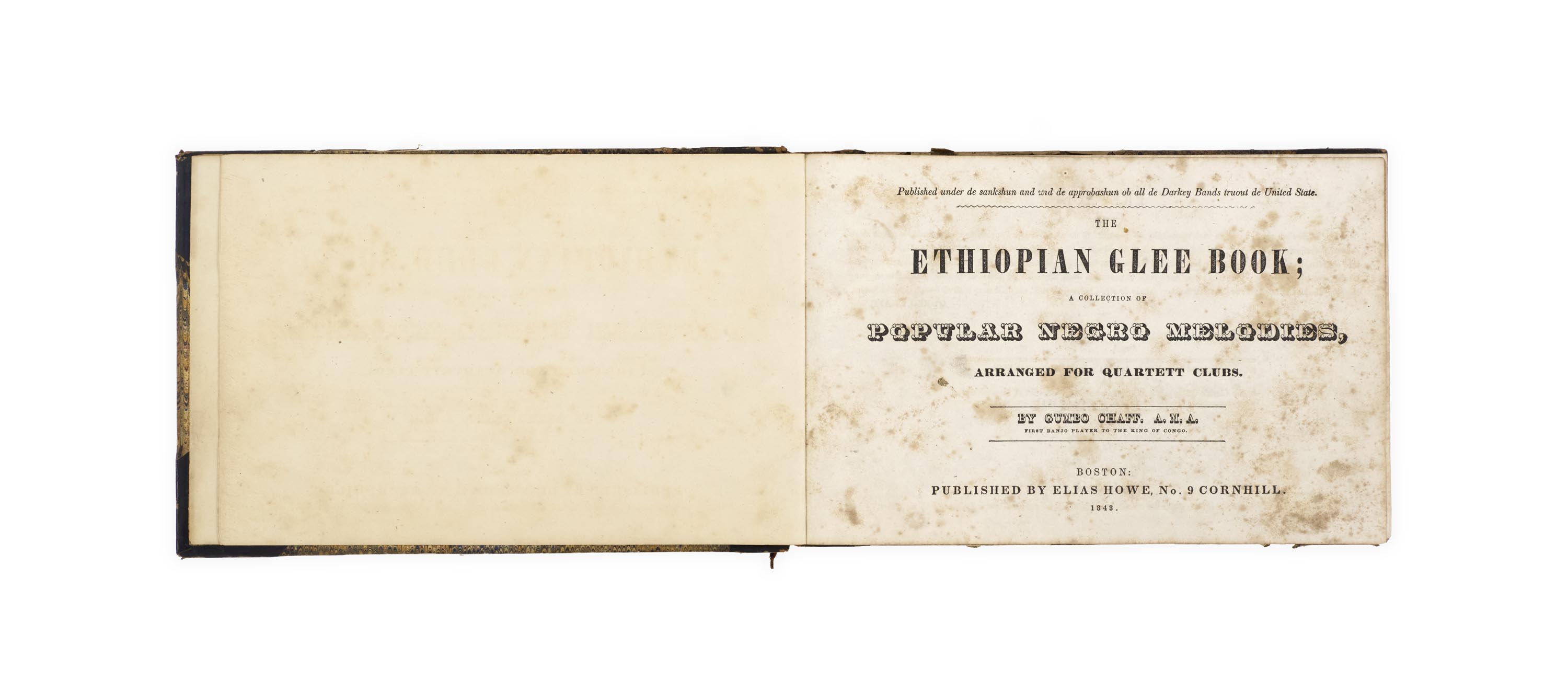
The Ethiopian Glee Book; a Collection of popular Negro Melodies, arranged for Quartett Clubs. [– No. 2; – No. 3]. Boston, Elias Howe, 1848 [– 1849].
Three works, oblong 8vo, pp. 55, [1]; [2], 59–111, [1]; [2], 115–167, [1]; title printed partly in hollow type; subtitles to Nos 2 and 3 ‘containing the Songs sung by the Christy Minstrels’; the first part somewhat foxed, Nos 2 and 3 slightly so; good copies in contemporary half calf, marbled paper sides, morocco label on front cover, spine and edges worn; ownership signature to front endpaper of Sir James Edward Alexander, Montreal, 1850.
Added to your basket:
The Ethiopian Glee Book; a Collection of popular Negro Melodies, arranged for Quartett Clubs. [– No. 2; – No. 3].
First editions of all three parts – a very early collection of blackface minstrel tunes, with songs in two to four parts set to words in supposed African American dialect. The pseudonym of the publisher-compiler, ‘Gumbo Chaff’, is taken from the eponymous song of the 1830s (printed on p. 4 here), and was one of the first blackface stock characters.
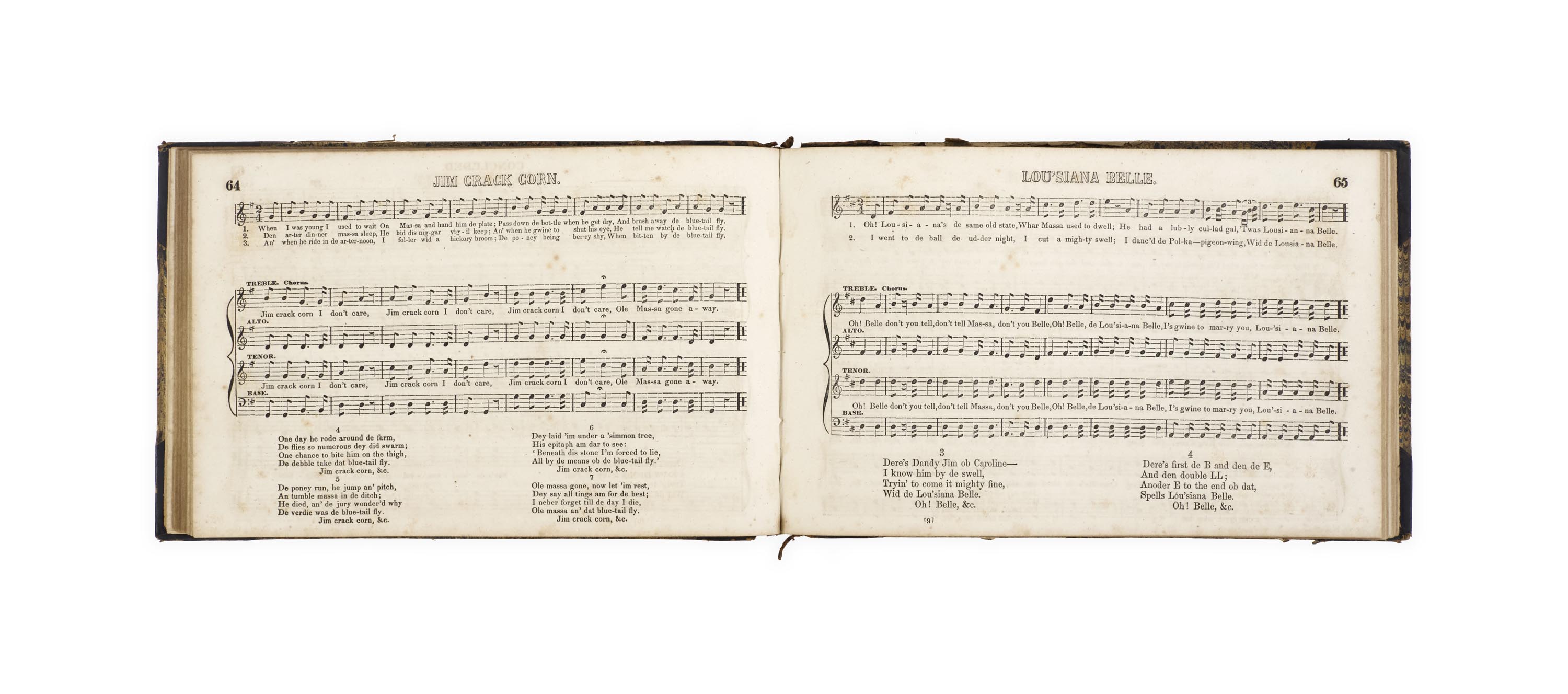
Although blackface minstrelsy began with exclusively white performers, and helped to cement, popularise, and export derogatory racial stereotypes, which are in ample evidence here, by the 1840s there were also shows with mixed or all-black casts. The half-mocking dedication ‘To all de Bobolashun [Abolition] and Antislabery ’cietis truout de world’ reflects some anxiety about the complex racialised nature of this specifically American genre, and the first song ‘Lucy Neal’, is an open lament on the break-up of a family by slavers, while ‘Uncle Gabriel, the Negro General’ takes as its subject a slave revolt in Virginia in 1800 and is featured in Callahan’s Songs of Slavery and Emancipation. Some of the most famous songs, such as ‘Jim Crack Corn’ (p. 64), about a slave whose master is thrown to his death after his pony shies from the bite of a blue-tail fly, may have had their origins in earlier African American songs, and were taken up by contemporary slaves. Lincoln admired ‘that buzzing song’, asking his friend Ward Lemon to sing it and play it on the banjo, and is sometimes said to have requested it as his lead-in at Gettysburg. Another longer rendition of the story, with some shared lines, is found as ‘De Blue Tail Fly’ in No. 3, which also includes ‘Revolutionary Echoes’, about the events of 1775–6.
The title-pages of the second and third numbers refer on their title-pages to the Christy Minstrels, formed by Edwin Pearce Christy in 1843 in Buffalo, NY, who had a seven-year residency in New York from 1847, and came to specialise in the songs of Stephen Foster, sometimes known as the ‘father of American music’.
Provenance:
The Scottish soldier, writer, and explorer Sir James Edward Alexander (1803–1885) served in Canada from 1841 to 1855. He had earlier published Transatlantic Sketches, comprising Visits to the most interesting Scenes in North and South America and the West Indies, with Notes on the Enslavement of Black People (1833), his position on abolition being that it was admirable and necessary but that slave-owners should be compensated.
Blockson 7992 (No. 1 only); Library Company of Philadelphia, Afro-Americana 2141 (No. 1 only). The three parts were reprinted together in 1849 and 1850. Nos 2 and 3 are very uncommon.