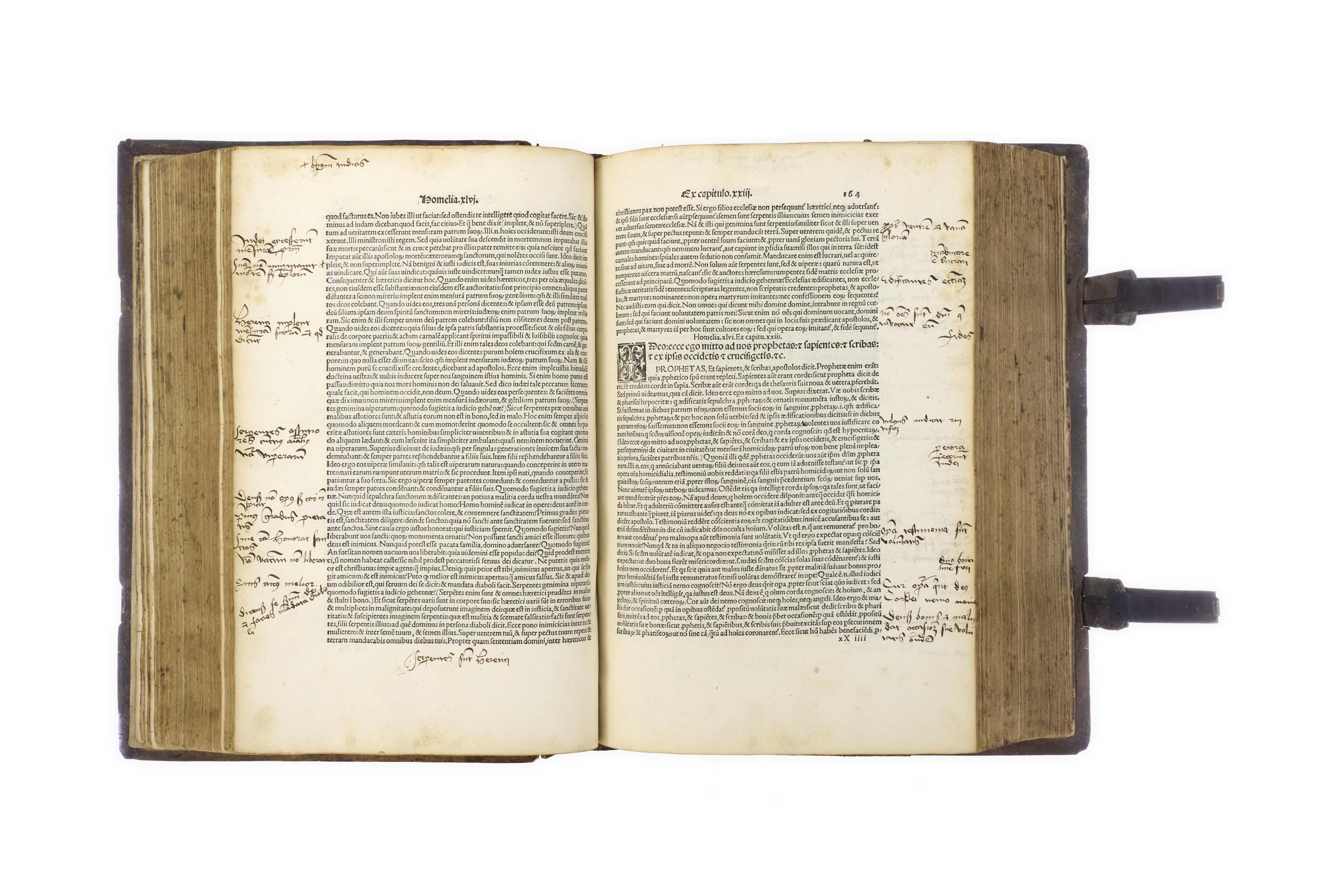
‘Heretics Are Snakes’
CHRYSOSTOM, John.
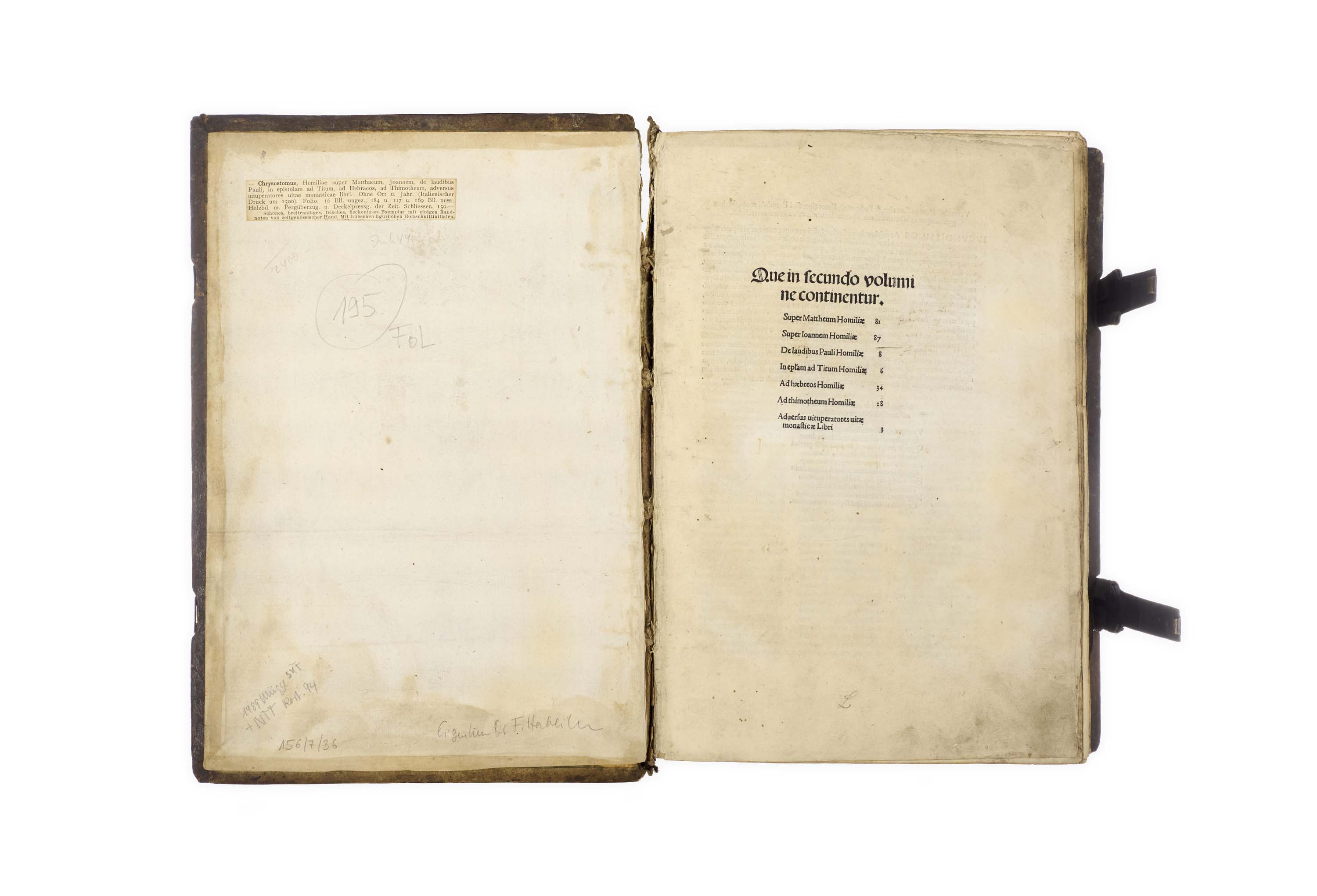
[Opera] Que in secondo volumine continentur super Mattheum homiliae … super Joannem homiliae … de laudibus Pauli homiliae … in ep[isto]lam ad Titum homiliae … ad haebreos [sic] homiliae … ad thimotheum homiliae … adversus vituperatores vitae monasticae libri … [Venice, Bernardino Stagnino and Gregorio de’ Gregori, February 1503.]
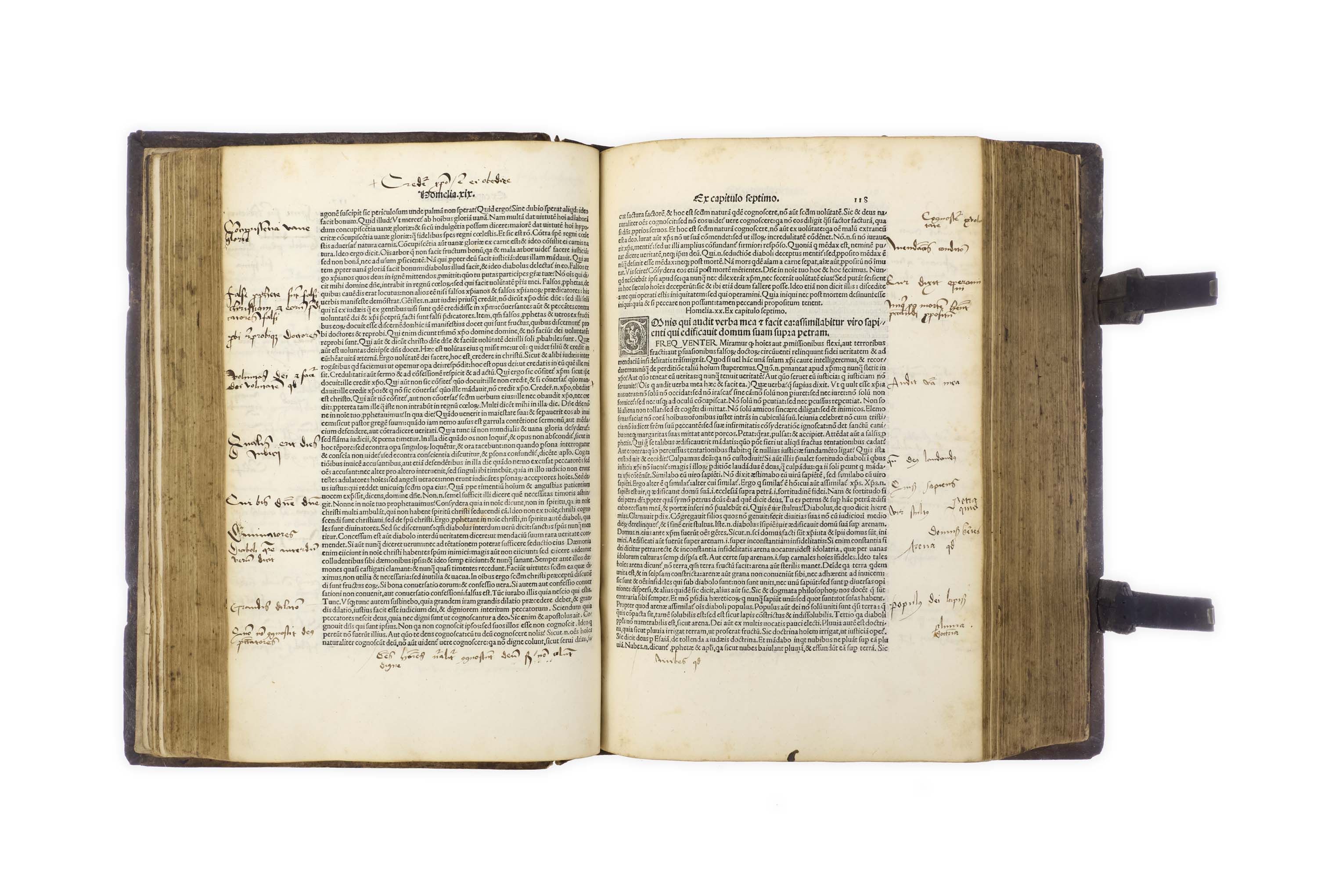
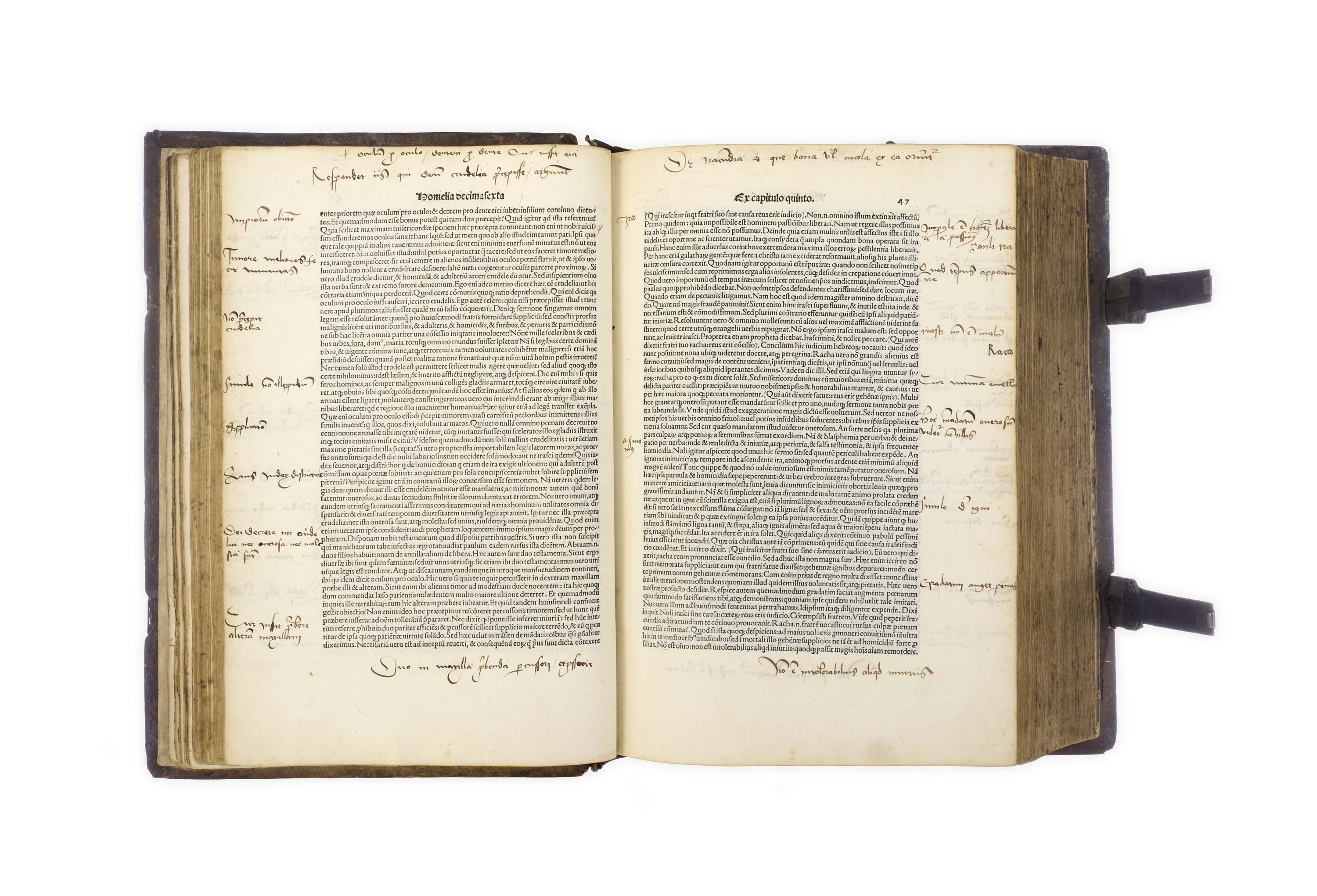
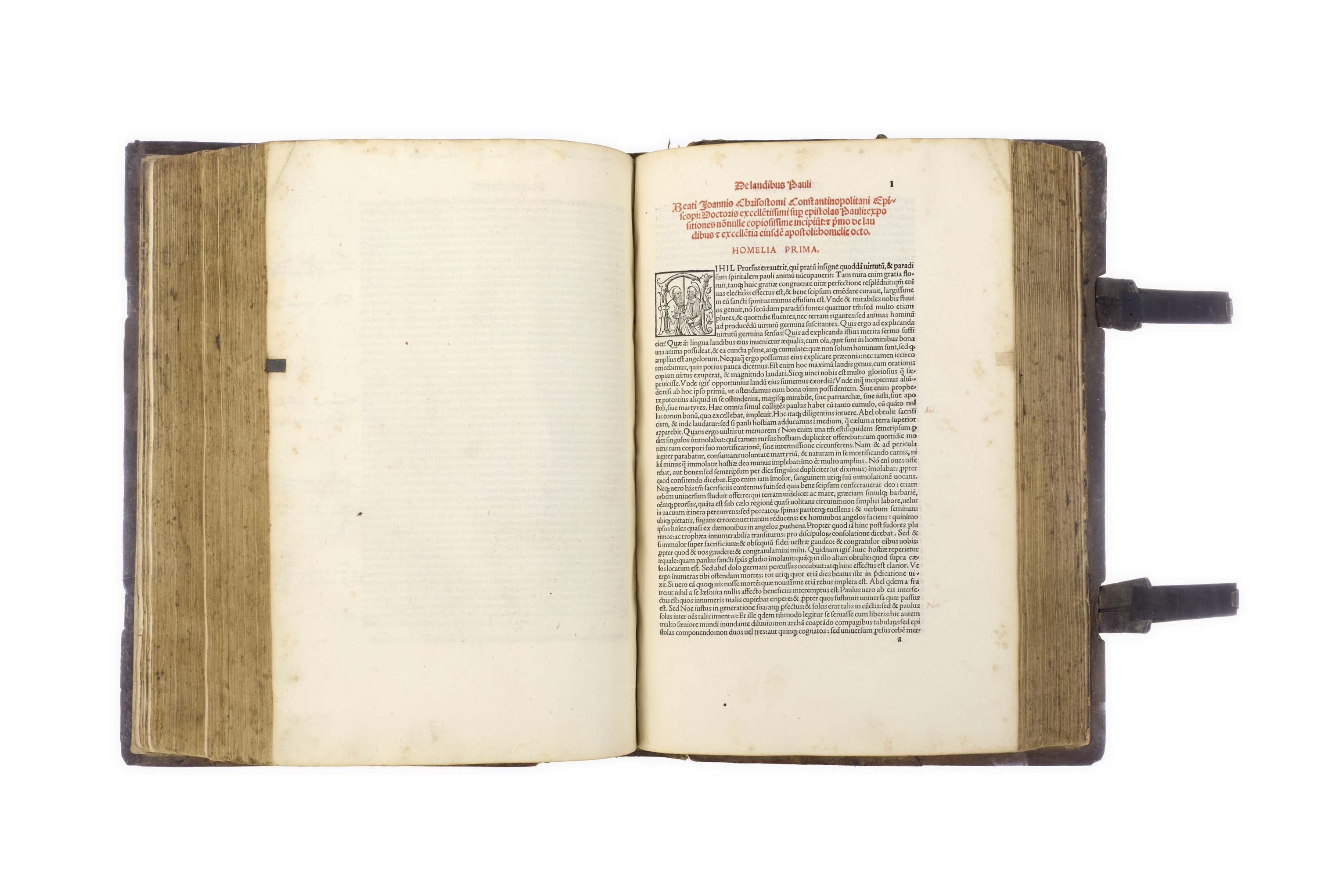
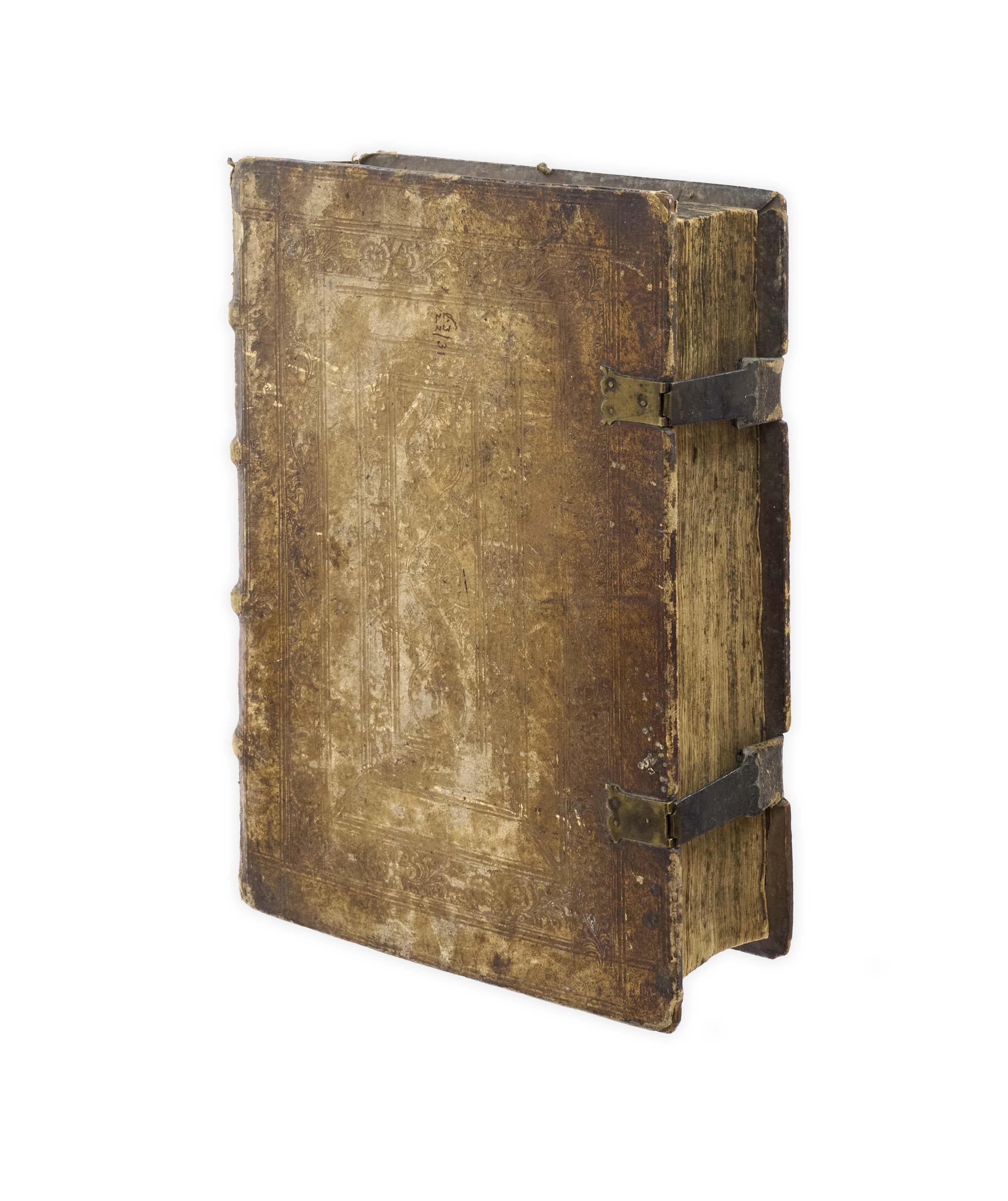
Vol. II only (of II), folio, ff. [xvi], 184, 117, [1, blank], ‘168’ [recte 169]; bound without final blank leaf x10; roman type but with title-page, headlines and some incipits in gothic, a few (roman) incipits printed in red, woodcut initials, woodcut de’ Gregori device at end of index (with initials ZG, for Giovanni/Zuane de’ Gregori, Gregorio’s brother); inscriptions washed from title, occasional light marginal soiling or foxing, title tipped in, but a very good copy; bound in contemporary German blind-stamped pigskin over wooden boards, concentric frames made from two different foliate and floral roll tools, a central panel of undulating leafy stems filled with a small foliate stamp (repeated at corners and alongside spine bands), rear free endpaper with watermark of a cardinal’s hat (Briquet 3404, early sixteenth-century, NE Italy and Transylvania; also used in Innsbruck in 1511), two brass clasps to fore-edge, edges stained blue (faded), remains of index tabs, some deckle edges, sewn on 4 double cords laced and pegged, spine lined with manuscript waste; binding somewhat rubbed and soiled with some losses to rear cover, short crack to front joint, front pastedown renewed and front free endpaper absent; numerous Latin annotations on c. 336 pp. throughout, in one confident sixteenth-century Germanic hand; ownership inscription of Dr Franz Hablitzel at foot of front pastedown, extract from a German sale catalogue to front pastedown.
Added to your basket:
[Opera] Que in secondo volumine continentur super Mattheum homiliae … super Joannem homiliae … de laudibus Pauli homiliae … in ep[isto]lam ad Titum homiliae … ad haebreos [sic] homiliae … ad thimotheum homiliae … adversus vituperatores vitae monasticae libri …
The second volume of the first collected edition of John Chrysostom’s sermons on the New Testament and the monastic life, a wide-margined copy with extensive annotations.
The preface to the homilies on the Gospel of John by Francesco Griffolino is addressed to Cosimo de’ Medici, reinforcing the interest in Chrysostom shown by fifteenth-century Florentine humanism. The volume concludes with the treatise against critics of the monastic life, with a preface by Ambrogio Traversari (1386–1439), a Camaldolese monk from Florence who translated several of Chrysostom’s works into Latin. He completed his translation on 28 March 1417, seeing in Chrysostom’s writings the use of humanist culture to reinvigorate monastic life. Traversari also translated the group of Chrysostom’s homilies he called ‘Contra Judeos’.
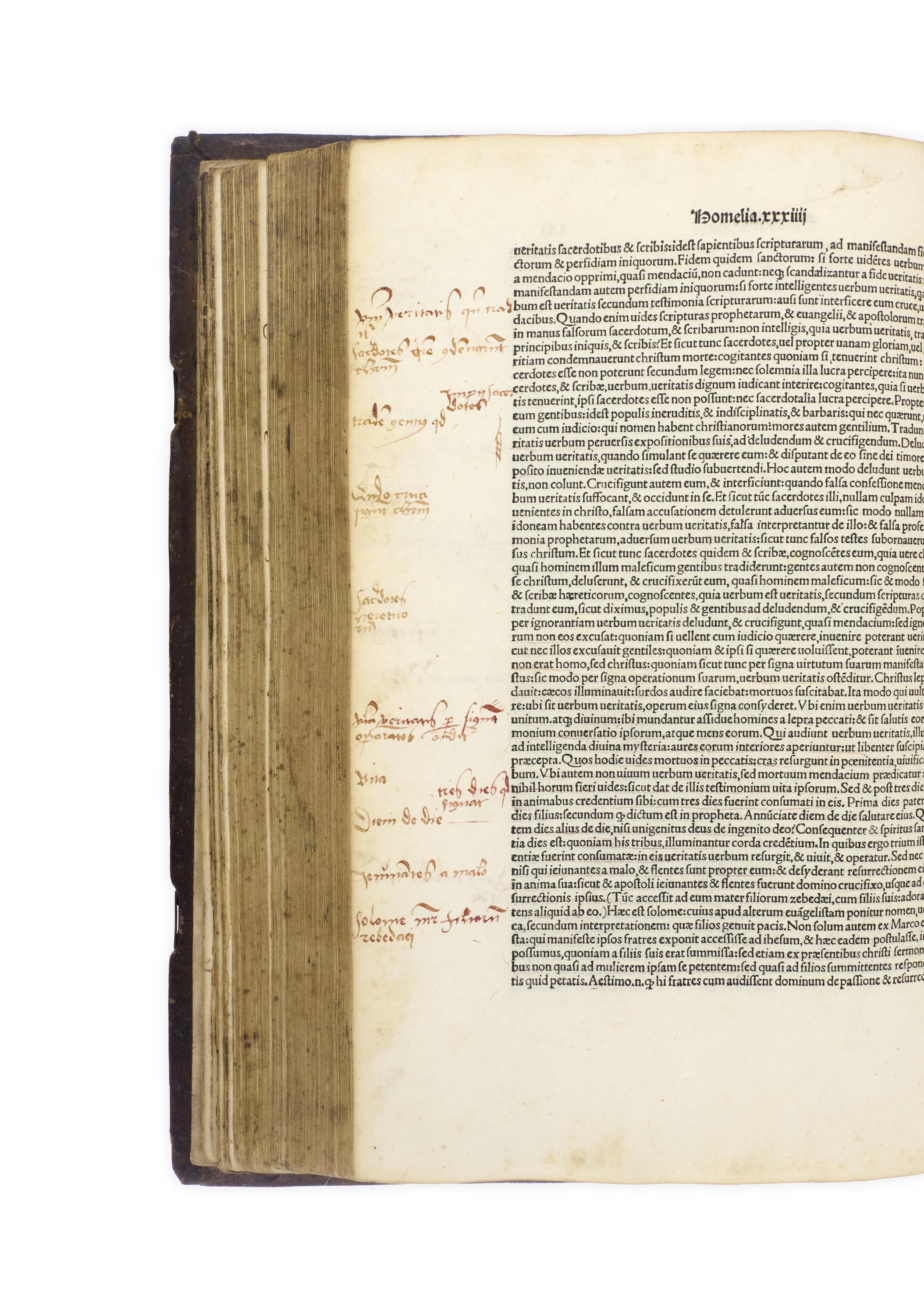
The annotations are for the most part in a fluent Germanic hand, in dark brown or occasionally red ink, repeating words and phrases from the text but also clarifying references and allusions by Chrysostom which might not be immediately evident. The notes predominantly appear down the margins, occasionally extending to the head or foot of a page when a longer note is required, and are focused on particular sermons rather than being spread throughout the volume.
Chrysostom harboured an antipathy to the Jews, which is evident in these sermons and also reflected in the annotations. On f. 17r, in the sixth homily on the Gospel of Matthew, in which Chrysostom berates the Jews for disregarding the birth of Jesus as the Messiah, the annotator notes ‘Torpor & languor Iudeorum’ (the laziness and sluggishness of the Jews); the following homily continues the theme, adding condemnation of King Herod (‘malicia & furor Herodis’), who is also called ‘Herodes Diabolus’ (Herod the devil) on f. 83v. The conversion of Christians to Judaism was not uncommon at this time, and Chrysostom’s preaching sought to prevent such conversion, and indeed general church policy at this time sought to limit the mixing of communities. The opposition to secular vices is noted in the headline to f. 21r, ‘Contra spectatores in theatro’ (Against the spectators in the theatre) and mention is made of ‘Judas & Theodas conspiratores’ on f. 27v; this is Judas of Galilee and Theudas, both leaders of uprisings against the Romans in the early first century AD, and both recorded (negatively) by Josephus in his Jewish War. Other notes in homily 40, which opens with a statement about how easily women are influenced, state ‘Serpentes sunt heretici’ (‘heretics are snakes’, f. 163v) and repeat Chrysostom’s condemnation of Jewish priests as heretics.
We have located copies of just this volume in Wisconsin and Durham, and of both volumes in Yale, Boston College, and Corpus Christi Oxford.
For both volumes, see EDIT16 CNCE 33769; USTC 762277.