Unphilosophical Philosophers
DIOGENES LAERTIUS; Henri ESTIENNE, editor.
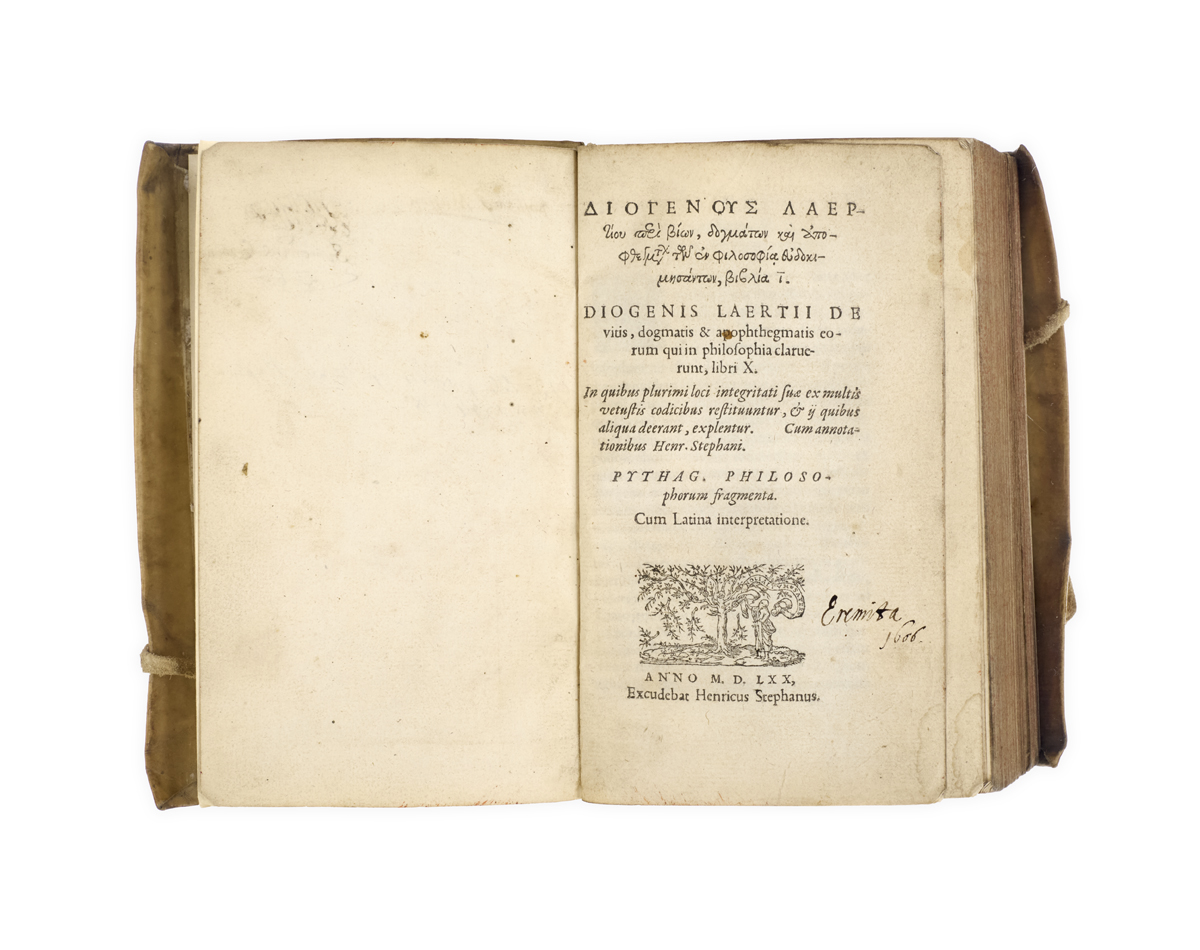
Περι βιων, δογματων και αποφθεγματων εν φιλοσοφια ευδοκιμησαντων, βιβλια ι … De vitis, dogmatis & apophthegmatis eorum qui in philosophia claruerunt, libri X … Pythag. Philosophorum fragmenta. Cum Latina interpretatione. [Geneva], Henri Estienne, 1570.
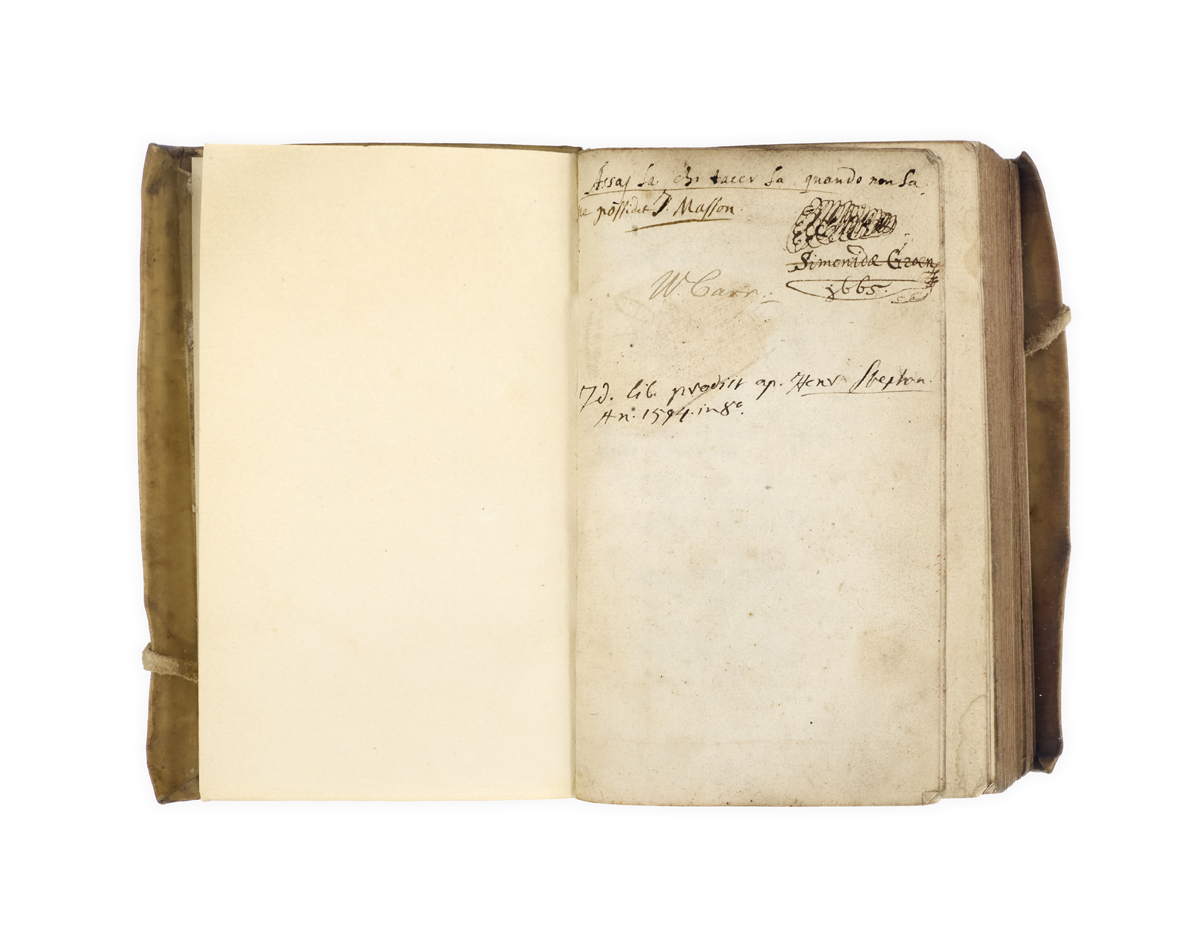
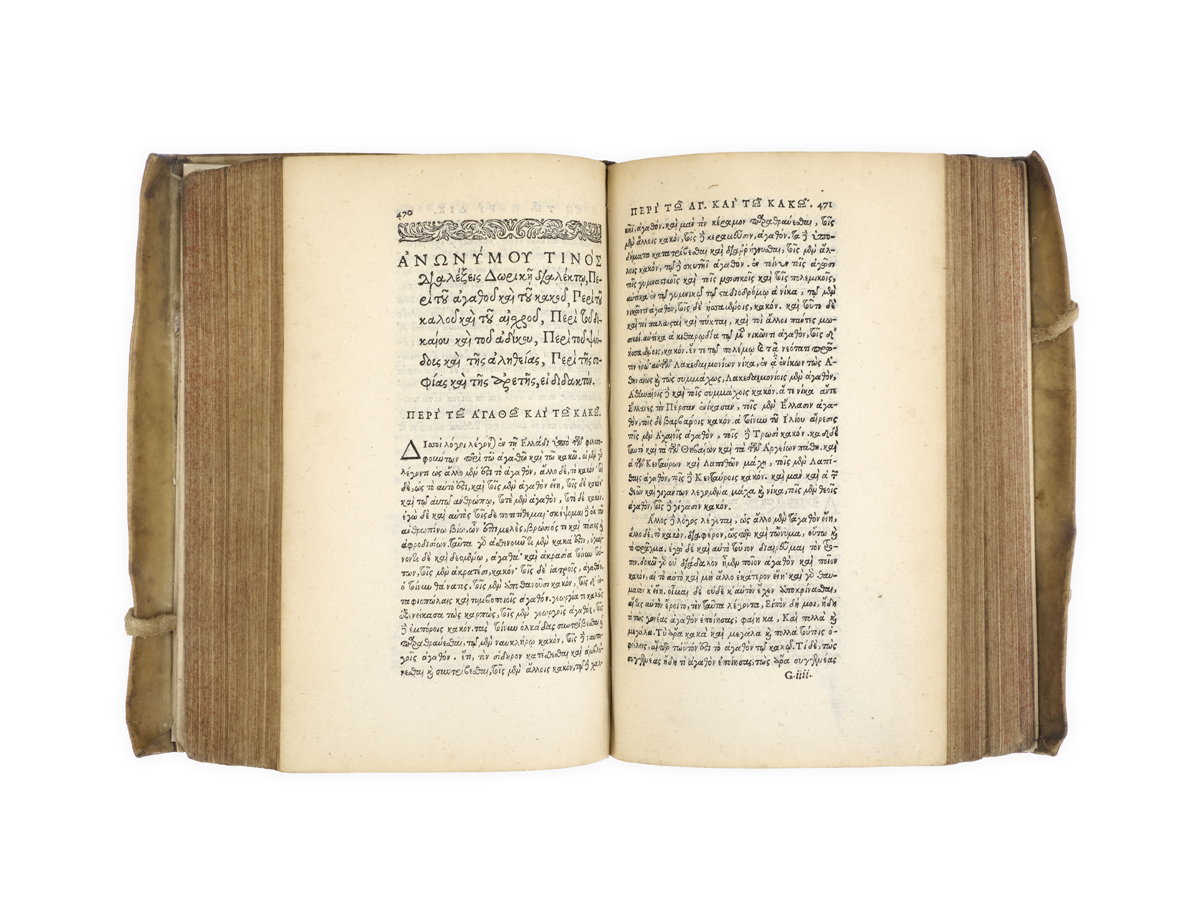
Two parts in one volume, 8vo, pp. 8, 494, [2, blank]; 40, 432; printed in Greek and in Latin, woodcut printer’s device to title-page (Schreiber 16), woodcut initials and headpieces; slight dampstaining to outer corners of first leaves, otherwise a very good copy; contemporary vellum with yapp fore-edges; recased, endpapers, ties, and thongs renewed; textblock splitting at foot between a2 and a3; inscription ‘Eremita | 1606’ to title, inscriptions ‘Simonidæ Groen | 1665’, ‘Me possidet J. Masson’, and ‘W. Carr’ to original front flyleaf (see below).
Added to your basket:
Περι βιων, δογματων και αποφθεγματων εν φιλοσοφια ευδοκιμησαντων, βιβλια ι … De vitis, dogmatis & apophthegmatis eorum qui in philosophia claruerunt, libri X … Pythag. Philosophorum fragmenta. Cum Latina interpretatione.
First Estienne edition of The Lives of the Philosophers, the main surviving source of information on many Greek philosophers and their writings, including quotations from works now lost.
Diogenes Laertius compiled his Lives probably in the early third century AD, often making use of earlier compilations and helpfully naming his sources. The Greek text was originally printed in 1533, but Estienne used manuscripts with additional sections of text which were incorporated for the first time into this edition, including a manuscript from Cardinal Bessarion’s library which he had borrowed in 1555. The Latin translation is that of Ambrogio Traversari, composed c. 1424–1433 and first printed in 1472, and the Pythagorean fragments were edited with notes by the Utrecht scholar Willem Canter (1542–1575).
Estienne was not, however, uncritical of Diogenes’ text: ‘In his preface he is critical of Diogenes’ subjects, explaining that while there are philosophical aspects to the Lives, the men in them are hardly worthy of the title of “philosophers.” Estienne, by separating the philosophical life from the possible lives of those whom Diogenes calls philosophers, was drawing a clear line between a collection of disparate philosophies and “the” philosophy, which could only come from a sacred text’ (Calhoun, Montaigne and the Lives of the Philosophers, 2015, pp. 87–88).
Provenance:
Likely from the library of the French Protestant antiquarian Jean Masson (1680–1750) who was in the Netherlands and then in England in the early eighteenth century, working under the patronage of William Lloyd, Bishop of Worcester, in his research on biblical chronology.
USTC 450603; Adams D 482; GLN 15–16 2405; Schreiber, The Estiennes 178.