Eudist Instructions
[EUDISTS.]
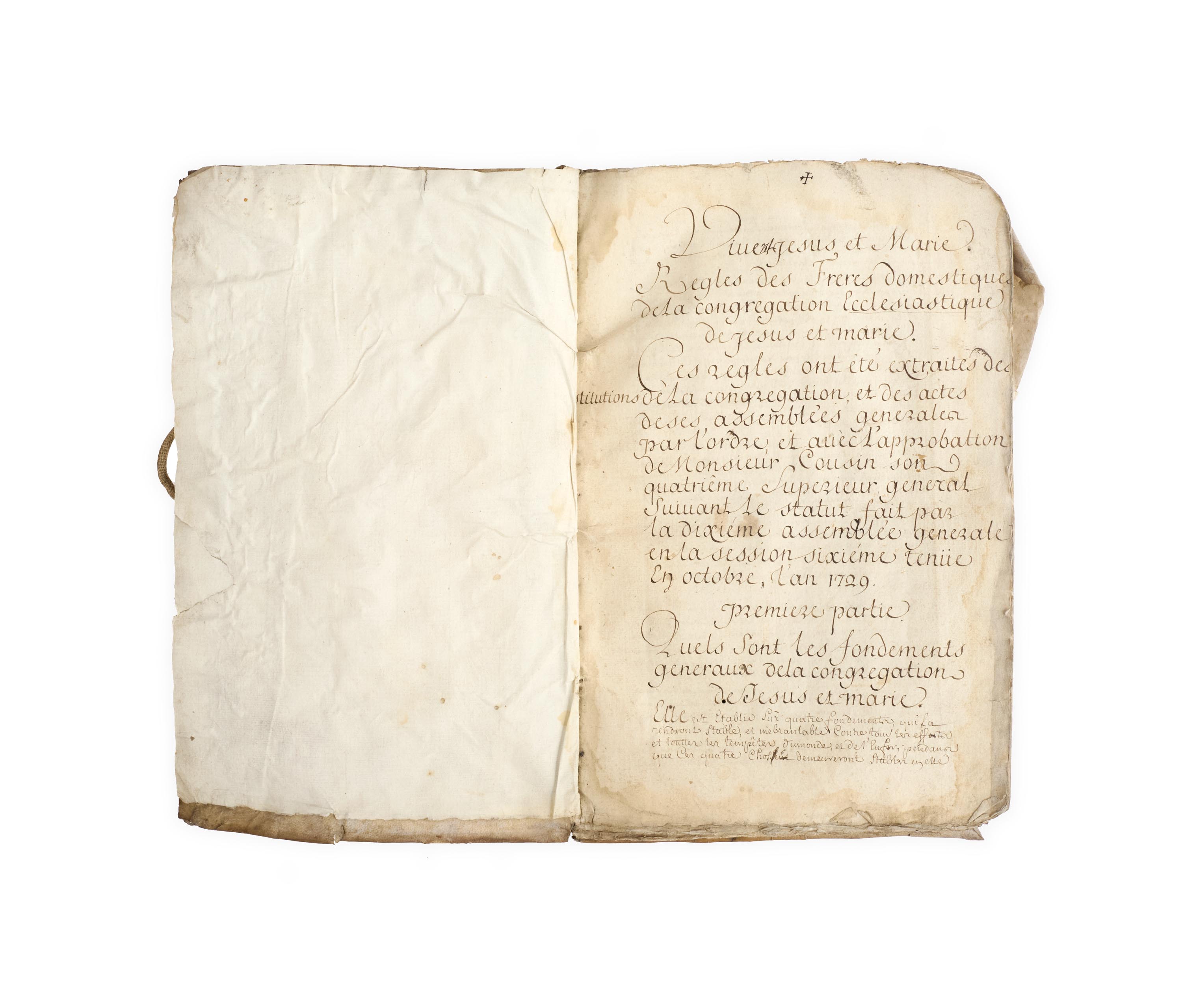
‘Vive Jesus et Marie. Regles des freres domestiques de la congregation ecclesiastique de Jesus et Marie. Ces regles ont été extraites des constitutions de la congregation, et des actes de ses assemblées generales par l’ordre, et avec l’approbation de Monsieur Cousin son quatrième superieur general suivant le statut fait par la dixième assemblée generale en la session sixième tenue en octobre, l’an 1729’. [Northwestern France, c. 1730].
Manuscript on paper, in French, small folio (290 x 200 mm), pp. [60]; neatly written in brown ink in a single hand, c. 40 lines per page, extensive marginal notes (slightly trimmed) to p. [32], occasional corrections; some light marginal dampstaining and cockling, a few small marginal chips, one small wormhole, else good; crudely stab-stitched in contemporary limp vellum wrappers, single tie to upper fore-edge; loss at foot of spine, stained and worn, text-block projecting at fore-edge and head.
Added to your basket:
‘Vive Jesus et Marie. Regles des freres domestiques de la congregation ecclesiastique de Jesus et Marie. Ces regles ont été extraites des constitutions de la congregation, et des actes de ses assemblées generales par l’ordre, et avec l’approbation de Monsieur Cousin son quatrième superieur general suivant le statut fait par la dixième assemblée generale en la session sixième tenue en octobre, l’an 1729’.
A most interesting manuscript detailing the regulations governing the brothers of the Congregation of Jesus and Mary, an ecclesiastical society dedicated to the education of priests in seminaries and to missions, founded at Caen in Normandy in 1643 by Jean Eudes (1601–1680).
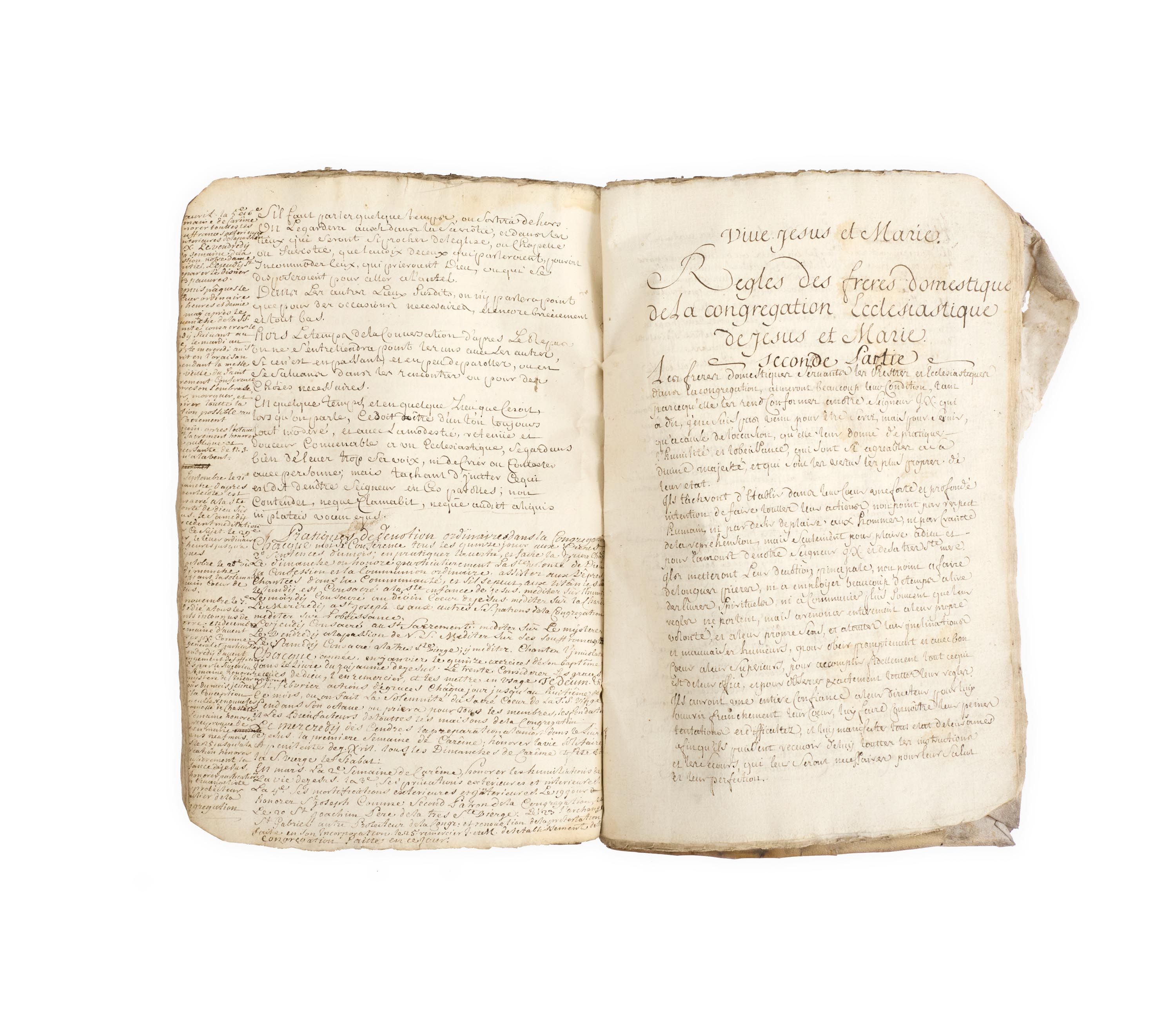
After explaining the four foundations upon which the Congregation is based, to render it ‘unshakeable’ against ‘the tempests of the world and of Hell’, as well as its ‘spirit’, the text turns to the qualities expected of the brothers. It then provides guidance on practising humility (‘Never disdain what one is given to eat as vile, simple, poor, and ill prepared … recalling that we deserve to be eternally tormented with hunger and thirst with the damned’); obedience; poverty; chastity; sobriety (cider is permitted but jams and sugar are not); modesty; and simplicity (‘be simple like doves’). Some of the advice is clearly directed at children, such as prohibitions against shouting or running around for no reason, staring at people (especially women), and enticing dogs and cats into one’s room. Passages then follow on being truthful in one’s speech and promises, and on silence. Further notes have been added on p. [32] regarding devotional practice on particular days of the year, at the bottom of the page and down the entire outer margin.
The second part comprises regulations governing ‘les frères domestiques’ (no eating in one’s room, no leaving the windows open at night, no reading in bed by candlelight etc.) as well as rules for specific office holders. The porter is forbidden from nattering to women; the cook is instructed to serve food with a knife and fork, not with his fingers and hands; the nurse is directed to ensure that rooms are kept clean and equipped with pious images and flowers; and the gardener is counselled to grow herbs and flowers but not ‘vain curiosities or fashions’. Considerable attention is paid to the proper care of barrels of cider.
The ‘Monsieur Cousin’ mentioned in the title is Pierre Cousin, Superior General of the Congregation from 1727 until 1751.