Hebrew Printing at Padua
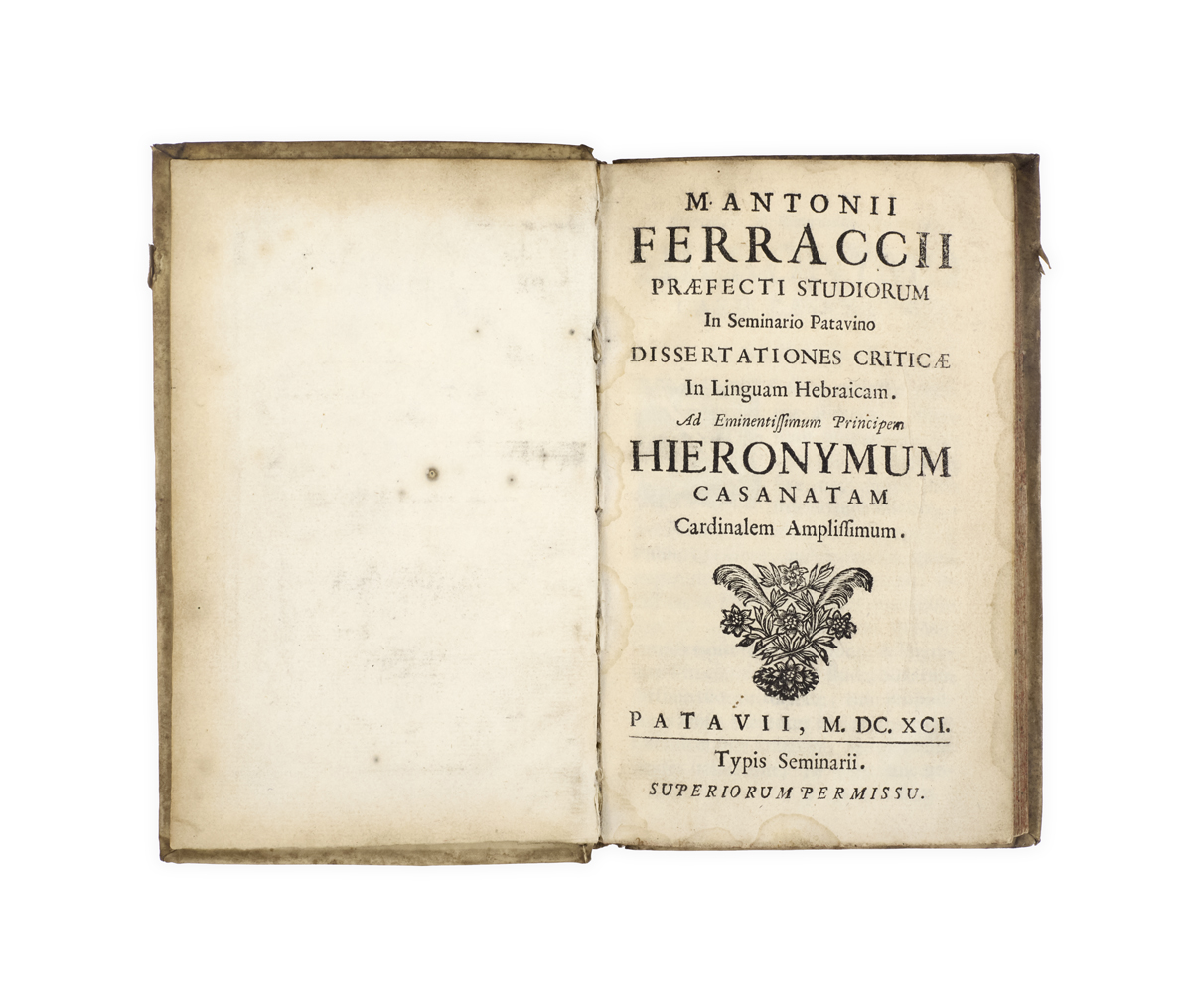
FERRAZZI, Marc’Antonio.
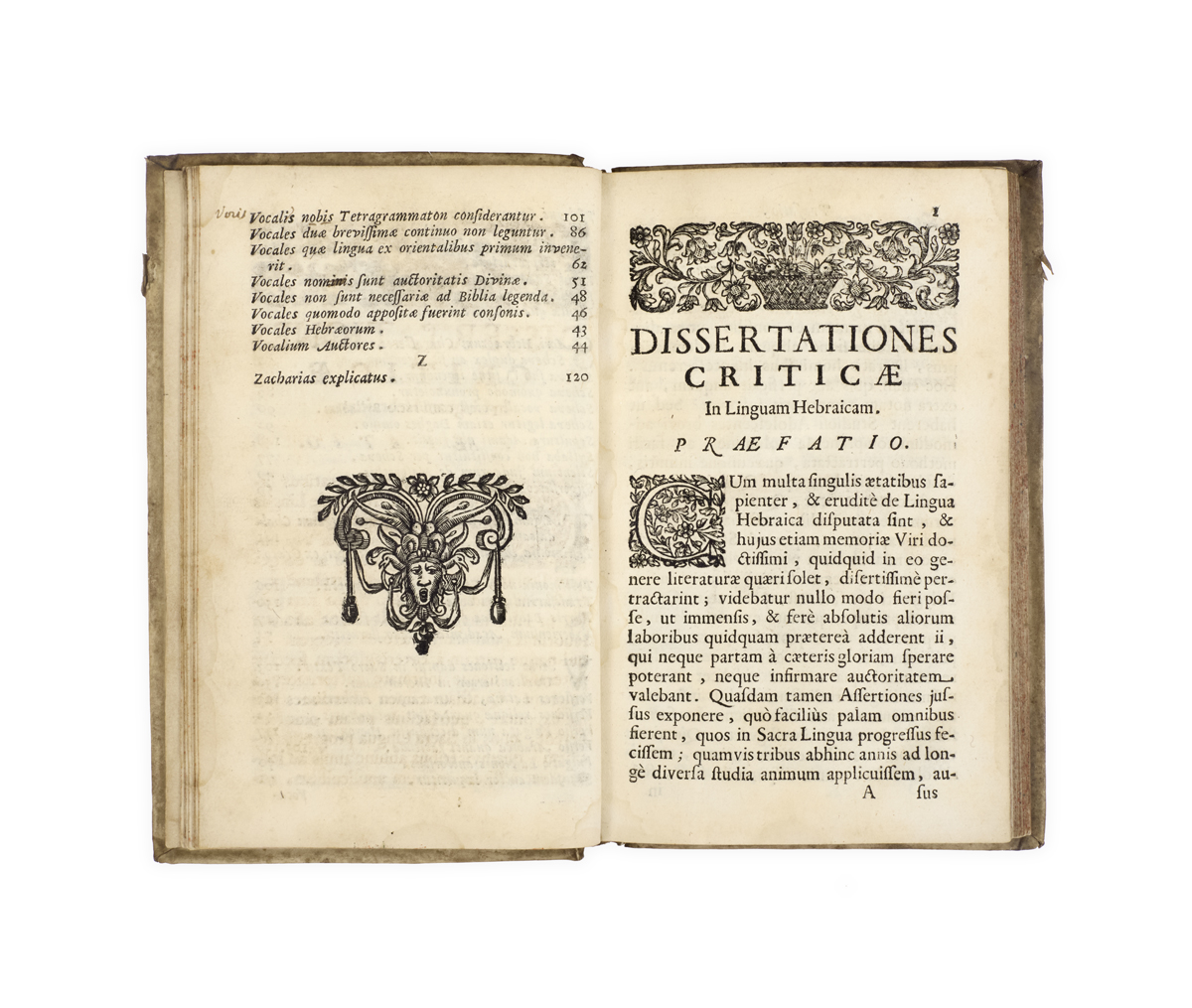
Dissertationes criticae in linguam hebraicam … Padua, ‘Typis Seminarii’, 1691.
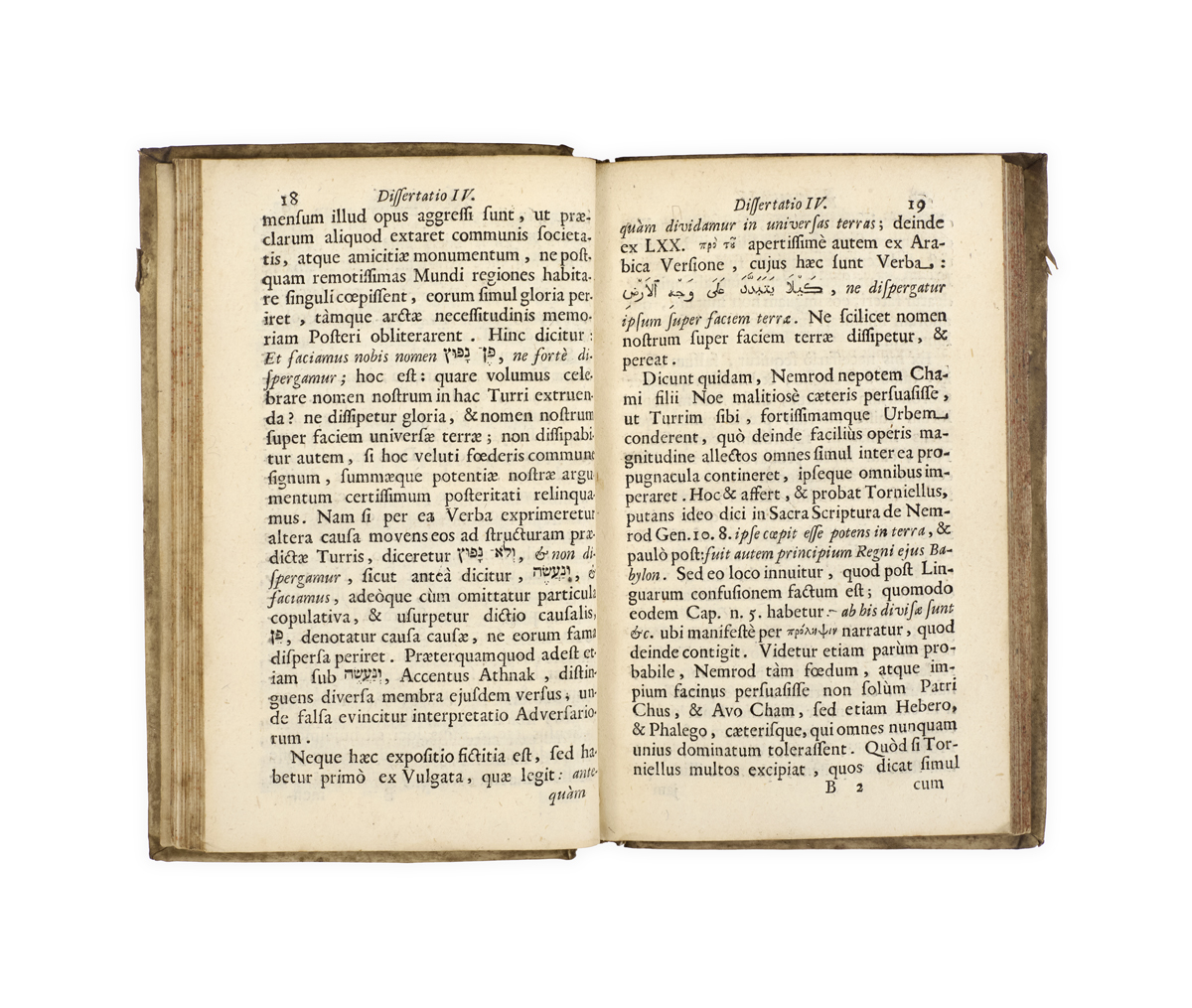
8vo, pp. [xvi], 160; text in Latin, interspersed with Hebrew, Arabic, Syriac, and Aramaic; woodcut ornament to title, woodcut initials, head-, and tailpieces; very slight marginal dampstaining to first and final leaves, nonetheless a very good copy; bound in contemporary Dutch vellum over boards, sewn on three vellum thongs laced in, edges speckled red and green; somewhat dust-stained, short crack at head of front joint; contemporary manuscript correction in ink to p. [xvi].
Rare first edition of this philological treatise on the Hebrew language by the prefect of the episcopal seminary of Padua, who would be instrumental in shaping the seminary’s newly reformed curriculum.
The Tipografia del Seminario di Padova had been established in 1684 under Cardinal Gregorio Barbarigo, Bishop of Padua, following an increased push to instruct trainee Paduan priests in Semitic languages. To avoid having to outsource the printing of books for their instruction, Barbarigo was gifted matrices in Hebrew and Arabic by Cosimo III, Grand Duke of Tuscany, Antonio Renato Borromeo, head of the Ambrosiana in Milan, and Cardinal Girolamo Casanate, Vatican Librarian from 1693 and the dedicatee of the present work. The expansion of printing was closely tied to Barbarigo’s ratio studiorum, or study plan for the seminary, introduced a year before the publication of the present work, refined over the course of nineteen years, and reliant on the author’s contributions: ‘It is evident that Barbarigo did not work alone, nor did he rely solely on his own experience … but he availed himself of the precious contribution of the prefect of studies M. A. Ferrazzi’ (Seminario di Padova, online, trans.).
In a series of thirty dissertationes, Ferrazzi (or Ferracci, 1661–1748) here discusses the etymology of the word ‘Hebrew’, Aramaic and Syriac, the use of the double schva, the schva when used with a guttural ה, the paragogic א, written renderings of the names of God, and explications of Jeremiah, Isaiah, Habakkuk, and Psalm 67:19.
OCLC finds only two copies outside continental Europe (BL, Glasgow); no copies traced in the US.