A Success That Beggars Belief
GAY, John.
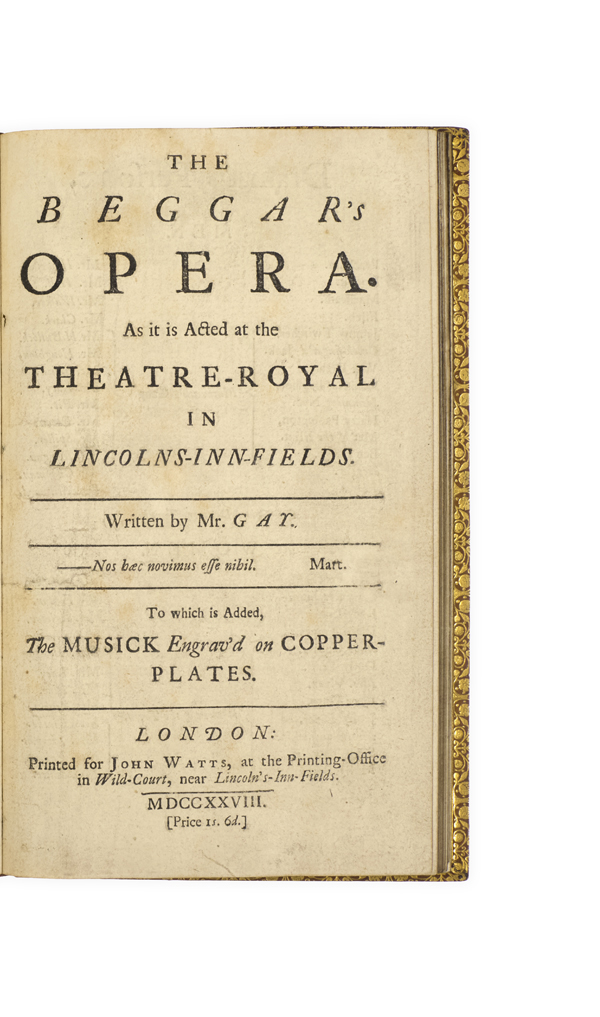
The Beggar’s Opera. As it is acted at the Theatre-Royal in Lincolns-Inn-Fields … to which is added, the Musick engrav’d on Copper-Plates. London, John Watts, 1728.
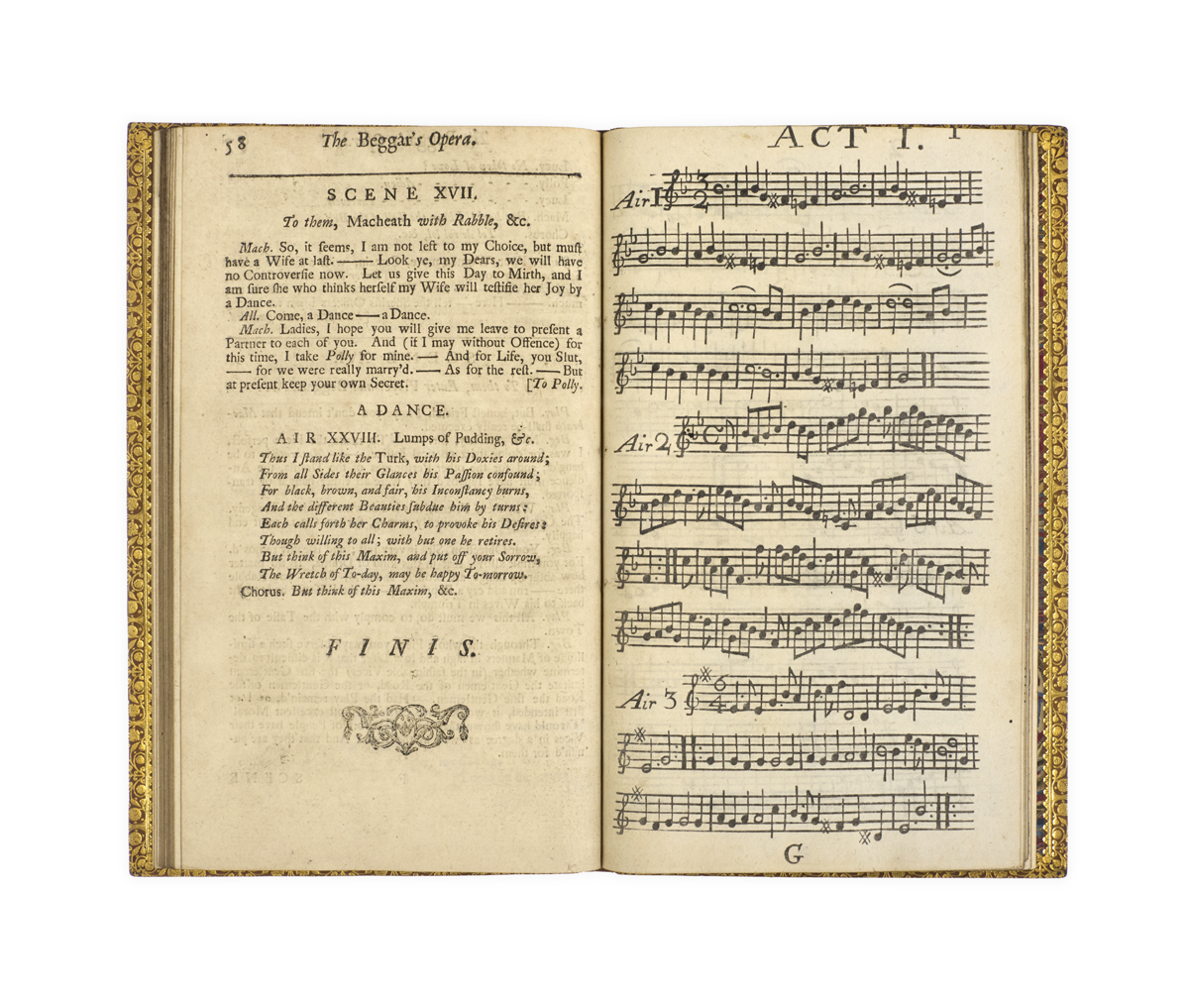
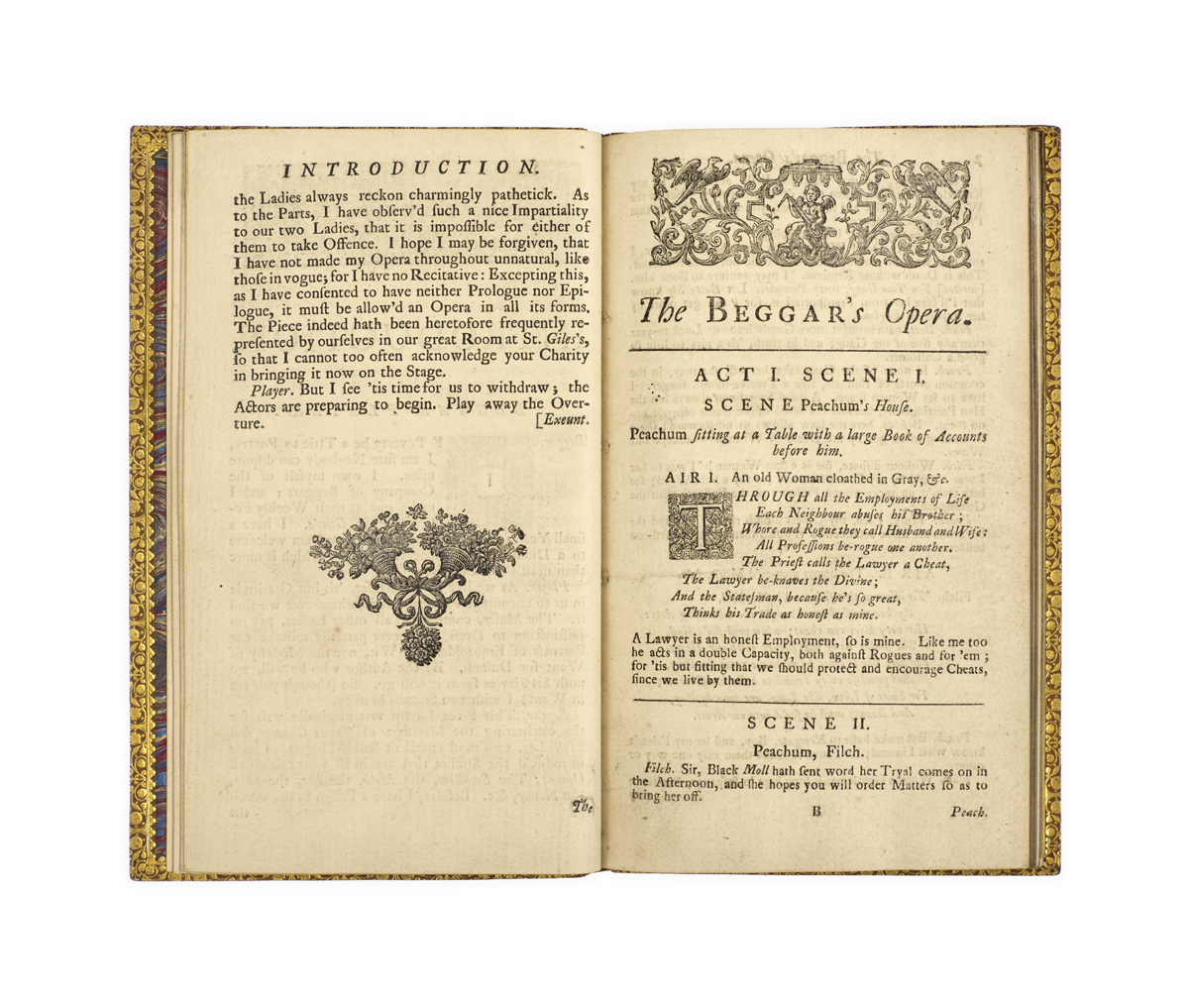
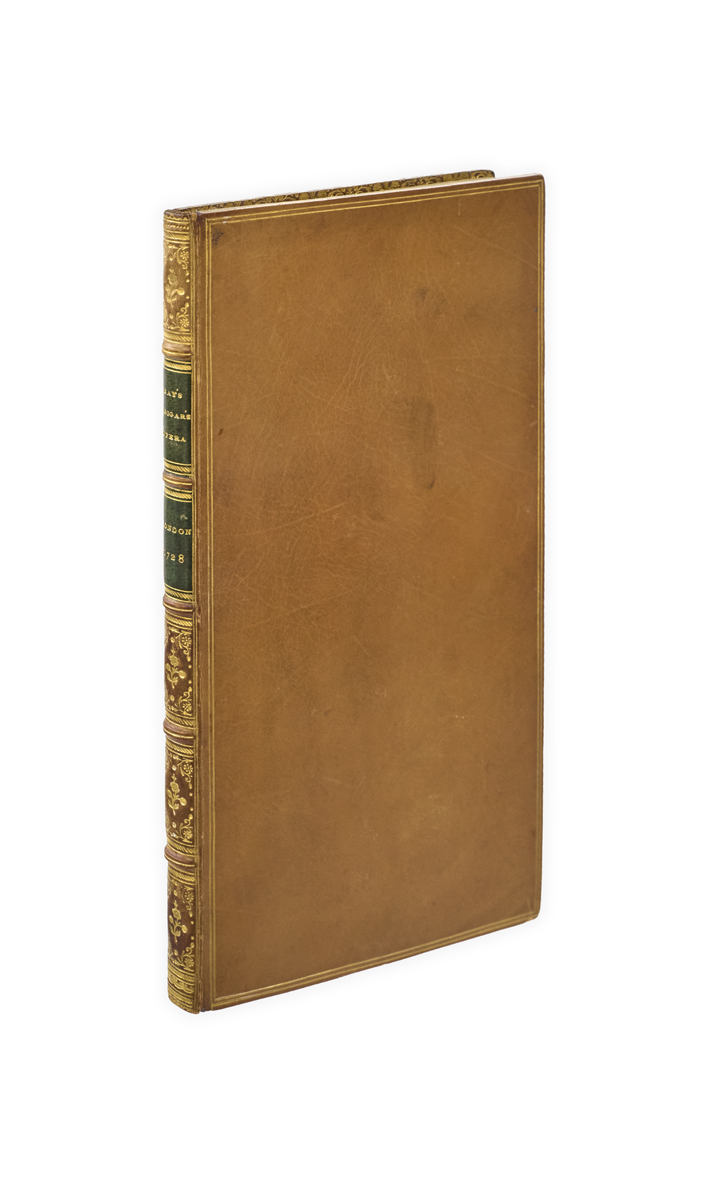
8vo, pp. [4], 58, 16 (engraved music); bound without the terminal advertisement leaf; engraved music slightly trimmed, otherwise a very good copy; bound in nineteenth-century polished calf by W. Pratt, spine gilt in compartments with gilt green morocco lettering-pieces, edges gilt, marbled endpapers; armorial bookplate of Francis R. C. Grant to front pastedown.
Added to your basket:
The Beggar’s Opera. As it is acted at the Theatre-Royal in Lincolns-Inn-Fields … to which is added, the Musick engrav’d on Copper-Plates.
First edition, first issue, of the greatest of the ballad operas, perennially popular since its first performance on 29 January 1728.
First staged at Lincoln’s Inn Fields under John Rich, it took the town by storm, achieving a remarkable run of sixty-odd nights in its first season, and thus reportedly ‘making Gay rich and Rich gay’. ‘The work combines comedy and political satire in prose interspersed with songs set to contemporary and traditional English, Irish, Scottish, and French tunes. In it, Gay portrays the lives of a group of thieves and prostitutes in eighteenth-century London. The action centres on Peachum, a fence for stolen goods; Polly, his daughter; and Macheath, a highwayman. Gay caricatures the government, fashionable society, marriage, and Italian operatic style. Particularly evident are parallels made between the moral degeneracy of the opera’s protagonists and contemporary highborn society’ (Britannica).
The first issue was printed without the air ‘A Cobler there was, &c.’ and the accompanying three bars of letterpress music on p. 53, added as an afterthought after the rest of the music had been engraved and thus causing a rearrangement of the type through the rest of the book in the second issue. The perennially problematic T. J. Wise proposed an alternative sequence, with the music inexplicably removed after the first issue, but has since been discredited.
Rothschild 928; Wise, Ashley Library II, pp. 139-140.