‘First Take Water of Rue…’
[GULIELMUS de Lavicea.]
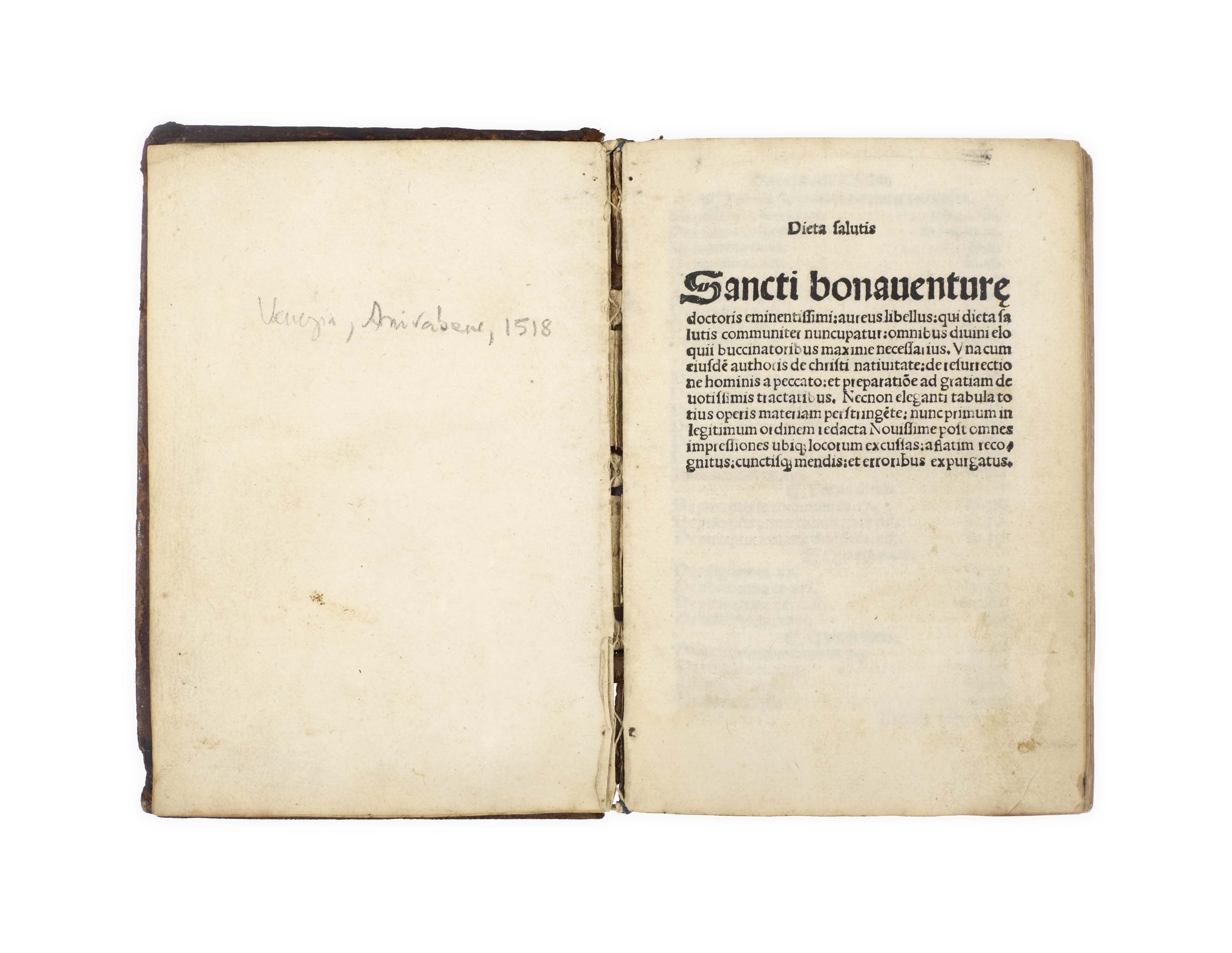
Dieta salutis. Sancti Bonaventure doctoris eminentissimi: aureus libellus: qui dieta salutis communiter nuncupatur: omnibus divini eloquii buccinatoribus maxime necessarius … [(Colophon:) Venice, Cesare Arrivabene, 24 December 1518.]
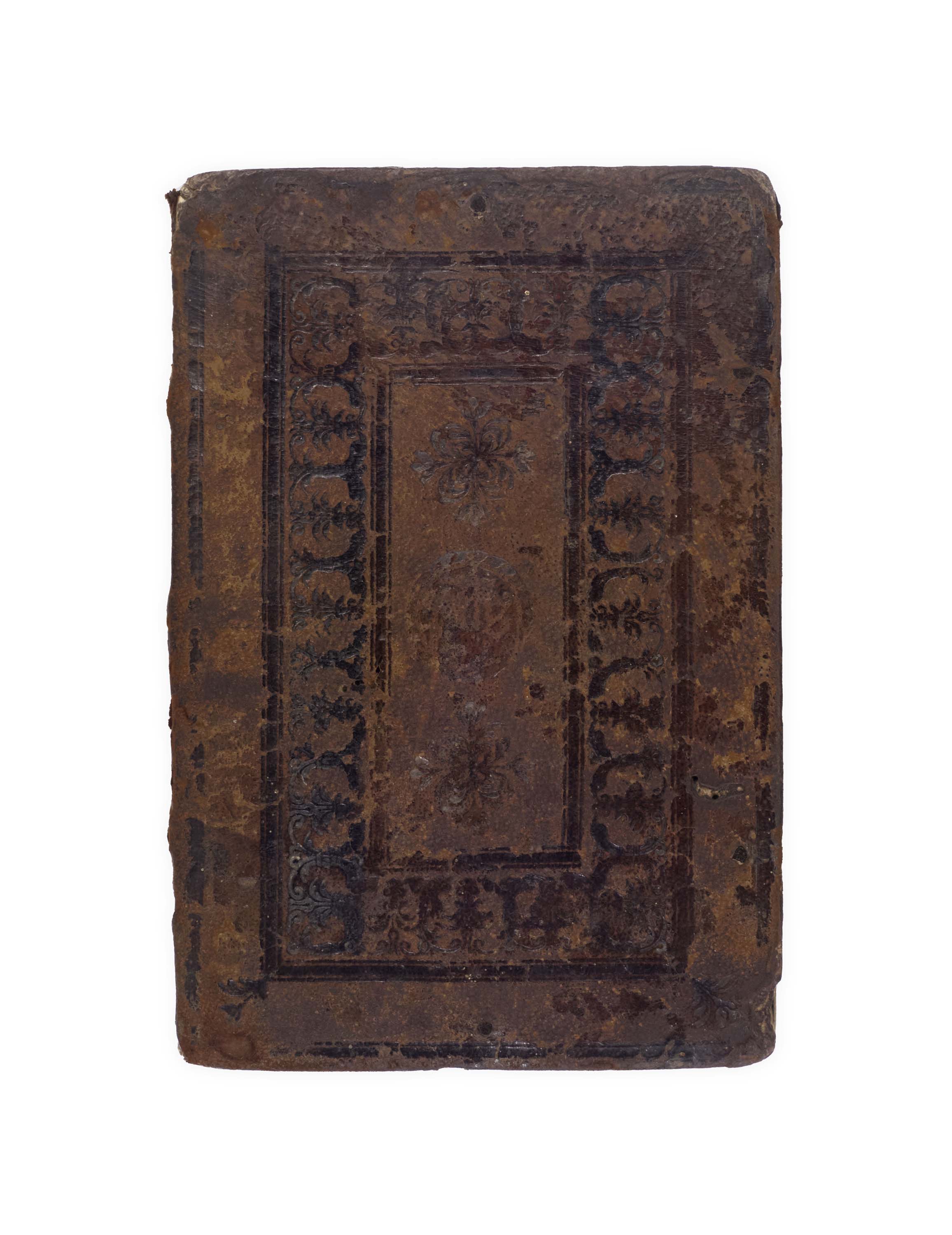
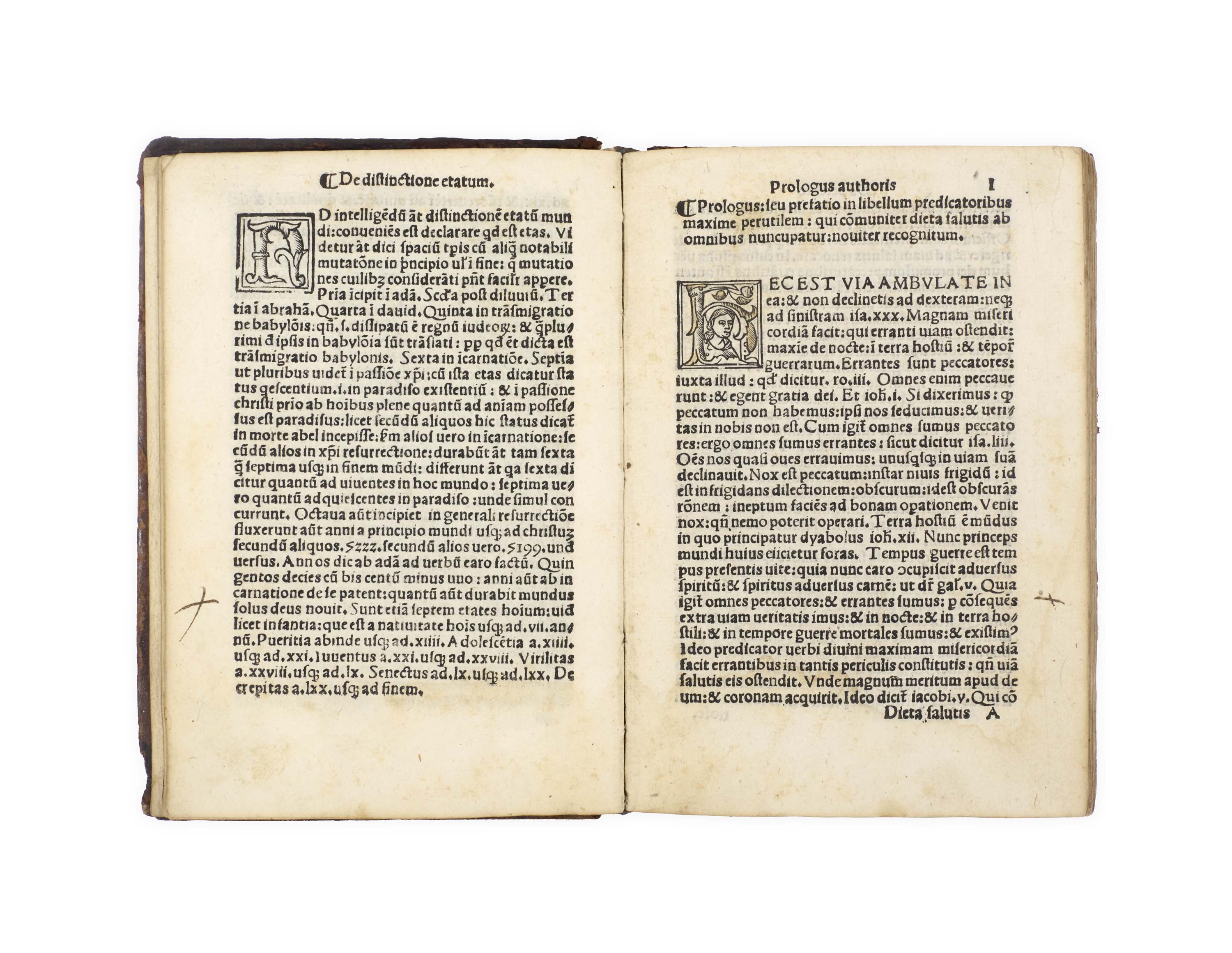
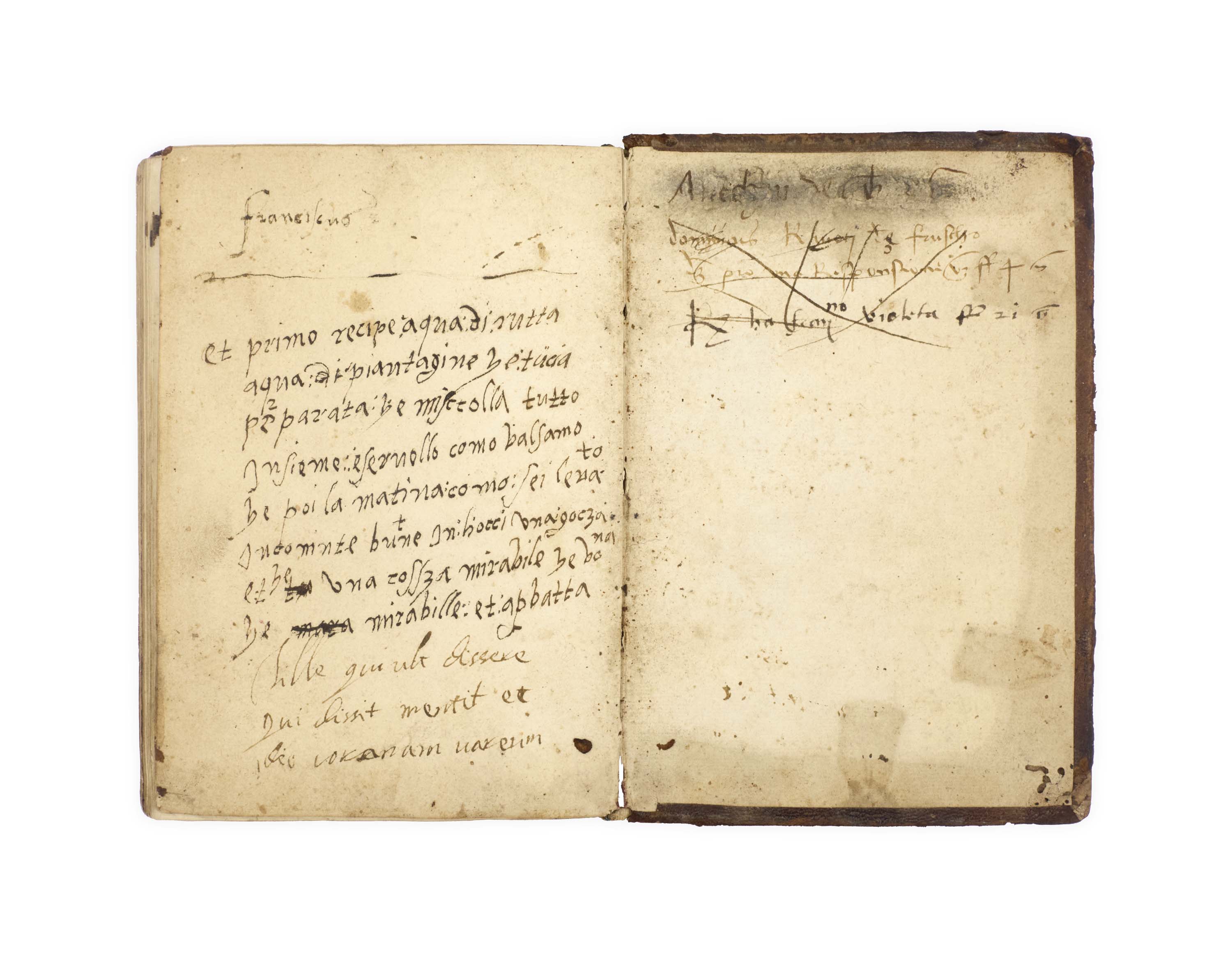
8vo, ff. [xvi], CXLIII, [1, device only]; woodcut initials, woodcut printer’s device to final recto; very lightly damp-stained at foot, but a very good copy; bound in contemporary Florentine(?) blind-stamped calf over pasteboard, a frame composed of a repeated leafy stamp within a blind fillet border with corner fleurons, centre of boards with a central round IHS sacred name stamp and two composite stamps (made from four of the corner fleuron stamps) above and below, spine with remains of a longitudinal manuscript title, plain edges, stubs from four pairs of ties; binding rubbed with a some defects, IHS stamps rubbed away, spine very rubbed and defective; sixteenth-century manuscript recipe in Italian written in a shaky hand on rear flyleaf, other early notes on inside lower cover (partly crossed through), late seventeenth-century inscription on second flyleaf ‘Emilius Laurentius bonus'.
Added to your basket:
Dieta salutis. Sancti Bonaventure doctoris eminentissimi: aureus libellus: qui dieta salutis communiter nuncupatur: omnibus divini eloquii buccinatoribus maxime necessarius …
A compilation of Franciscan devotional works attributed to St Bonaventure in a contemporary Florentine(?) blind-stamped binding, with a manuscript recipe in Italian written at the end of the volume.
Although attributed to St Bonaventure, this devotional text on obtaining salvation through perfection was by Gulielmus de Lavicea (Lanicea, Lancea), a fellow Franciscan from Aquitaine, writing a generation or so after St Bonaventure. The text of Dieta salutis is followed by short works on the Nativity (attributed to Bonaventure but by Johannes de Caulibus) and on the Resurrection and preparation for grace (by Pseudo-Bonaventure). The volume has been supplied with an extensive table of contents at the beginning, to make it easier for preachers (or ‘trumpeters’ as they are called in the title, buccinatores) to find sections for use in sermons, though it also seems to have been devised for the personal use of Franciscan friars.
The binding could be tentatively attributed to the Florentine Dolphin Shop, from the leafy stamp used to create the frame (illustrated in Hobson, Decorated Bookbindings in Renaissance Italy, pp. 225, 226 and 228). Hobson’s census of bindings from this workshop covers books printed in Basel, Milan, Venice and Zwolle, from the 1480s up to 1518. Stamps of the sacred name, originally devised by St Bernardino of Siena, a fellow Franciscan, can be found on bindings across Italy; Hobson even identifies a Sacred Name Shop in Florence (p. 266).
The manuscript recipe on the lower flyleaf seems to be for a medicinal preparation, using water of rue and plantain mixed together; and on taking a drop of it in the morning when you awake, it will be ‘a miraculous and good thing’:
‘Et primo recipe aqua di rutta | aqua di piantagine che tu cia | preparata che mise colla tutto | insieme e servollo como balsamo | che poi la matina como sei levato | incominte br[-?] in[g]hocci una gocza | et che una cossza mirabile che bona | che mirabille et ap[ro?]batta’
The language seems more Tuscan than Venetian, reinforcing the likelihood that this volume reached Florence at an early date.
We have found two copies in the UK (British Library, National Library of Wales), and four in the US (Yale, Harvard, Washington State University, and St Bonaventure University).
EDIT16 CNCE 17165; USTC 835569.