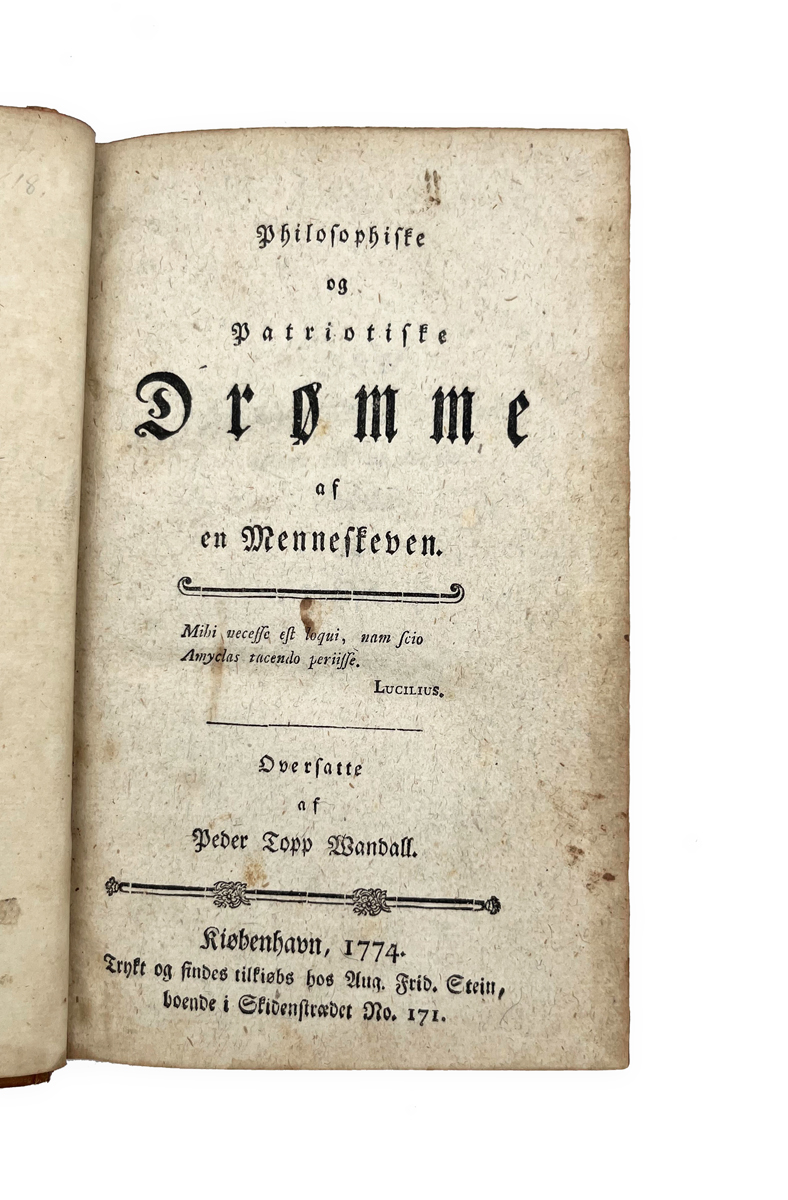

First Danish Edition
[ISELIN, Isaak; Peder Topp WANDALL, translator].
Philosophiske og Patriotiske Drømme af en Menneskeven. Oversatte af Peder Topp Wandall. Copenhagen, Aug. Frid. Stein, 1774.
8vo, pp. [vi], 254; one or two spots, pp. 9–12 with short fore-edge tear not affecting text; a very good copy bound in contemporary sheep, spine decorated with a gilt floral motif in compartments and a gilt morocco lettering-piece; a little worn, joints rubbed, head of spine chipped to expose headband; contemporary ink ownership inscription to front flyleaf, contemporary table of contents in ink to rear flyleaf recto and verso, later bookplate to front pastedown, occasional marginal underlining in pencil.
Added to your basket:
Philosophiske og Patriotiske Drømme af en Menneskeven. Oversatte af Peder Topp Wandall. Copenhagen, Aug.
Very rare first Danish edition of Iselin’s earliest work, the very successful Filosofische und patriotische Träume, translated by the librarian, writer, and dramatist Peder Topp Wandall (1737–1794).
The work was first published in 1755, a couple of years after Iselin’s deeply affecting journey to France, where he met amongst others Rousseau, Fontenelle and Buffon. His reformist version of utopia, a response to Rousseau’s ideal state of nature, aimed at sketching the traits of the optimum government in concrete terms of public administration, social structure, education and legality, and at tracing the history of human progress from barbarism to higher states of civility, which was to be the basis of the organic notion of state, as opposed to Rousseau’s theory of social contract. Iselin’s subsequent articles were infused with natural law arguments, with Leibniz’ and Wolff’s ‘enlightened’ logical tools, and with a practical view of religion as active and beneficial participation in the community.
These early reform-utopian works prepared the ground for Iselin’s encounter with Quesnay’s physiocratic theories: ‘Afterwards [i.e. after the Filosofische und patriotische Träume], by good fortune, the Ephémérides du Citoyen came into his hands, after reading which, Quesnay became in his eyes “what Newton is in the eyes of a mathematician”’ (Palgrave II, p. 459). Iselin became one of the foremost promoters of physiocracy in Switzerland and Germany.
OCLC finds two copies only, both of which in Denmark; not in Library Hub.