
Local Government, Murder, and Football
[JUSTICES OF THE PEACE.]
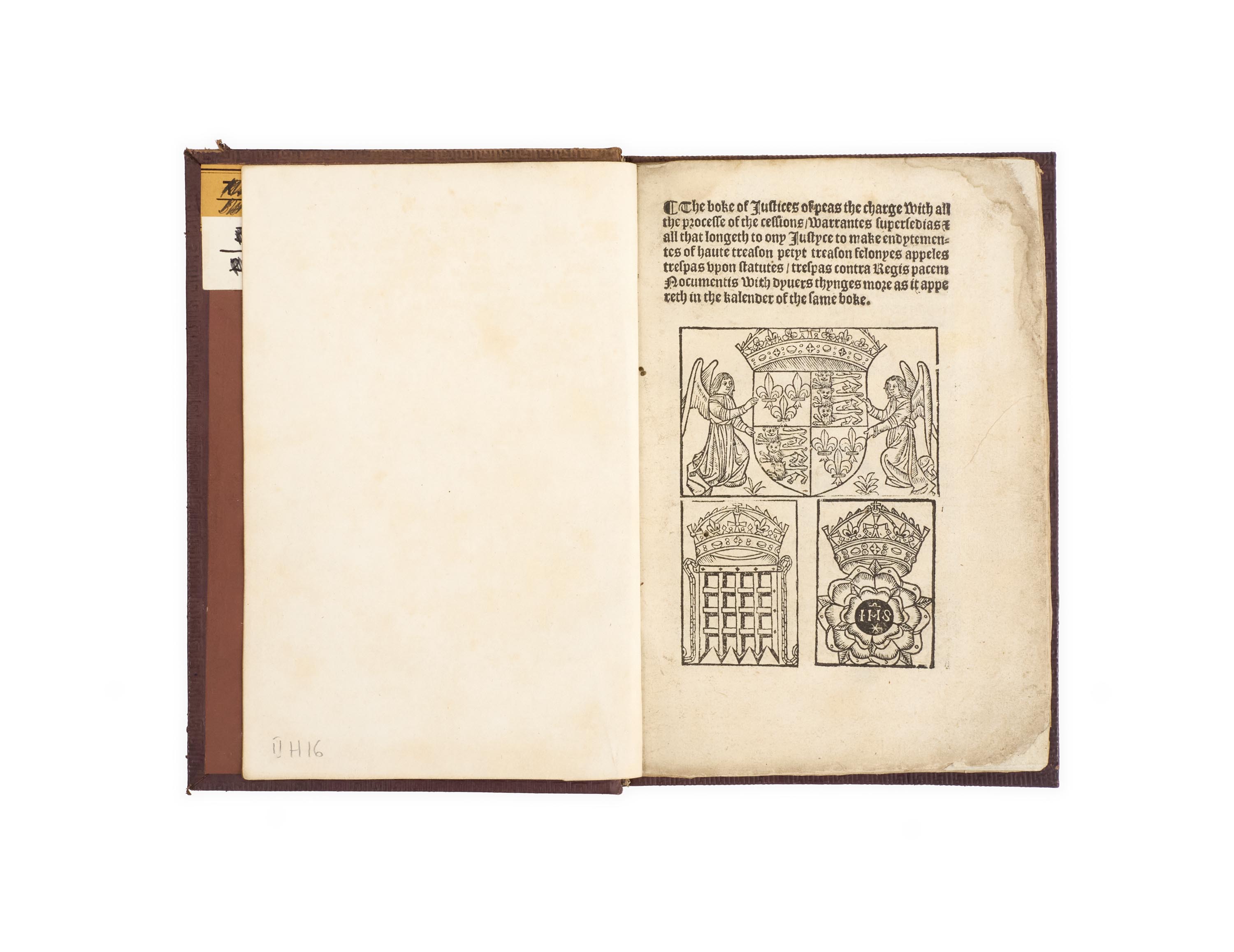
The Boke of Justices of Peas the Charge with all the Processe of the Cessions, Warrantes Supercedias & all that longeth to ony Justyce to make Endytementes of haute Treason petyt Treason Felonyes Appeles Trespas upon Statutes, Trespas contra Regis Pacem Nocumentis with dyvers Thynges more as it appereth in the Kalender of the same Boke.
[Colophon: London, Richard Pynson], [1505–6?].
[bound and probably issued with:]
[LAND LAW.] Crata [i.e. Carta] feodi simplices cu[m] littera atturnatoria. [London, Richard Pynson, 1505–6?].Two works in one vol., 4to, in 6s and 8s, Boke of Justices of Peas: ff. [34], ii–xxvii, [1], title-page with woodcuts of the royal arms, the Beaufort portcullis, and the rose and crown around IHS, Pynson’s woodcut device to colophon leaf (McKerrow 9b); Carta feodi: ff. [30] (of 34, wanting F1–4, of which F4 is a blank), woodcut rose and crown to first recto; text in English and Latin in blackletter throughout; old repairs to corners of A1–4 and A6 in first work and E5–6 in second work; a few small stains, marginal wormtrack in the second work, touching the odd letter; library stamp of Stonyhurst College to title verso.
Added to your basket:
The Boke of Justices of Peas the Charge with all the Processe of the Cessions, Warrantes Supercedias & all that longeth to ony Justyce to make Endytementes of haute Treason petyt Treason Felonyes Appeles Trespas upon Statutes, Trespas contra Regis Pacem Nocumentis with dyvers Thynges more as it appereth in the Kalender of the same Boke.
First edition(?), very rare, of the first printed guide for Justices of the Peace, issued with a short guide to land law.
Taking over from the role of feudal and communal courts of the Middle Ages, the office of Justice of the Peace became fundamental to local governance in early modern England. ‘In spite of striking changes – social, political, economic, and governmental – the importance of the Justices of the Peace has been inevitable and omnipresent’ (Skyrme). ‘By the time of the Tudors, the English system of local government rested solidly on the social control wielded by the justice of the peace. The men chosen from the local gentry to fill the position were seldom trained in law. Since they were given wide discretion in the performance of their duties, they often required some form of guidance, usually from a manual or handbook. During the sixteenth century there appeared at least fifty-seven editions of four different treatises on the office of justice of the peace. The first, The Boke of Justices of peas, was printed in 1506 and reprinted thirty-one times in the sixteenth century’ (Boyer).
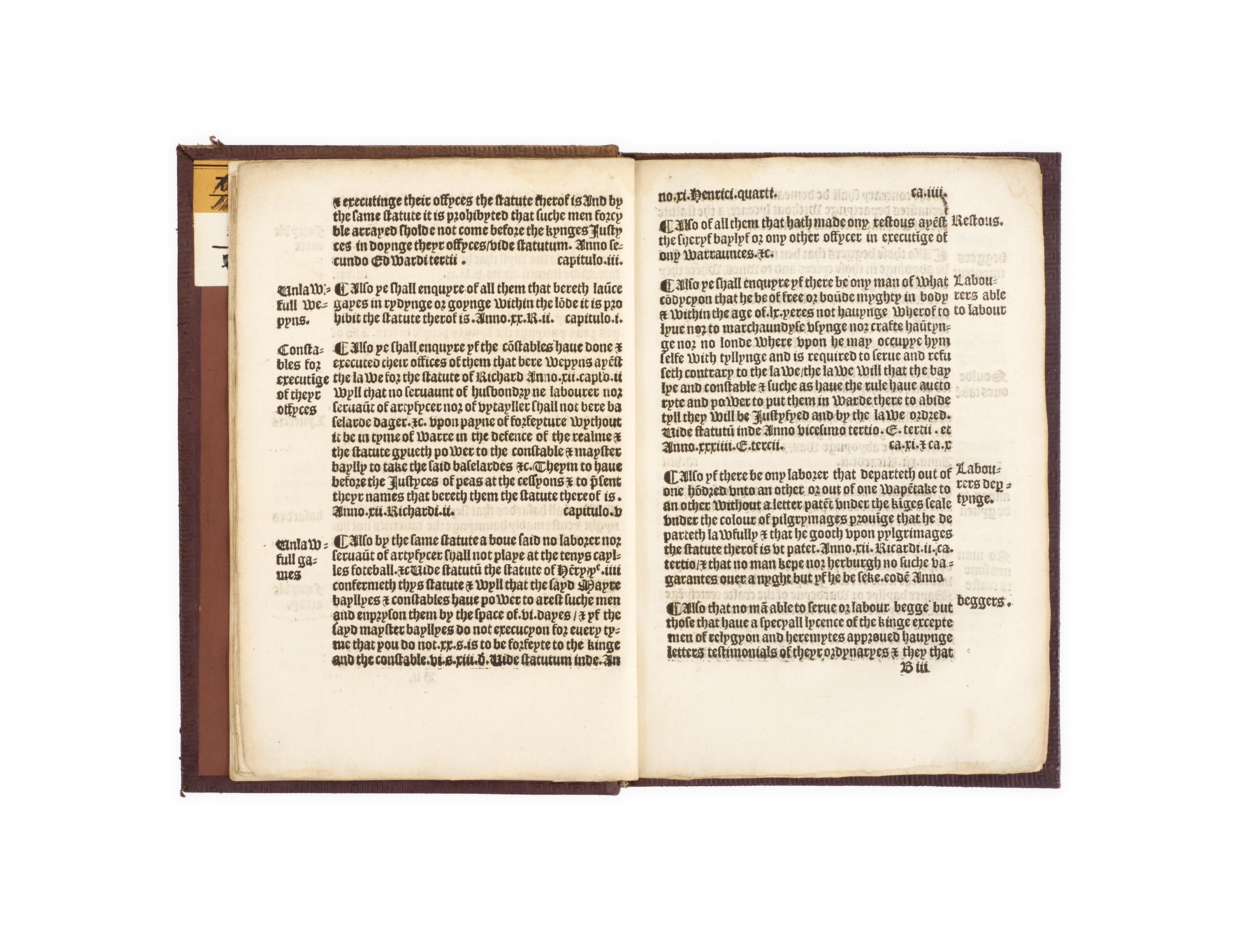
‘The Boke is actually divided into two sharply differentiated sections, the first containing summaries of statutes and the charge, the second, forms of writs of process and of indictments. The startling anomalies about this second section are that in the indictments there are so few references to justices of the peace and that some of the offences, high treason for example, are not even within their jurisdiction’ (Putnam). The ‘Charge’ is mostly in English and details a Justice’s responsibility to make enquiry into heresy, false coin, murder, rape, robbery, desertion of soldiers, extortion, riot, etc. Also covered are, for example, the cutting of roadside hedges (to discourage highway robbery), and statutes regarding trade standards, wages, and measures. The paragraph on ‘unlawfull games’ notes that ‘no laborer nor servau[n]t of artyfycer shall not playe at the tenys cayles foteball’ [tennis, kayles or ninepins, and football]. Citing the statutes of Richard II and Henry IV, this one of the earliest printed references in English to both tennis and football.
Although undated, this Pynson edition has often been considered the first (by e.g. Putnam). A similarly rare dated edition of 1506 printed by Pynson’s competitor Wynkyn de Worde, is in a near-identical setting in different type, differing most substantially in the title-page: the latter has only the royal arms, while our edition also has the Beaufort device (used by Henry VII and his mother Margaret Beaufort), and the rose and crown. Both the Pynson and the Wyknyn de Worde editions of The Boke were issued with a printing of the ‘Charter of fee simple’, outlining the terms of land grants and ownership with associated rights and obligations. Pynson had moved to the ‘sign of the George’ on Fleet Street in 1502; in January 1506 he first began to style himself Printer to the King. Legal printing ‘was always to be a mainstay of his trade’ (ODNB) – indeed law books make up two-thirds of his total output. Both Pynson and Wynkyn de Worde published later editions of the Boke.
All early editions of the Boke of Justices of Peas are very rare. This copy, for many years thought a unique survival, is one of three copies of this edition in ESTC, bound as issued with Carta feodi, the others being at King’s Inn Dublin, and Harvard Law. Copies of The Boke only are also at the BL and Bodley (imperfect). We can trace only one copy of any other early edition at auction in the last sixty-five years, a copy of the 1506 Wynkyn de Worde edition, bound without Carta feodi, sold at Christie’s, 8 June 2005, lot 222, £26,400.
Boke of Justices of Peas: ESTC S104306; STC 14862; Beale T130. Carta feodi: ESTC S3960; STC 15579.3; Beale T158. See Boyer, ‘The Justice of the Peace in England and America from 1506 to 1776: a bibliographic History’, The Quarterly Journal of the Library of Congress, 34:4, 1977; Putnam, Early Treatises on the Practice of the Justices of the Peace (1924); Skyrme, History of the Justices of the Peace (1991).