Annotated Abbreviated Histories
JUSTINUS, and AURELIUS VICTOR; Johann SICHARD, editor.
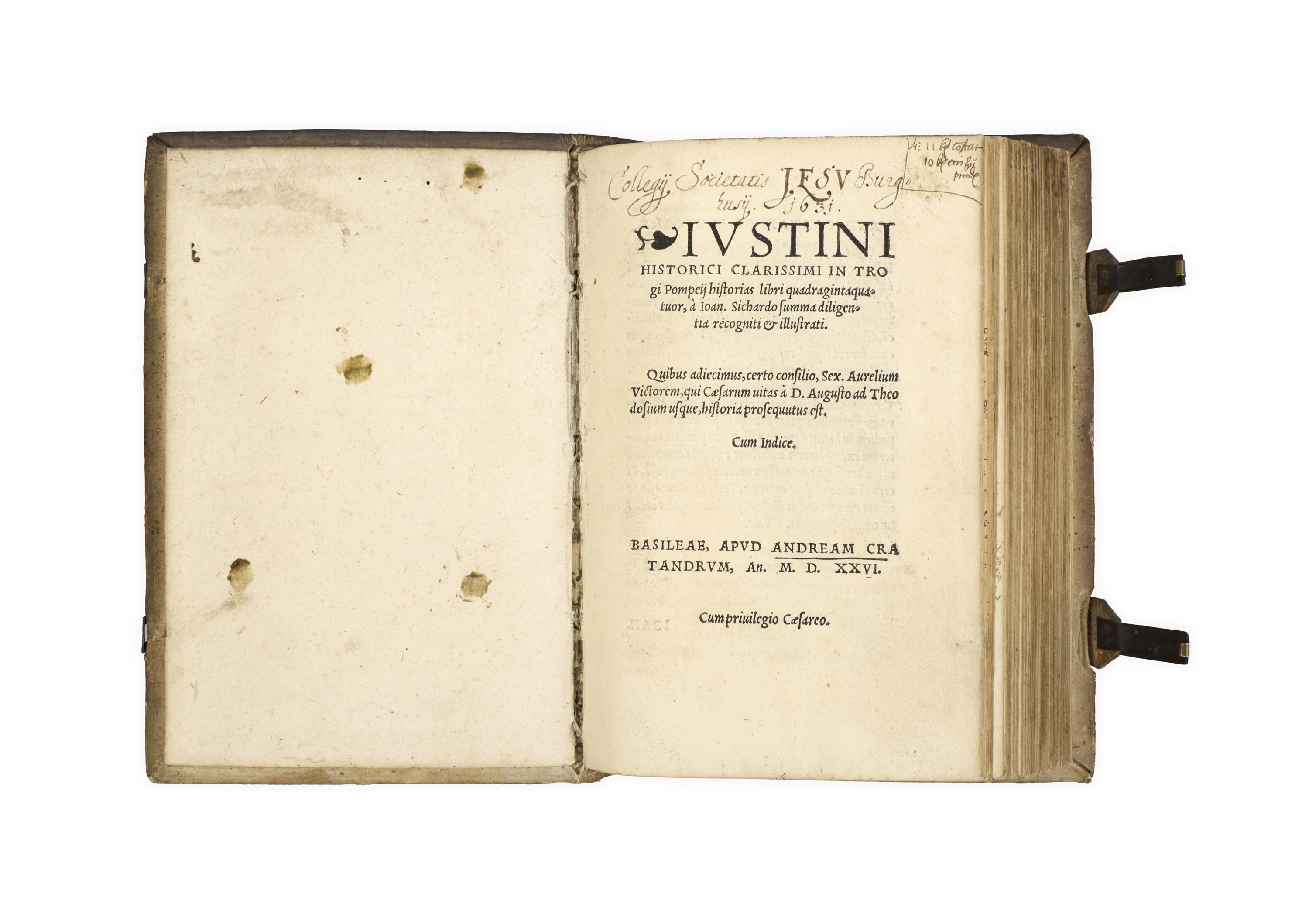
In Trogi Pompeii historias libri quadragintaquatuor, a Ioan. Sichardo summa diligentia recogniti & illustrati. Quibus adiecimus, certo consilio, Sex. Aurelium Victorem, quo Caesarum vitas a D. Augusto ad Theodosium usque, historia persequutus est. Basel, Andreas Cratander, [January] 1526.
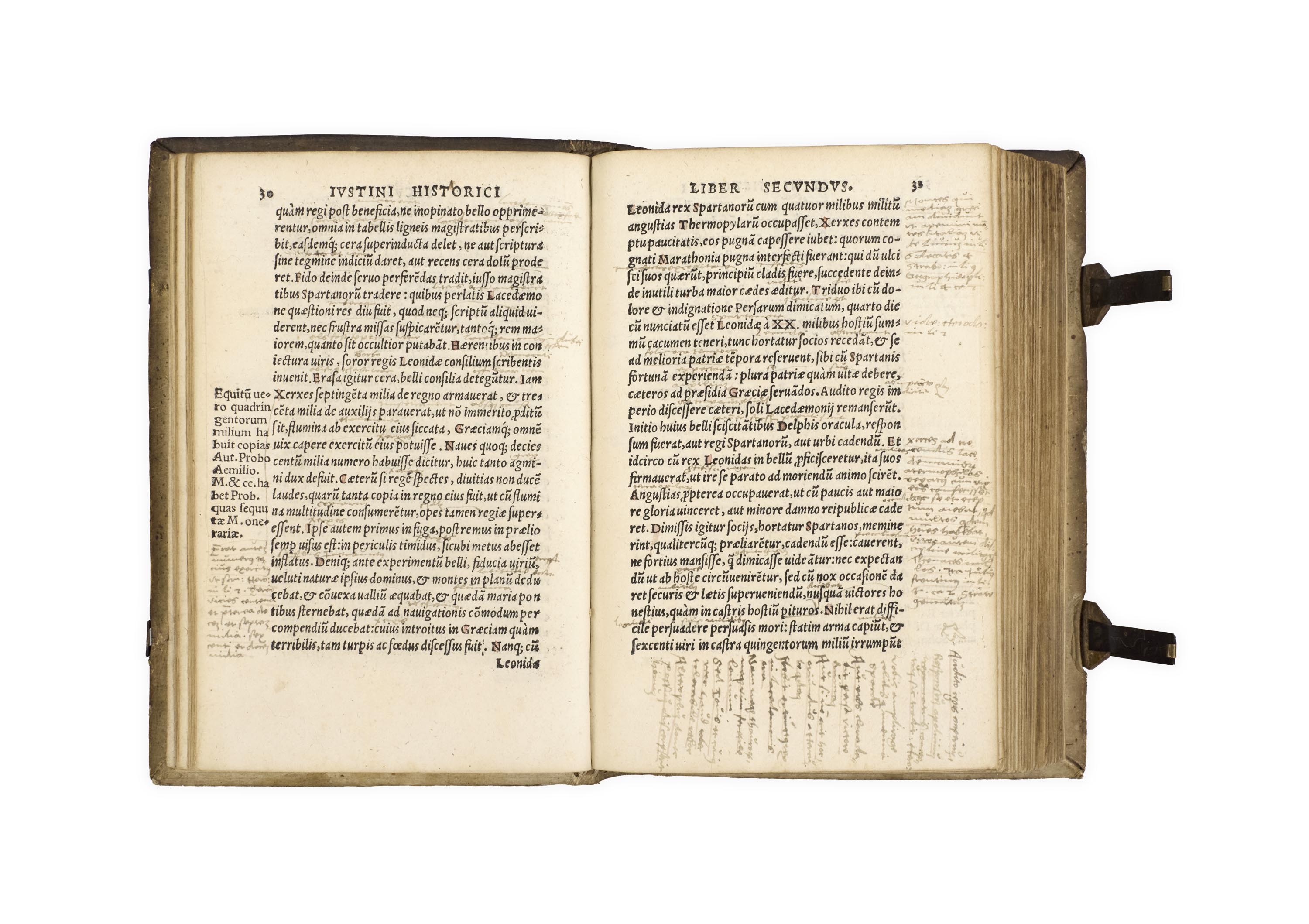
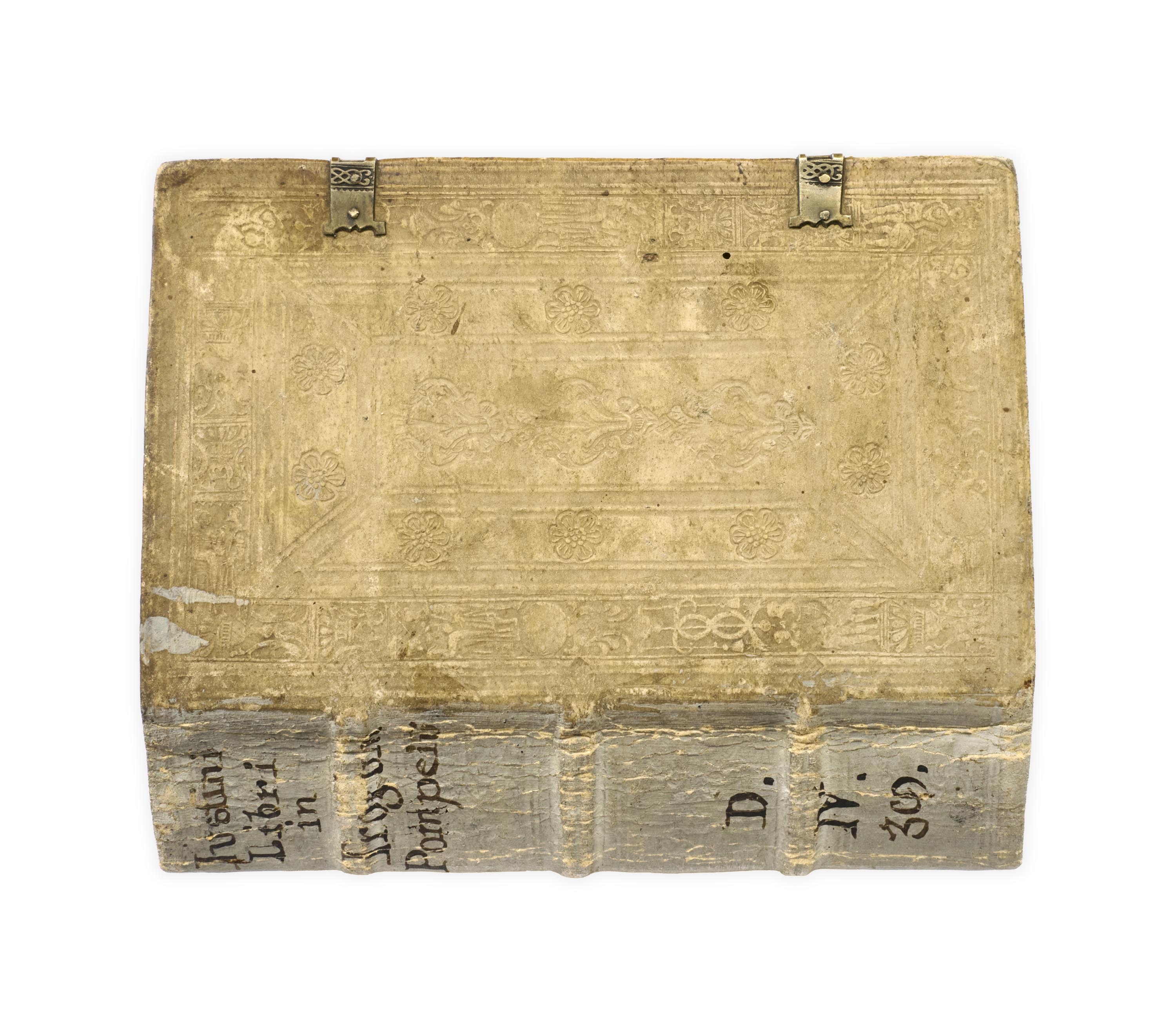
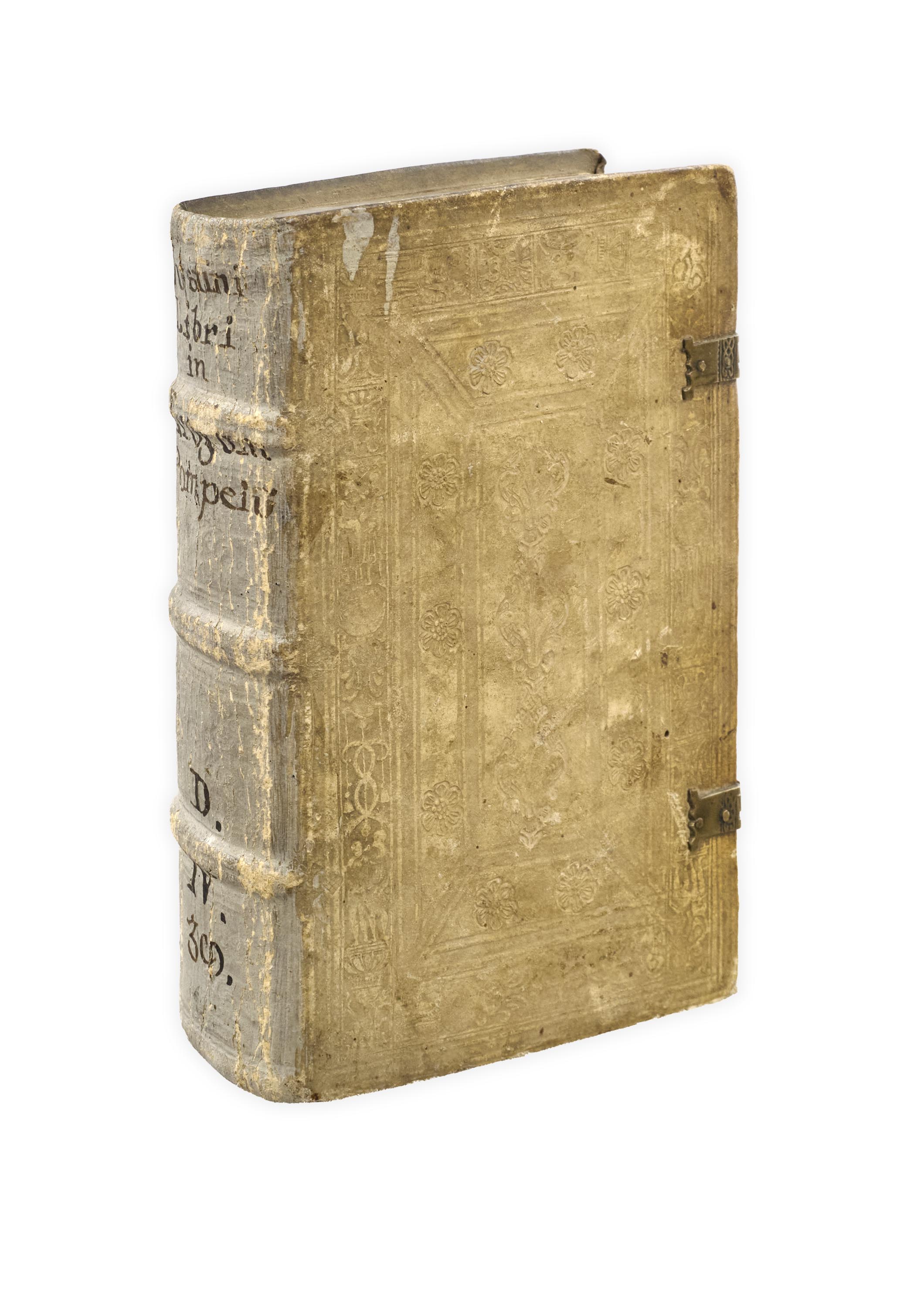
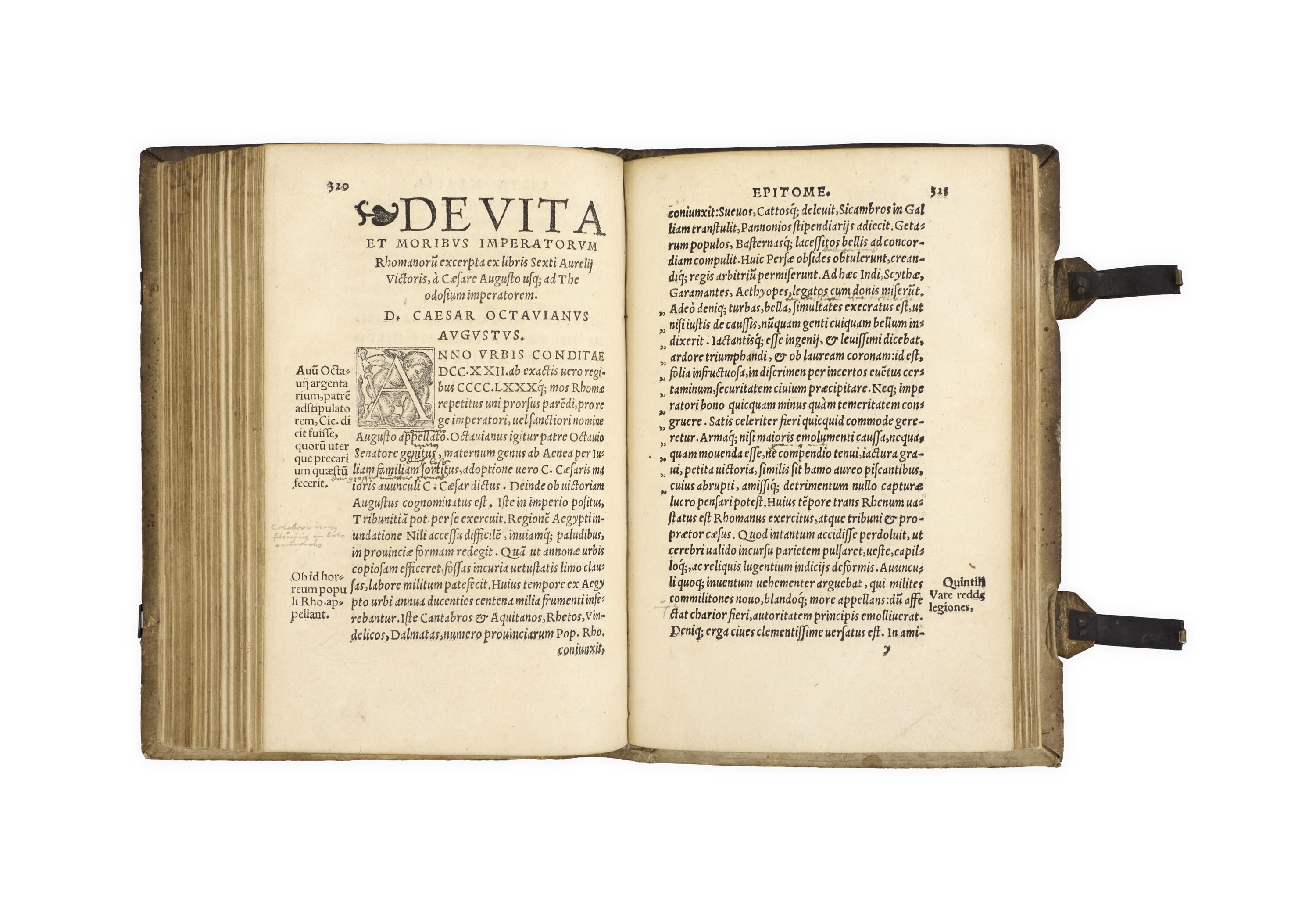
8vo, pp. [viii], 371, [41]; woodcut initials, woodcut printer’s device to final verso (device and a few initials coloured with red ink); a very good copy; bound in contemporary south German blind-stamped pigskin over wooden boards, two clasps, spine overpainted in grey with black manuscript lettering and shelfmark, author and date in manuscript across foredge; binding slightly rubbed and soiled; inscriptions to inside upper cover of Gregorius Khuep[er]ger dated 1540 and his price of 20 [Groschen?] and Virgilius Kuep[er]g[er] dated 1553 with his motto ‘Vive ut post vivas’ and another faded inscription in red ink (‘… Bar’), flyleaf with inscription of Andreas Welser (lightly crossed through), title-page with note of price and inscription of the Jesuits of Burghausen dated 1631, device and a few woodcut initials coloured with red ink, red initial-strokes in first few quires, early annotations to c. 76 pp. (see below).
Added to your basket:
In Trogi Pompeii historias libri quadragintaquatuor, a Ioan. Sichardo summa diligentia recogniti & illustrati. Quibus adiecimus, certo consilio, Sex. Aurelium Victorem, quo Caesarum vitas a D. Augusto ad Theodosium usque, historia persequutus est.
First Sichard edition of two abbreviated classical histories, both providing a witness to sources that no longer survive, in a contemporary pigskin binding, with early annotations and Upper Austrian provenance.
This volume contains two abbreviated histories: that of Justinus, based on Pompeius Trogus’s monumental and now lost world history in 44 books, Historiae Philippicae, based around the Macedonian kings and the Hellenistic kingdoms, probably composed around 200 AD; and the Epitome de Caesaribus, containing short biographies of emperors from Augustus to Theodosius, plausibly composed in the later sixth century, and based on the lost fourth-century history of Aurelius Victor.
This edition is one of the earliest produced by Johann Sichard (1499–1552), professor of rhetoric and of law in Basel, who dedicated it to Peter Reich von Reichenstein (died 1540), canon of the cathedral in Basel. Sichard subsequently turned his attention to editing and publishing legal texts, and he later became professor of law in Tübingen. Cratander reissued Sichard’s edition in 1530.
The bulk of the annotations, perhaps in two different minute hands, mostly in Latin but a few also in German, occur in the first three books of Justinus. They add information to the text both in the margins and using interlinear notes, with some underlining, marginal manicules and crosses. The first mention of Pompeius Trogus is annotated with the detail that he was Spanish, and many sentences have had their subject written in for clarity. The marginal notes provide context (at the foot of p. 7, there is a short description of Persia) and references (including Herodotus, Pliny, Strabo, Gellius, Solinus, Vegetius, and even Erasmus’s Adagia), as well as some short notes and translations of words or phrases into German.
The same two binding rolls are found on a volume now in the Bavarian State Library in Munich, on book printed in Hagenau in 1528 (EBDB w004744).
Provenance:
1. Khueperger is a family name recorded in Upper Austria (Linz and Hals, near Passau) in the sixteenth century. Gregorius and Virgilius were presumably relatives.
2. Andreas Welser: an Andreas Welser from the notable Augsburg family studied in Ingolstadt in 1538 then Padua in 1545, but it is not possible to establish the exact identity of the owner from the signature.
3. The Jesuit college in Burghausen (Bavaria) was founded in 1627–1630 and dissolved in 1773.
We have located two copies in the US (Yale and Harvard), and two in the UK (British Library, and Trinity College Dublin; an incomplete copy in Edinburgh may be this edition).
USTC 668646; VD16 T 2050. See Stover and Woudhuysen, The lost history of Sextus Aurelius Victor (2023).