Extra-Marital Relations, and Murder in Hispaniola … True Crime for Youth?
KOTZEBUE, August Friedrich Ferdinand von.
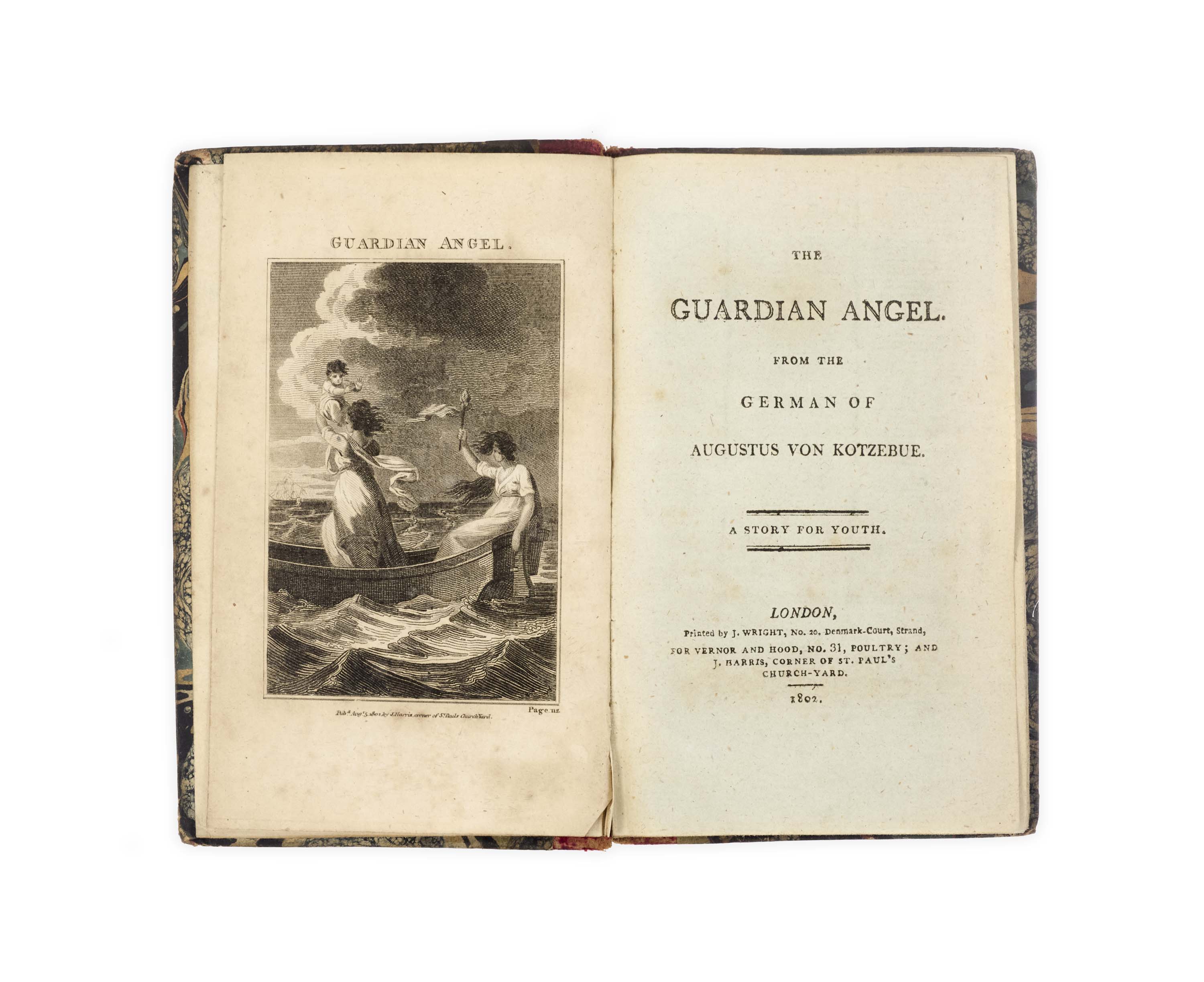
The Guardian Angel. From the German … A Story for Youth. London, J. Wright for Vernor and Hood, and J. Harris, 1802.
12mo, pp. 117, [1, blank], [2, advertisements]; with an engraved frontispiece; very light foxing to frontispiece; a very good copy in the publisher’s quarter red roan and marbled boards, gilt-lettered spine; spine worn at head and foot, some wear to corners and edges; ownership inscription of Eliza Bush dated January 1808 to front pastedown.
First edition in English (and the first separate edition in any language?) of Kotzebue’s novella ‘Der Schutzgeist’.
Not to be confused with his later play of the same title, ‘Der Schutzgeist’ is a short story first published in Gottlieb Wilhelm Becker’s Erholungen of 1797, where Kotzebue claimed it was based on real events from the 1760s.
Despite the title-page, it is not obviously a tale ‘for youth’, though its main protagonists are the young orphans Philip and Babet Renaud. After the modest house they inherited from their father burns down in a fire they are rescued from destitution by the Count of Lauraguais, who has ulterior motives. ‘“I love the Count”’, Babet soon exclaims, and he will marry her ‘“as soon as certain relations –”. “Does he speak of relations? I understand that.”’ Philip confronts the libertine, but is gravely injured when they fight, and despite the count’s repentance, the siblings depart for a new life in the West Indies, alighting on Hispaniola. Babet is taken on as attendant to a planter’s daughter, the beautiful young creole Francisca, with whom Philip cannot help falling in love. Sadly, she is already promised to a young French nobleman, and when Philip flees the emotional torment for a life at sea, Francisca gives him a flag embroidered with a forget-me-not, the ‘guardian angel’ of the title.
Time passes, and then in a sudden and horrific denouement, Francisca’s husband is murdered with an axe by an English renegade, and Francisca (with her new baby) and Babet are abandoned in a canoe. They drift for seven days until a ship with a forget-me-not flag fortuitously happens upon them…
Concealed behind the imprint ‘Vernor and Hood’ lies Ann Vernor (d. 1807), wife and successor of the London bookseller, publisher, and circulating library proprietor Thomas Vernor (d. 1793). After her husband’s death, Ann worked in association with his partner Thomas Hood (d. 1811), initially at 10 Birchin Lane, and then, from 1797, at 31 Poultry, with Ann and Hood’s names both appearing on the firm’s insurance policy. It was from here that Ann and Hood began publishing the women’s magazine The Lady’s Monthly Museum in 1798. Charles Sharpe later joined the firm in 1806. During Ann’s collaboration with Hood and Sharpe they published and sold over six hundred titles (see The Women’s Print History Project). The final leaf here advertises sixteen ‘books for youth, printed for Vernor and Hood’.
Rare: Library Hub and OCLC record six copies only, at the British Library, Bodley, Cambridge; Indiana, Penn State, and Toronto. A different translation appeared in 1807 as ‘The Protecting Spirit’ in the Pastor’s Daughter and other Romances 1807.
Moon 466.