

Hungarian Pro-Habsburg Handbooks in Venice
LAKITS, György Zsigmond.
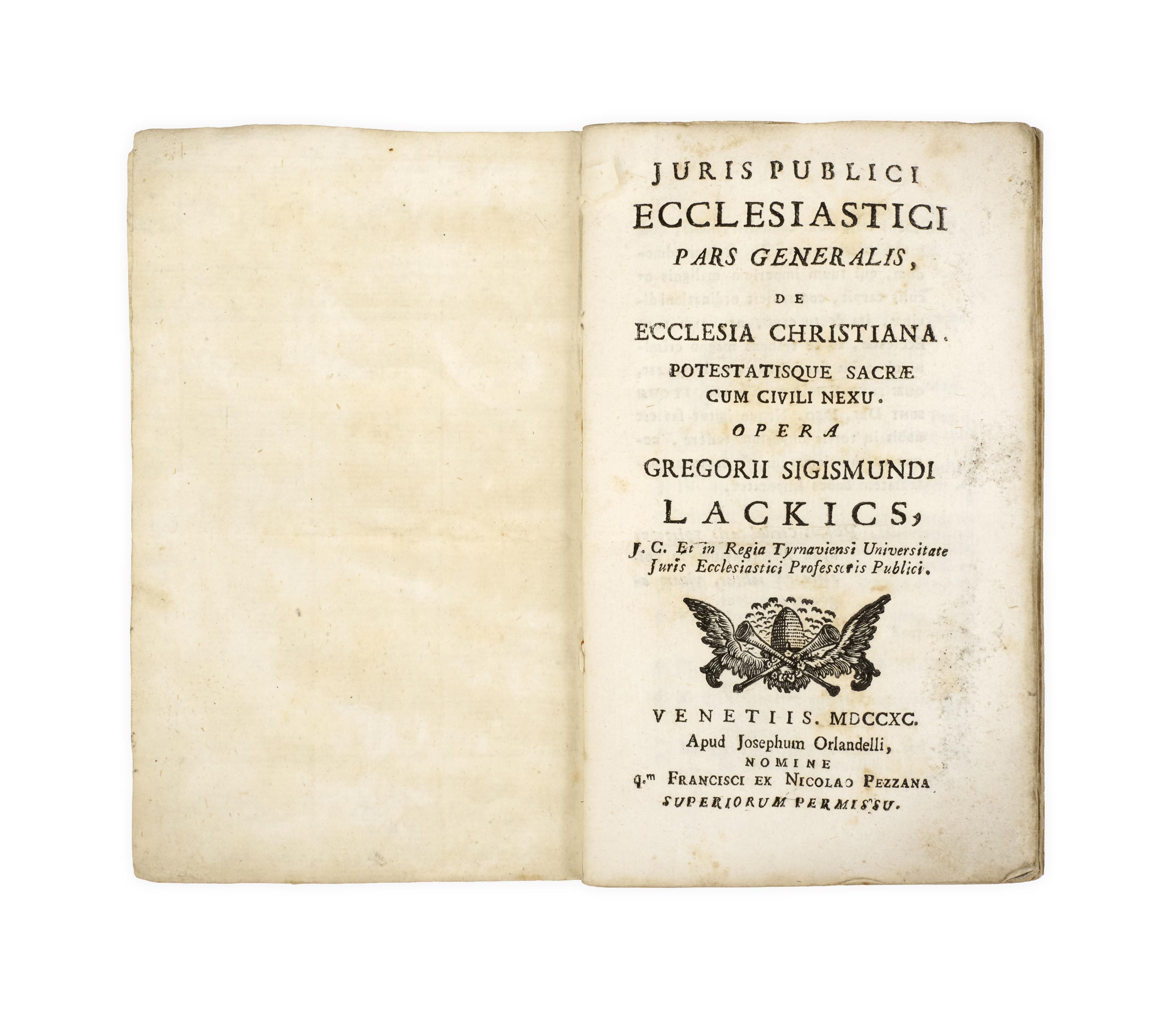
Juris publici ecclesiastici pars generalis, de ecclesia christiana. Venice, Giuseppe Orlandelli, 1790.
[and:]
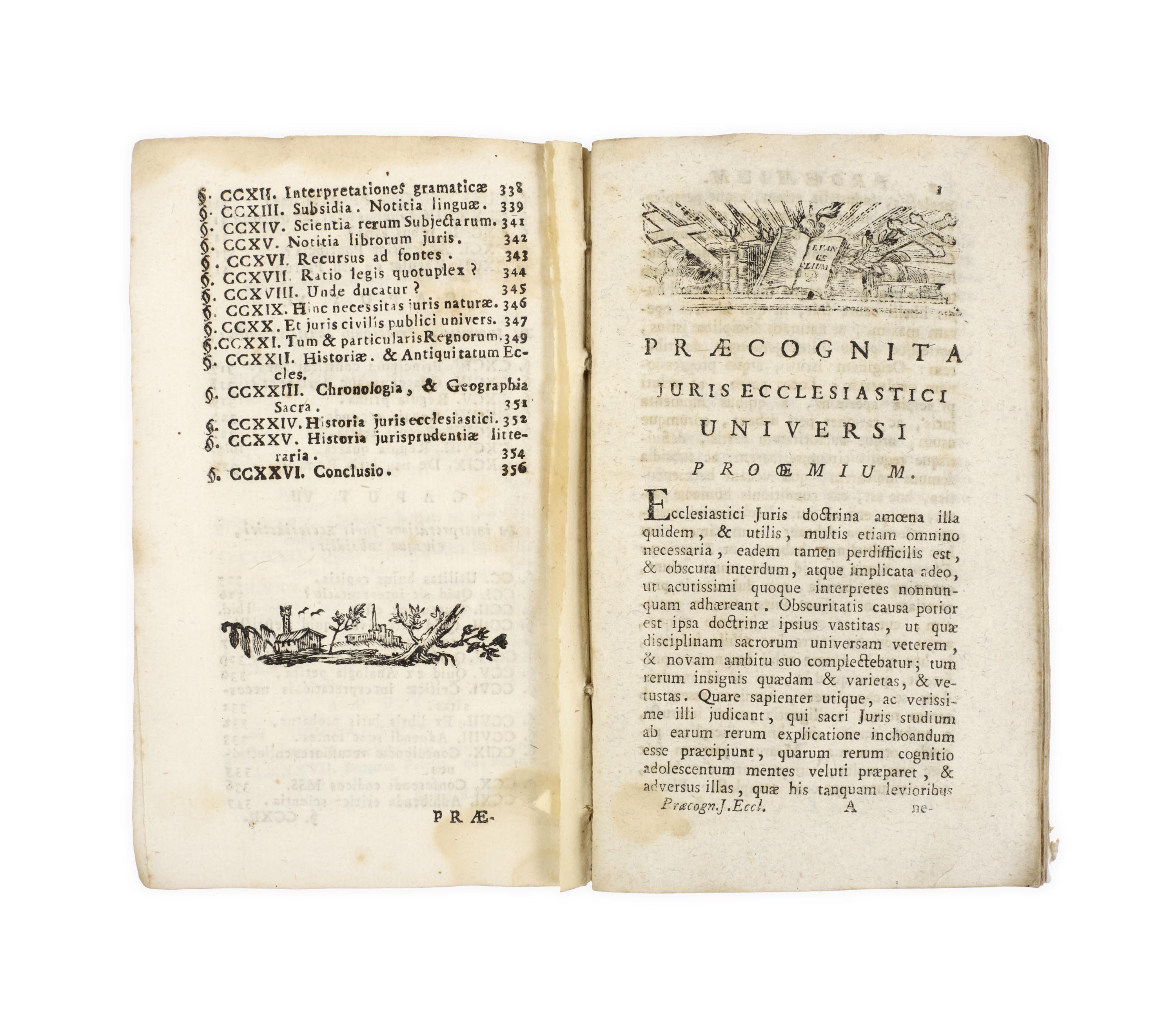
—. Præcognita juris ecclesiastici universi. Venice, Giuseppe Orlandelli, 1790.Two works, 12mo, I: pp. [16], 270, [2 (blank)], II: pp. [12], 358, bound without final blank leaf; woodcut device to each title, woodcut head- and tailpieces; both with occasional light foxing, but very good copies; uniformly bound in light grey wrappers block-printed with straight and undulating horizontal bands in black; small tears to spines.
Added to your basket:
Juris publici ecclesiastici pars generalis, de ecclesia christiana.
Second Venice editions of two pro-Habsburg works on ecclesiastical law by a notable Hungarian jurist, in matching decorative block-printed wrappers.
The Hungarian jurist Lakits (or Lackics, 1739–1814) taught at the universities of Vienna and Ingolstadt before returning to Hungary, later becoming a royal counsellor and Rector of the University of Buda, where he was the first secular professor of ecclesiastical law and the first secular Rector. His two textbooks on canon law were printed in several university towns: Vienna in 1774–5, Venice in 1781, Valencia in 1788, and later in Madrid in 1822. The university press in Buda, which he directed, issued a joint two-volume edition in 1779–81.
In Hungary, following the policy of enlightened absolutism of Maria Theresa and Joseph II, only legal texts closely aligned with the government’s stance could be published. Lakits had studied at Vienna under Karl Anton Martini, whose idea of the ‘pact of subjection’ to the ruler by their subjects was promulgated by his pupils Joseph von Sonnenfels and Lakits, expanding royal power at the expense of the nobility.
‘György Lakits contested the mixed character (i.e. the power is divided between the ruler and the nobility) of the Hungarian constitution, claiming that it had become deformed over time, and that it originally had an absolutistic spirit … Lakits’s view of the nobility was extremely hostile. Contradicting Montesquieu, he questioned the necessity of the nobility in monarchies at all, pointing out that nobles performed their military duties less and less frequently, while increasingly tying the monarch’s hands by an unconstitutional expansion of their own power’ (Hönich and Nagy, ‘Hungarian constitutional Thought between Tradition and Innovation’ in Nineteenth-Century Hungarian political Thought and Culture, 2023, p. 81).
The first work is in OPAC SBN’s variant B, with the correct pagination 270 (not ‘170’).
Very rare: no copies of either in the US or UK.