Machiavellian Musings and Tacitean Troubles
LIPSIUS, Justus.
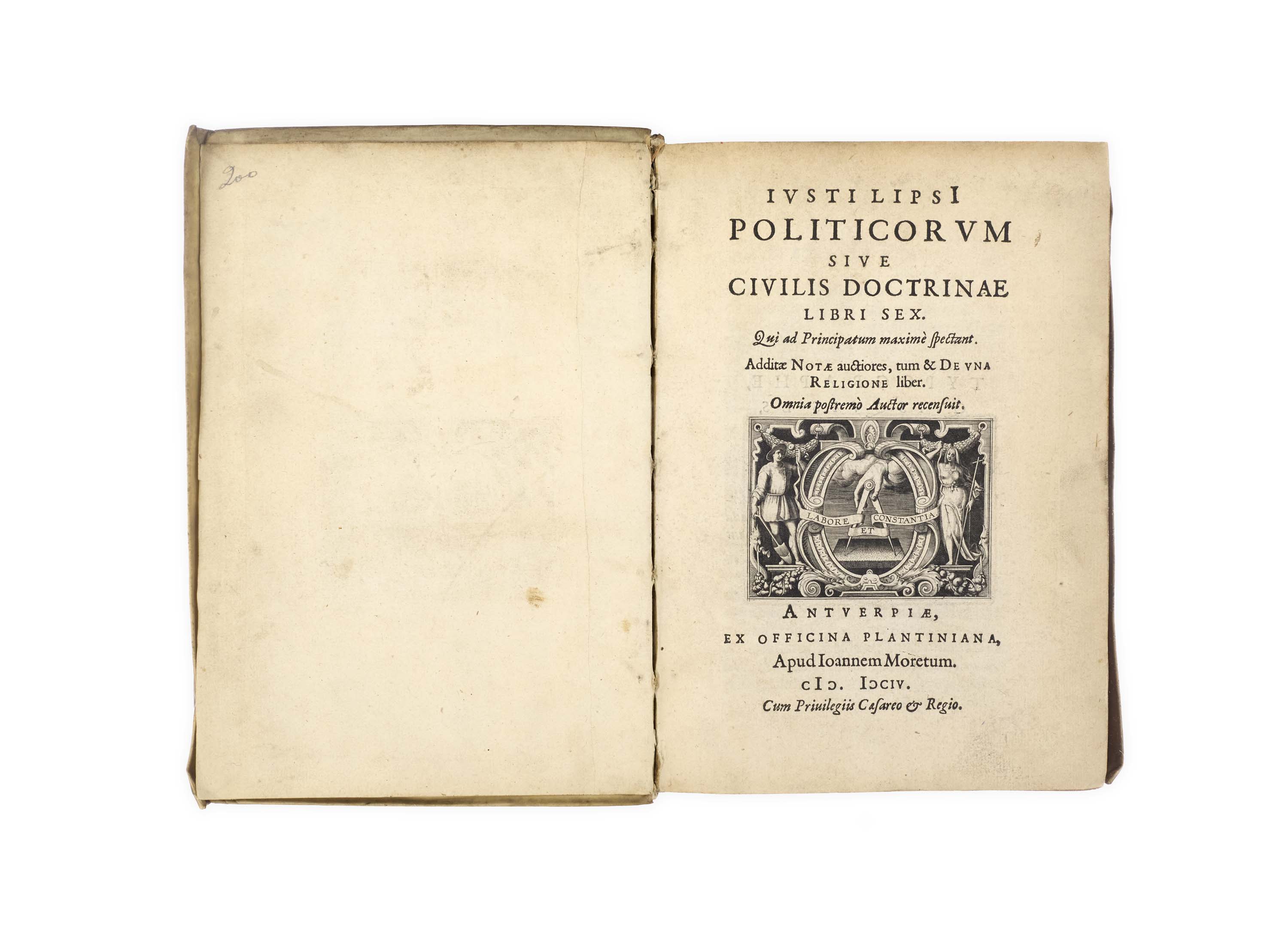
Politicorum sive civilis doctrinae libri sex. Qui ad Principatum maxime spectant. Additae notae auctiores, tum & de una religione liber. Omnia postremo auctor recensuit. Antwerp, Jan Moretus, ex officina Plantiniana, 1604.
[bound with:]
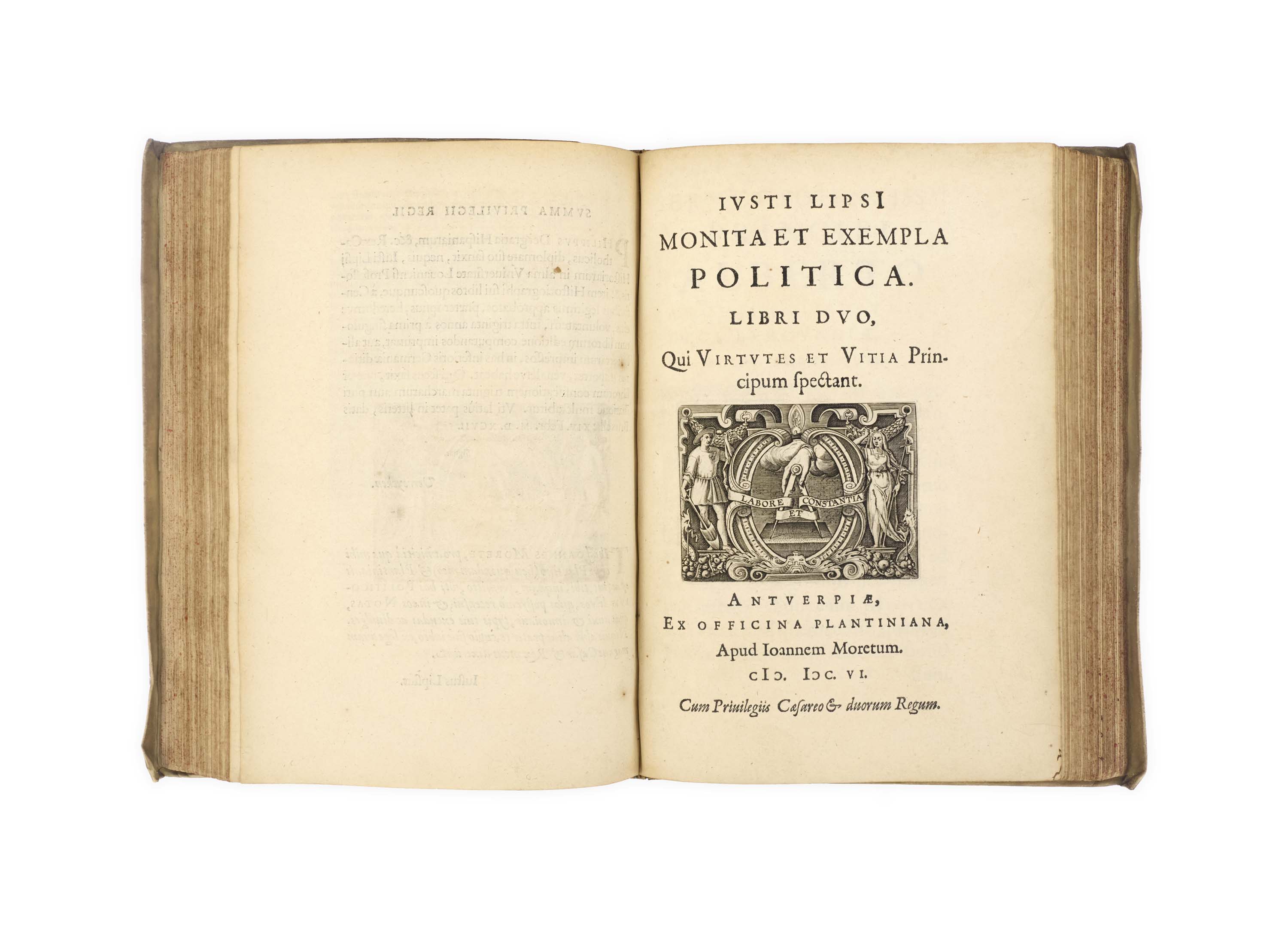
–. Monita et exempla politica. Libri duo, qui virtutes et vitia principum spectant. Antwerp, Jan Moretus, ex officina Plantiniana, 1606.
[and:]
–. Leges regiae et leges X. virales, I. Lipsii opera studiose collectae. Editio ultima. Antwerp, Jan Moretus, ex officina Plantiniana, 1601.
[and:]
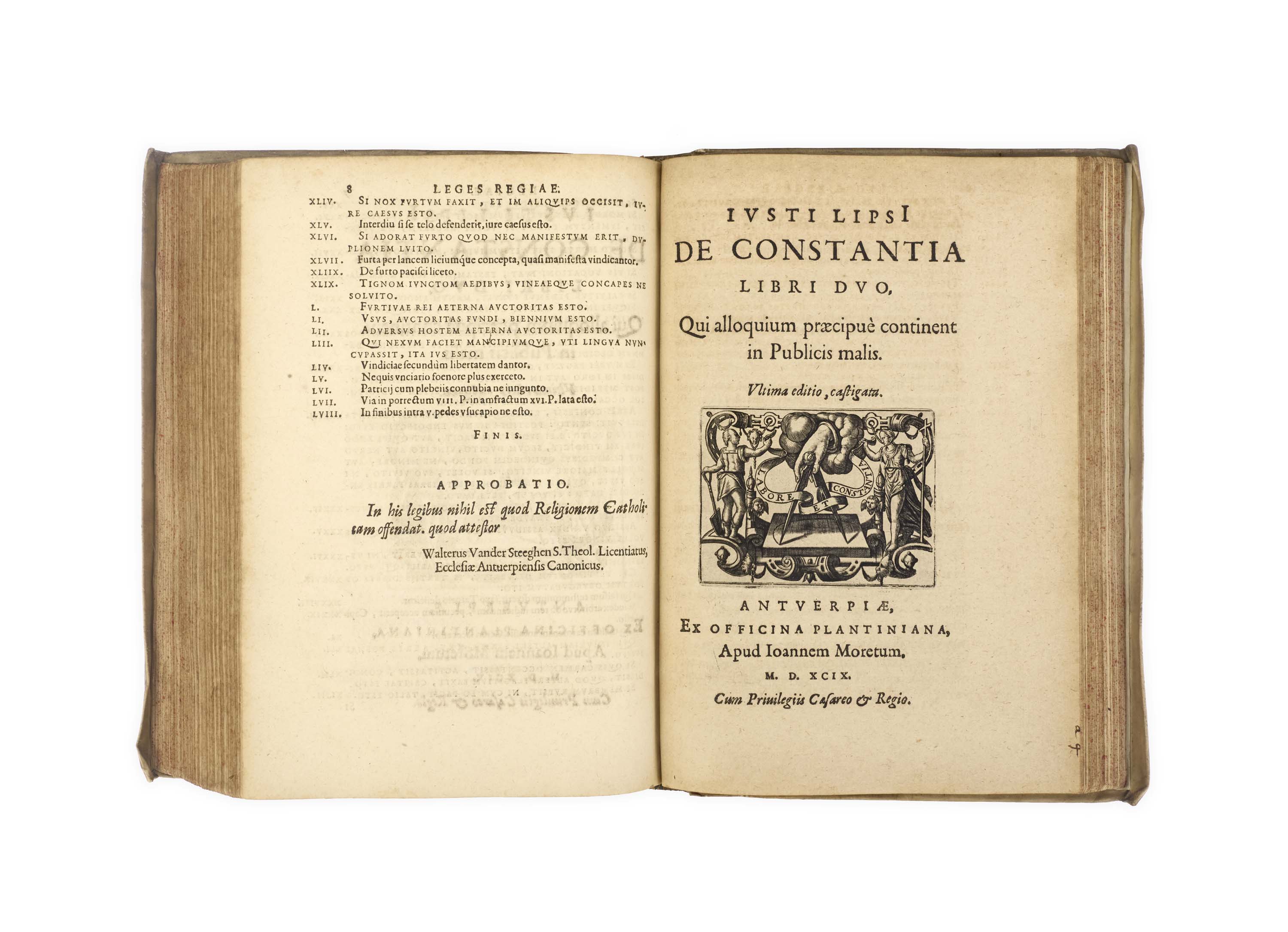
–. De constantia libri duo. Quo alloquium praecipue continent in publicis malis. Ultima editio, castigata. Antwerp, Jan Moretus, ex officina Plantiniana, 1599.
[and:]
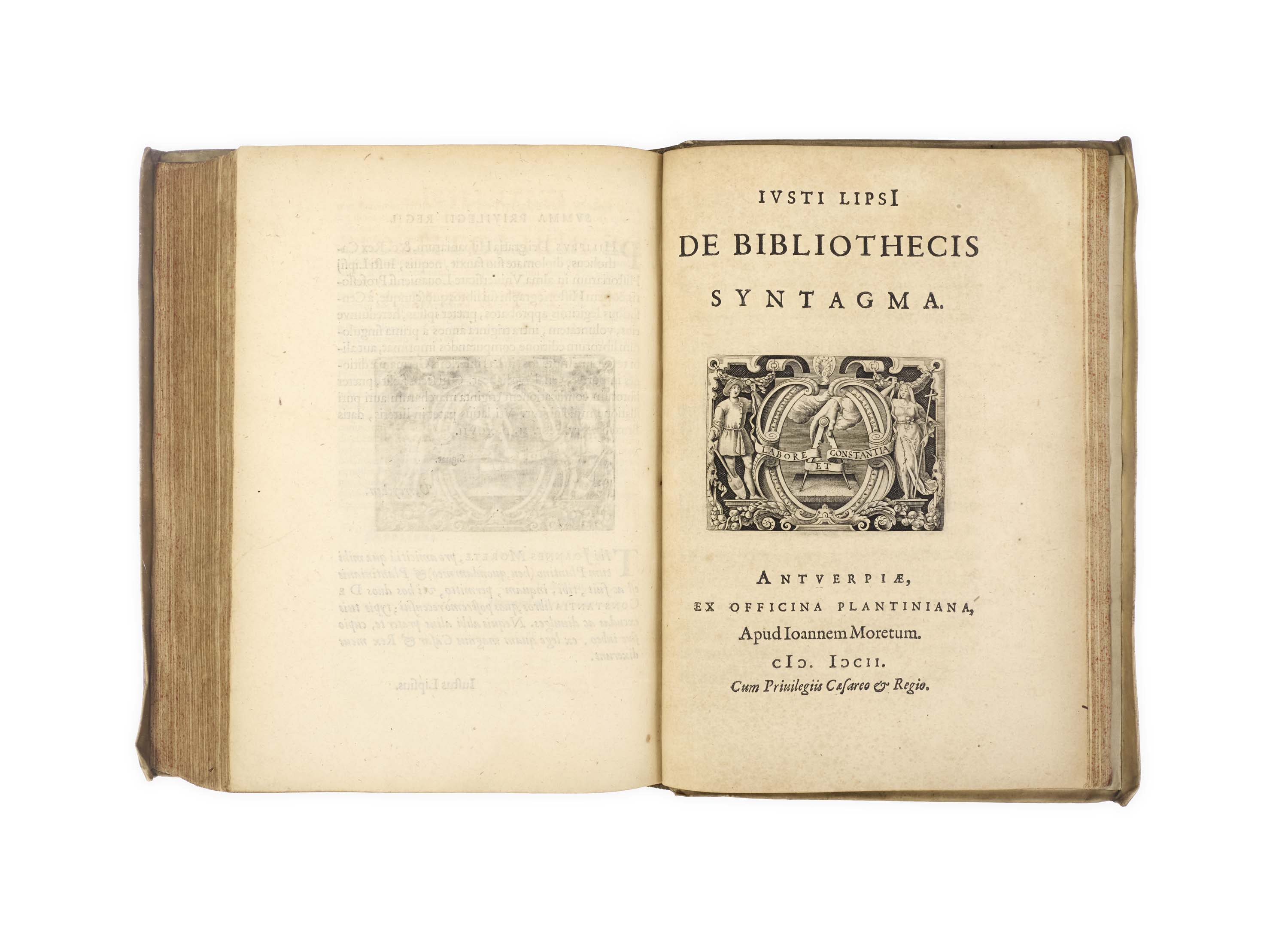
–. De bibliothecis syntagma. Antwerp, Jan Moretus, ex officina Plantiniana, 1602.
[and:]
–. Dispunctio notarum Mirandulani codicis ad Cor. Tacitum. Antwerp, Jan Moretus, ex officina Plantiniana, 1602.
Six works in one vol., 4to, I: pp. 223, [1, blank], 103, [5], engraved device to first title-page, woodcut device to second; II: pp. [viii], 213, [7], engraved device to title, woodcut device to final leaf; III: pp. 8, woodcut device; IV: pp. [xvi], 86, [10], engraved device; V: pp. 34, [2], engraved device; VI: pp. [viii], 40, [4], woodcut device; all works with woodcut initials and tailpieces; occasional light browning; a very good copy; bound in contemporary Dutch vellum, spine lettered in ink, yapp foredges, edges speckled red; binding slightly soiled; bookplate of Joseph A. Schockaert (1906–1995, professor of obstetrics and gynaecology at the University of Louvain).
Added to your basket:
Politicorum sive civilis doctrinae libri sex. Qui ad Principatum maxime spectant. Additae notae auctiores, tum & de una religione liber. Omnia postremo auctor recensuit.
A volume containing controversial works on politics and philology by the renowned scholar Justus Lipsius (1547–1606), including the first edition of his treatise on libraries, all produced by the Plantin Press.
The first work in this volume, Lipsius’s compilation of sayings and maxims on statecraft from authors ancient and modern, from Aristotle to Machiavelli via Tacitus, fell foul of the Catholic authorities and the first edition of 1589 was banned. He then worked with the local censors to ensure that subsequent editions, beginning with the 1596 edition, would be acceptable to the Vatican. The required changes included portraying Machiavelli negatively and removing the suggestion that heresy could be tolerated for political gain. This later edition, for which ‘the author finally revised everything’, retains Lipsius’s note to printers, admonishing them not to reprint without his permission because changes to the layout would affect the meaning. He also provided a warning (Monita) to the reader, explaining how to use the book correctly.
Lipsius was criticised by other scholars as well as the Church, and he produced a defence of his original text entitled De una religione liber, here printed alongside the Politica.
The De Constantia, a work of moral philosophy about individual behaviour, partly derived from Seneca and Epictetus, also proved controversial. Lipsius used it to describe and decry the political problems of the Low Countries and the civil strife that resulted.
First edition of the last two works, on libraries and on the text of Tacitus, issued together in 1602, and both dedicated to Charles duc de Croÿ, a renowned collector of books and coins. De bibliothecis opens with a definition of the word bibliotheca, a term used in both Greek and Latin, clarifying that libraria is used for a shop that sells books.
The final work in this volume formed part of a philological controversy about the text of Tacitus, which Lipsius had edited for publication early in his career, in 1574. A pseudonymous tract criticised Lipsius’s readings, based on the Medicean manuscripts in Florence which Lipsius had not consulted; Lipsius’ response was to produce a new edition of his Tacitus, integrating some of these new and better readings, which however only appeared shortly after his death.
‘The two works formed a kind of pair, in that the D[e] B[ibliothecis] was a call to fund libraries and scholars, and the Dispunctio was a display-piece of the kind of scholarship such funding could engender’ (Hendrickson, p. 40). Plus ça change.
USTC 1004726, 1004719, 1004729, 407072, 1003389, 1003422; STCV 6823365, 6823313, 6823370, 12914085, 6619168, 6620059; Imhof, Jan Moretus and the Continuation of the Plantin Press (1589–1610), L-66, L-58, L-52 (issue A), L-16, L-13, L-29. See Hendrickson, Ancient libraries and renaissance humanism: the De Bibliothecis of Justus Lipsius (Leiden, 2017), a11602 in the list of editions.