Satire Starts Here
Editio Princeps
LUCILIUS, Gaius; Franciscus DOUSA, editor.
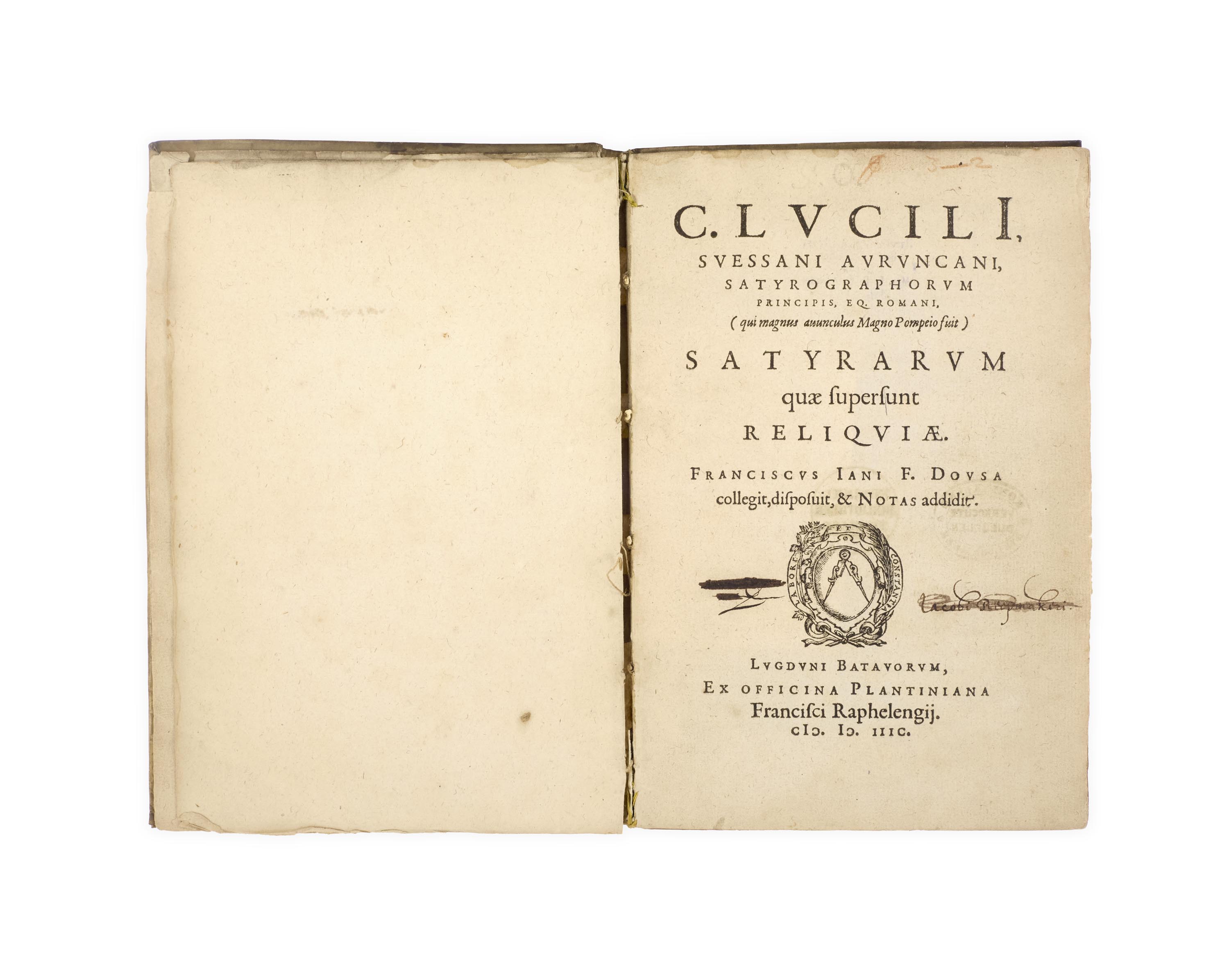
Satyrarum quae supersunt reliquiae. Franciscus Iani F. Dousa collegit, disposuit, & notas addidit. Leiden, Franciscus Raphelengius, ex Officina Plantiniana, 1597.
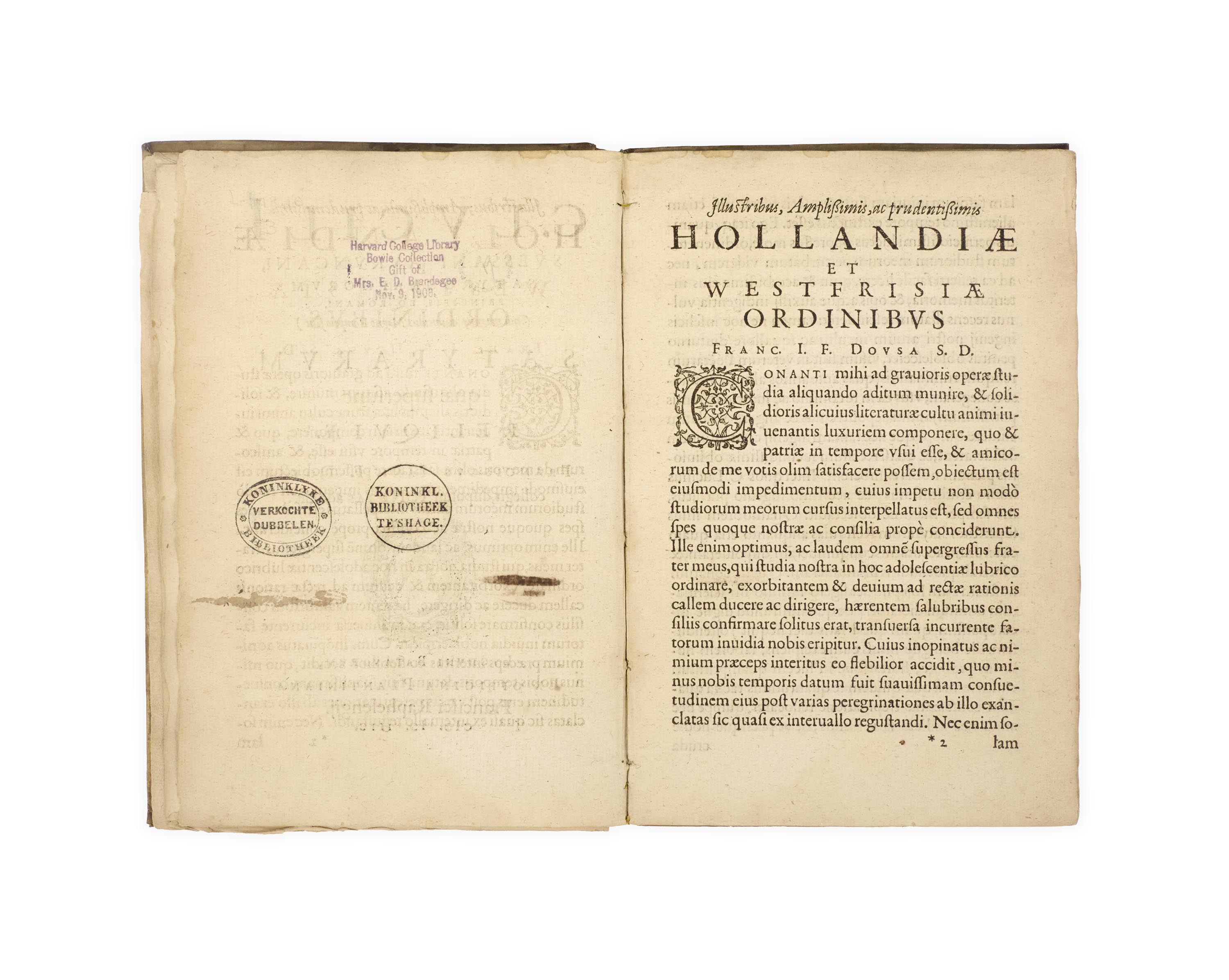
4to, pp. [xxiv], 139, [1, errata]; woodcut Plantin device to title-page, woodcut initials; some staining to title-page from obscured inscription, occasional light damp-staining, a very good copy; bound in contemporary Dutch vellum, title lettered in manuscript to spine, stubs from two pairs of ties; binding lightly soiled, upper joint splitting, sewing broken between flyleaf and title, front flyleaves detached, a strip excised from the head of one flyleaf; numerous inscriptions (see below), Bibliotheca Reuvensiana book label, ink stamp of the Royal Library of The Hague with their duplicate stamp to verso of title, Harvard College bookplate (mostly erased) with their blind stamp to *1r and A1r and their Bowie Collection ink stamp dated 1908 to verso of title, nineteenth-century bibliographical notes to front and rear flyleaves in different hands.
Added to your basket:
Satyrarum quae supersunt reliquiae. Franciscus Iani F. Dousa collegit, disposuit, & notas addidit.
Editio princeps of the earliest Roman satirical verses, the origin of modern satire, a copy that journeyed from Edam to Harvard via the Royal Library in The Hague.
The Campanian writer Lucilius was active towards the end of the second century BC (fl. 130–103 BC), and unlike most Latin literature, his writings were not derived from Greek models but considered to be distinctively Roman. Writing under the Republic, before the civil wars of the first century BC, Lucilius was able to name those he ridiculed, unlike his notable successors Juvenal and Persius in the more repressive imperial period. Many verses are given from a personal perspective, stating opinions and providing biographical snippets, as well as criticisms of contemporary society and fellow Romans, both aristocratic and lowly. He also wrote in the epic metre of hexameters, which became the standard for later satirical authors to follow.
He composed thirty books of poems called ‘satura’ (poetic medleys), from which our word ‘satire’ originates. Only 1,300 or so verses survive, and there are no complete poems. Many of the extracts were preserved through grammatical texts, such as Nonius Marcellus and Festus, providing examples of vocabulary or other linguistic features, and many quotations are found in the writings of Cicero, Horace, and Aulus Gellius.
‘Lucilius’ facility with language, his stylistic resourcefulness, and his linguistic inventiveness, no doubt a function of the genre he was developing, set his language apart from the literary prose of the period as well as from the language of everyday discourse’ (Breed, Keitel, and Wallace eds, Lucilius and Satire in second-century BC Rome (2018), p. 29).
Franciscus Dousa, son of Janus Dousa, is named as the editor on the title-page, but it is quite likely that Janus composed much of the text with assistance from Joseph Scaliger.
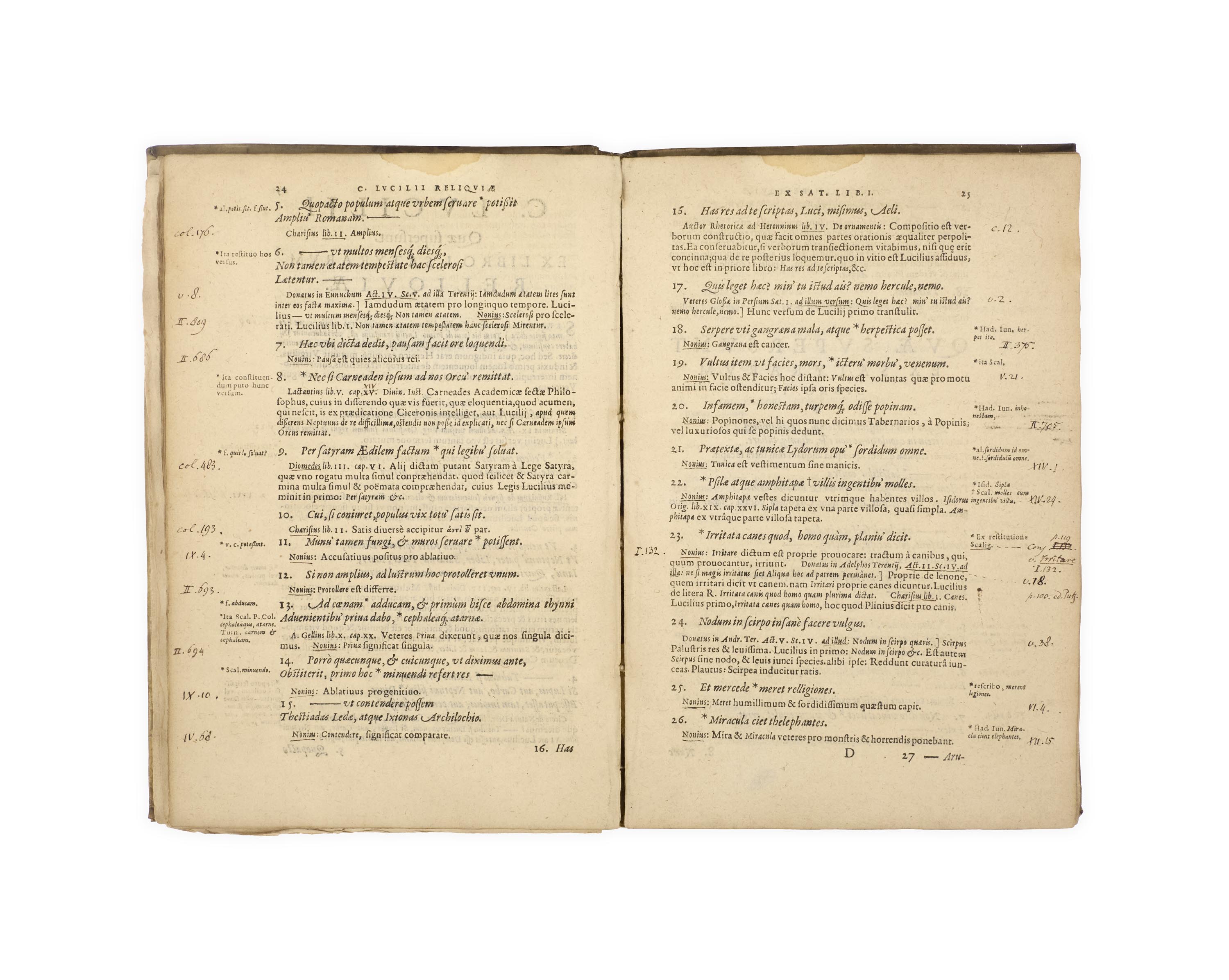
This copy contains marginal annotations to pp. 23–27, 32, and 36–37, noting the specific source for each passage of Lucilius; in the printed text, only the name of the author of the source is given, sometimes with a book number, but the annotator has provided chapter and verse and even, on occasion, the page number of a particular edition of that text, along with a few amendments to the text of the quotations. These notes, and those on the rear flyleaves referring to passages in the book, were plausibly made by Caspar Reuvens.
Provenance:
1. Robertus Puppius of Edam (c. 1585–1619, preacher), inscription on flyleaf.
2. Inscription on flyleaf ‘Sum Ant[–]’ dated 1619, crossed through.
3. Jacobus Reepmaker, seventeenth-century inscription to title-page.
4. Caspar Jacob Christiaan Reuvens (1793–1835), classicist and archaeologist, his Bibliotheca Reuvensiana book label, sold at auction in Leiden in October 1838; this volume was lot 468.
5. The Royal Library of The Hague (founded 1798).
6. Mary Brandegee (née Bryant Pratt, 1871–1956) presented this volume to Harvard University in 1908 as part of the substantial library of Richard Ashhurst Bowie (1836–1887, classicist and numismatist), though the bookplate stated that the gift was in memory of her grandfather, William Fletcher Weld (1800–1881, American shipping magnate and funder of Harvard’s Weld Hall in 1870). At nearly 12,000 volumes, the Bowie collection was the largest gift of books received by Harvard.
USTC 423869; STCN 840463499.