
Poetic Pleasures
NOMEXY, Nicolas de.
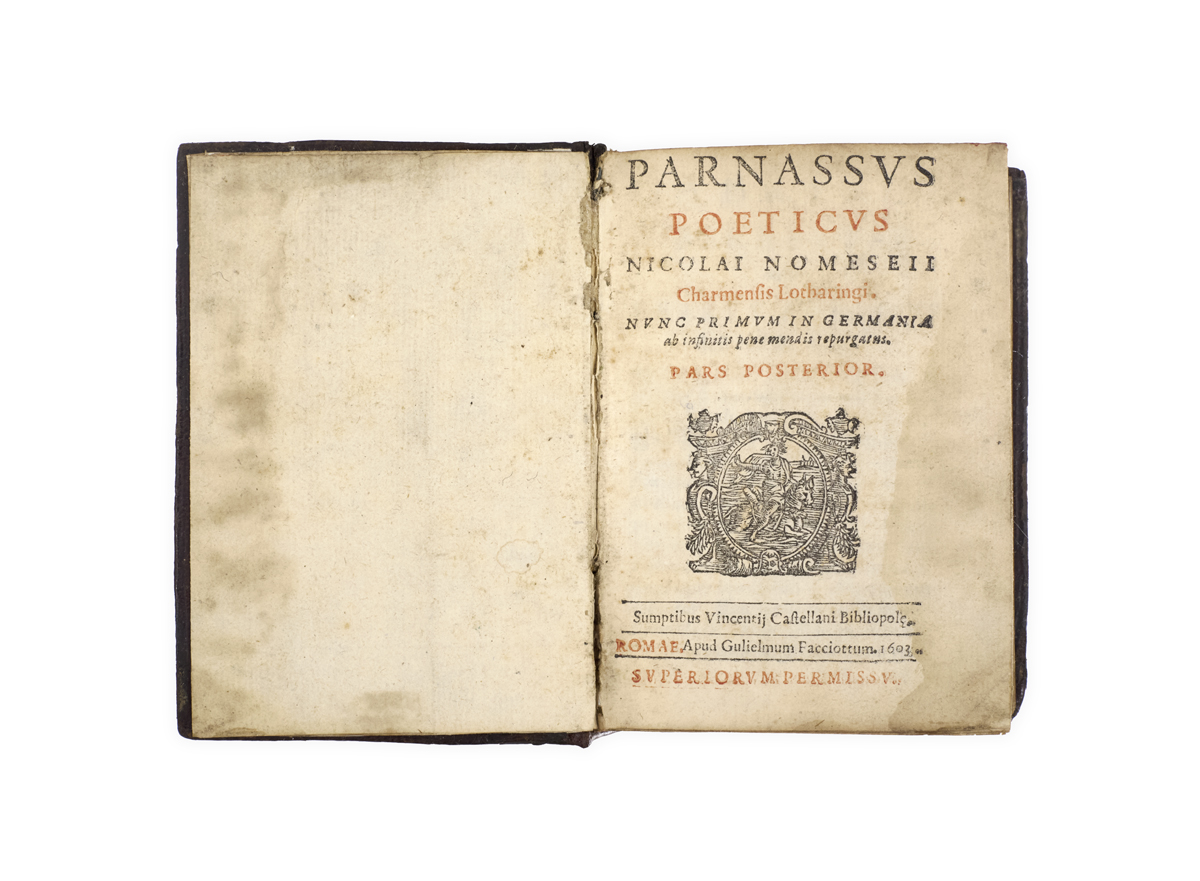
Parnassus poeticus … nunc primum in Germania ab infinitis pene mendis repurgatus. Pars posterior. Rome, Guglielmo Facciotti, for Vincenzo Castellano, 1603.
Vol. II only (of II), 16mo, pp. [xiv], [2 (blank)], 582; without final blank Ooo4; title printed in red and black with woodcut Castellano device, woodcut initials and tailpieces; very light staining to first quire, scattered light foxing, blank leaf †8 tipped in obscuring a few letters along left hand edge of AA1r, cut somewhat close, but a good copy; bound in contemporary Roman dark brown morocco, elaborately gilt with a central armorial block within a double oval of double gilt fillets, with a knight’s helm and leafy sprays between the two ovals, spine in compartments filled with an angular interlaced gilt stamp, edges gilt, stubs from two pairs of ties; very slightly rubbed with a few minute wormholes, neat restorations to spine and extremities, endpapers sympathetically renewed.
Added to your basket:
Parnassus poeticus … nunc primum in Germania ab infinitis pene mendis repurgatus. Pars posterior.
A bestselling compilation of Latin verse, an early dictionary of quotations, in a charming contemporary Roman binding by the Soresini workshop.
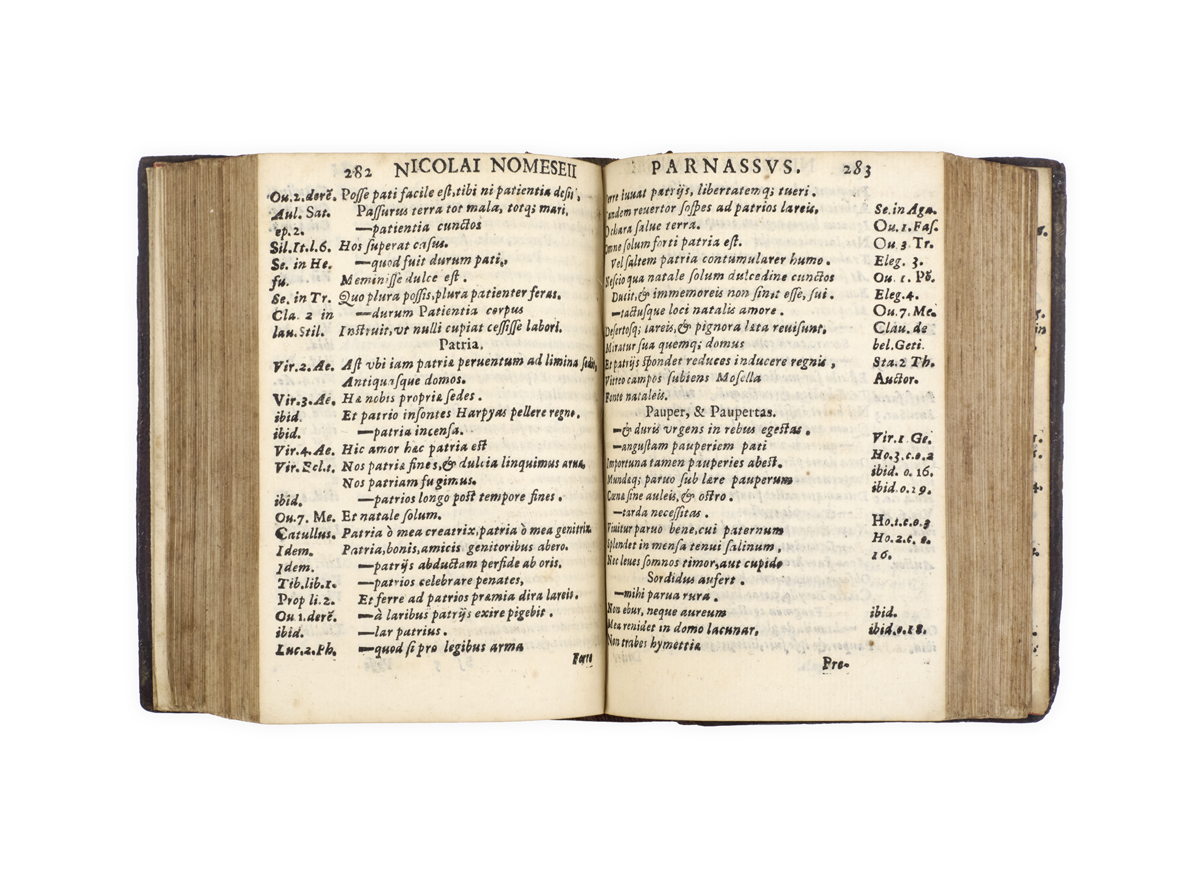
Nicolas de Nomexy (c. 1566–c. 1631), from Charmes, compiled this thematic Parnassus poeticus from classical and neo-Latin poets, including some of his own verses, arranged alphabetically; this second volume contains entries from Laborare to Uxor. The source of each line is provided in the printed marginalia, indicating the wide variety of poetic genres and styles included in the volume.
First published in Rome in 1595–1596 by Facciotti, de Nomexy’s work soon became a bestseller, with around forty printings in France, Germany, and Italy in the first half of the seventeenth century. Later editions were often revised and expanded, and it was adopted as a textbook by Jesuit schools to aid the study of Latin poetry (de Nomexy had a Jesuit education himself, in Rome); a second compilation was subsequently issued with extracts from religious writings. This is the second Roman edition, although it incorporates corrections from the intervening Cologne editions of 1601 and 1602 by Bernhard Walter, as indicated by the title.
Facciotti printed this edition for at least two other Roman booksellers. This volume retains the preface by Pietro Antonio Lanza, for whom Facciotti had printed the 1595–1596 edition.
The binding has a typically Roman design, with an oval armorial surrounded by swirls, leafy swags, and drapery, flanked by two cornucopias. It can be attributed to the leading Roman bindery of the time, the Soresini workshop, which produced bindings with similar decoration for Pope Paul V.
No copies traced outside continental Europe.
USTC 4032427 (both volumes); see Cullière, ‘Le Parnassus poeticus de Nicolas de Nomexy: histoire d’un best-seller au XVIIe siècle’ in Bulletin du Bibliophile (1985), pp. 417–430, no. 5 in his list of seventeenth-century editions.