Satire and Smut
PETRONIUS ARBITER, Titus.
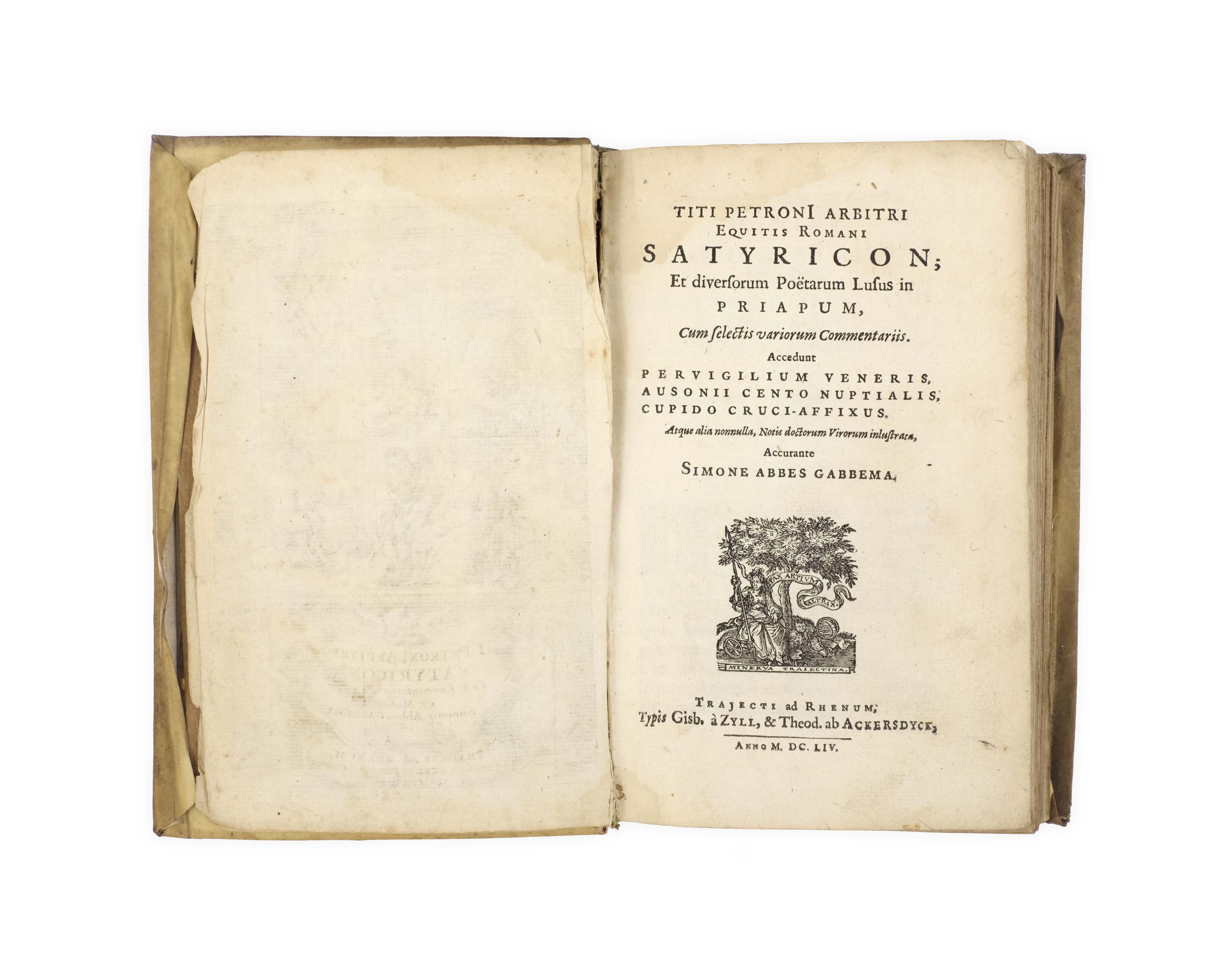
Satyricon; et diversorum poëtarum lusus in Priapum, cum selectis variorum commentariis. Accedunt Pervigilium Veneris, Ausonii cento nuptialis, Cupido cruci-affixus. Atque alia nonnulla, notis doctorum virorum inlustrata, accurante Simone Abbes Gabbema. Utrecht, Gijsbert van Zijll and Dirck van Ackersdijck, 1654.
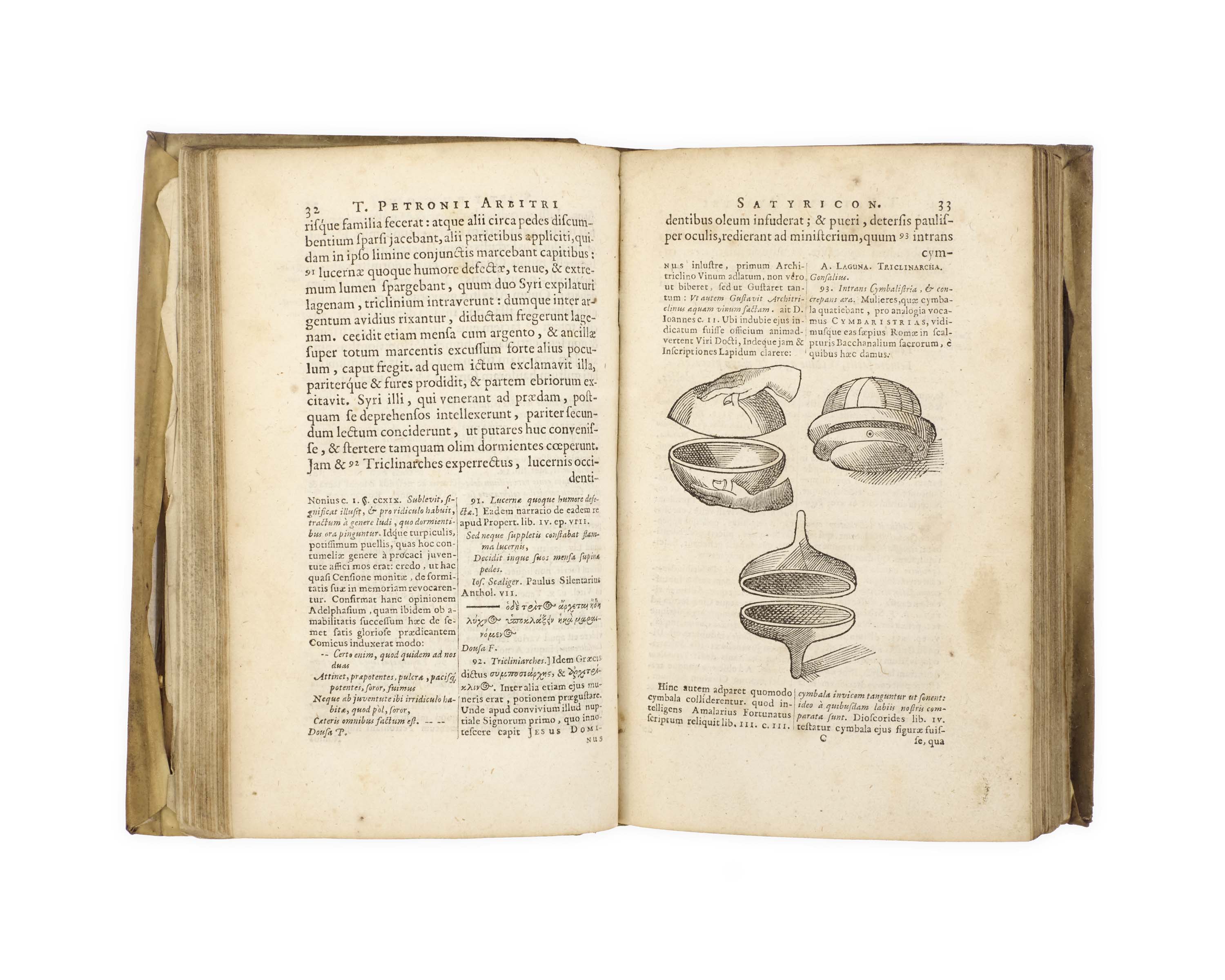
8vo, pp. [xiv], 56, [16], 252, [12], 130, [6]; engraved frontispiece, woodcut printer’s device to title-page, woodcut initials and tailpiece, woodcut illustrations of cymbals to C1r; frontispiece slightly defective and almost detached, light damp-staining to head of gutter of first few quires, paper flaw to head of (a4), (a8) slightly worn with small hole in text, slight water-damage to last third of volume, but a good copy; bound in contemporary Dutch vellum over thin wooden boards, spine with author’s name in manuscript, yapp edges; binding a little soiled, vellum detaching from boards along edges (flattening the yapp edges), a few cracks to boards.
Added to your basket:
Satyricon; et diversorum poëtarum lusus in Priapum, cum selectis variorum commentariis. Accedunt Pervigilium Veneris, Ausonii cento nuptialis, Cupido cruci-affixus. Atque alia nonnulla, notis doctorum virorum inlustrata, accurante Simone Abbes Gabbema.
A volume of Silver Age satire and lewd lyrics with fourth-century Virgilian verses.
The Satyricon is ‘an elegant first-person prose narrative interspersed with poems of various length, the adventures of the comic rogue Encolpius (“Mr. Groin”) and his companions as they travel around the Bay of Naples in search of a hedonistic life and a free meal … He exploits the sexual and satirical encounters of Encolpius with teachers of rhetoric, orgiastic priestesses, excessively wealthy freedmen, mediocre poets, nymphomaniac ladies, useless witches, and unscrupulous legacy hunters to poke fun at the social, religious, cultural, and aesthetic issues of his time’ (Oxford Bibliographies). The identification of the Petronius responsible for this text is still somewhat in doubt; the manuscript and this edition identify him as Titus Petronius Arbiter, but Titus Petronius Niger (a courtier during Nero’s reign) and Gaius Petronius Arbiter are also suggested.
Petronius’s Latin novel is accompanied by other lustful and witty Latin poems: the Priapeia, the late antique Vigil of Venus, and two works by the fourth-century writer Ausonius; the wedding Cento (essentially a series of extracts from Virgil compiled at the behest of the Emperor Valentinian) and a poem about Cupid’s visit to the Underworld, where he is attacked by women who died for love, based on a fresco which Ausonius saw in the dining room of a villa in Trier (and also heavily based on Virgil). The Carmina Priapeia, a collection of eighty obscene, mocking and witty verses relating to the god Priapus, was probably written (or assembled) sometime towards the end of the first century AD. This is the first appearance in print of the composite commentary on the Priapeia based on those of Joseph Justus Scaliger, Caspar Schoppe, and Friedrich Lindenbruch.
This is one of two classical texts produced by Simon Abbes Gabbema (1628–1688), a Frisian scholar; he also edited the poems of Catullus and Tibullus (Utrecht, 1659), but most of his publications were of his own poetry and works on the history of Frisia.
USTC 1824973; STCN 832309613.