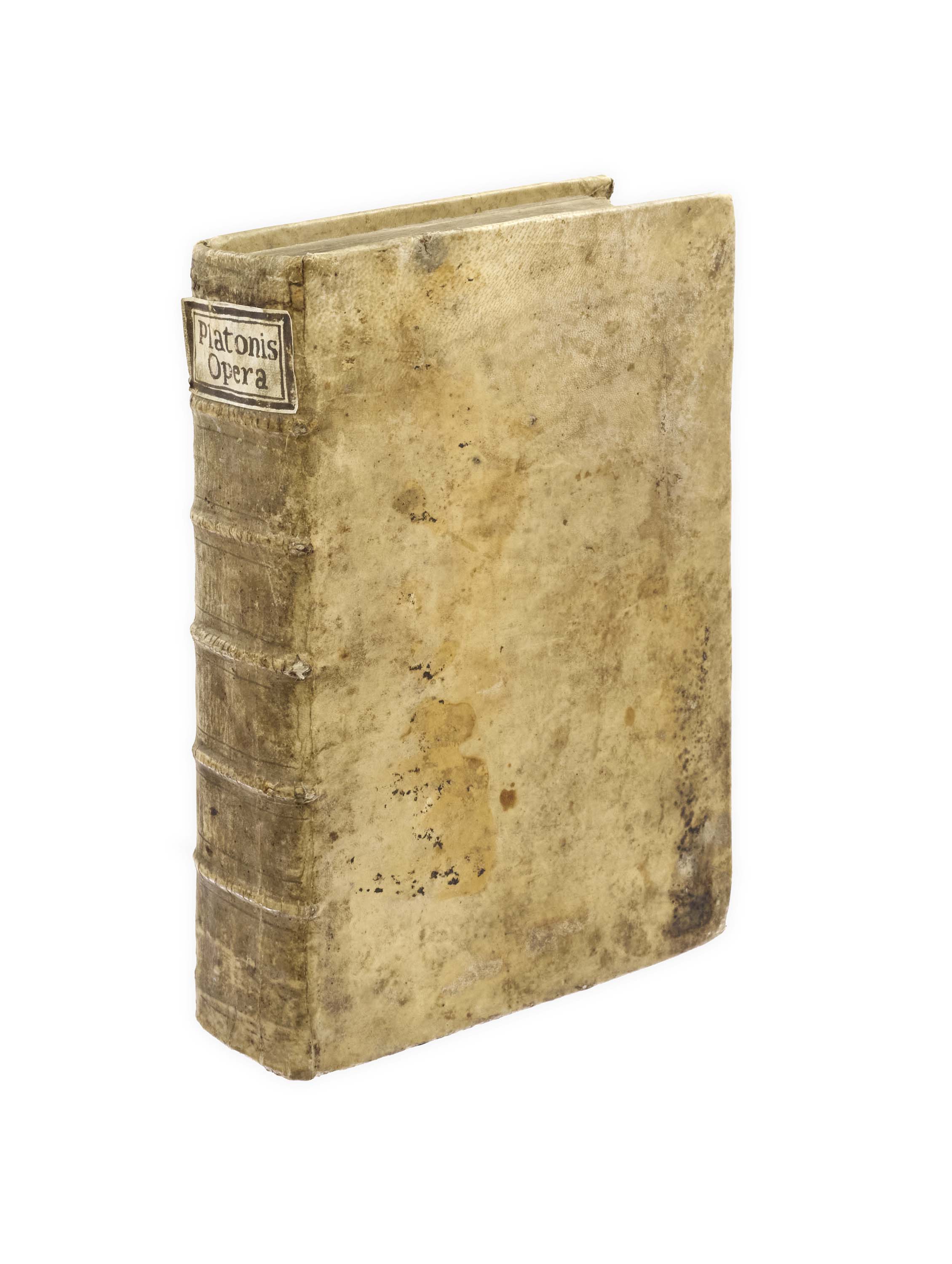
PLATO; [Marsilio FICINO].
Platonis opera. [(Colophon:) Venice, Filippo Pinzi, 22 April 1517.]
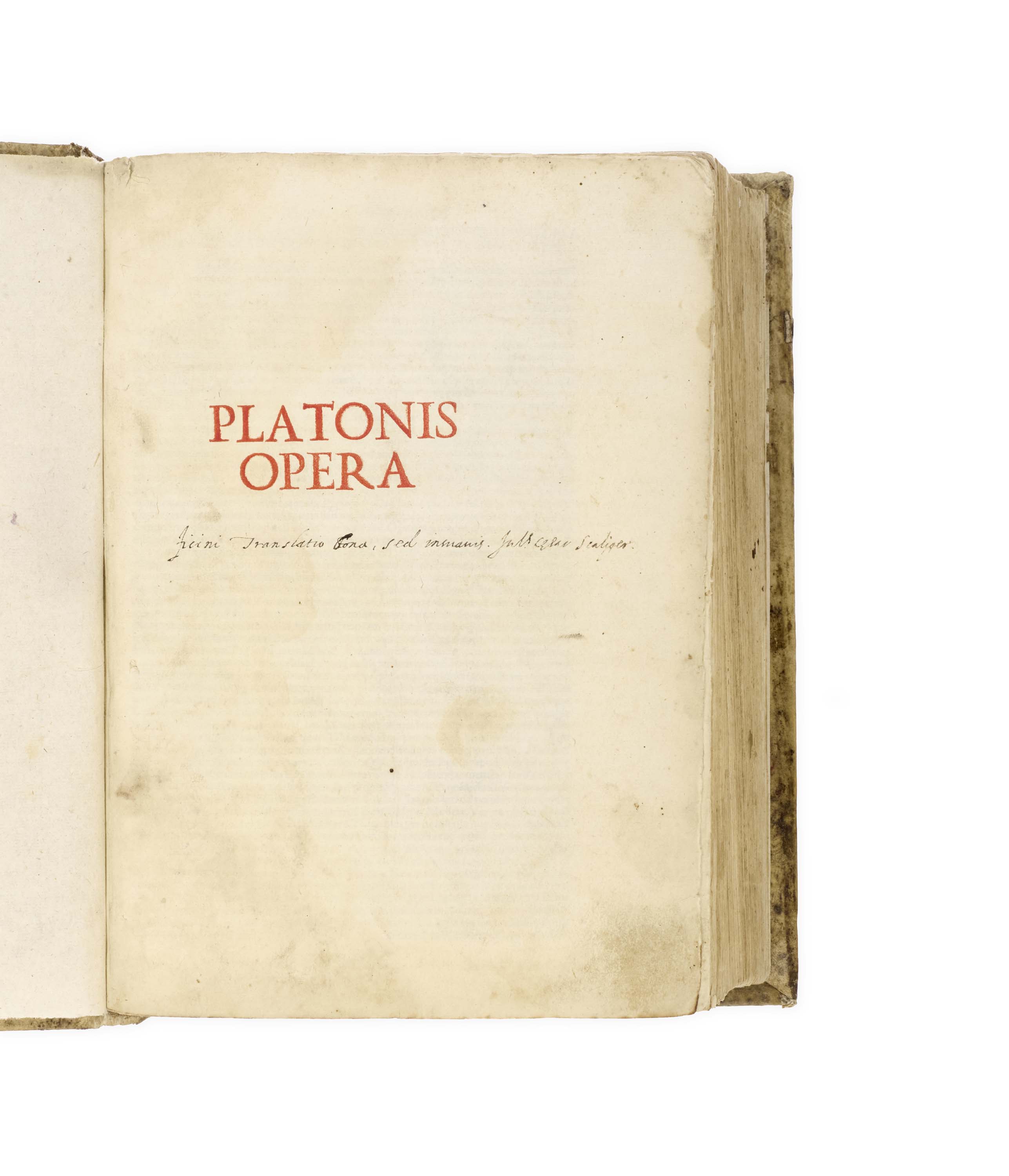
Folio, ff. [vi], CCXX, ‘167–174’ [i.e. CCXXI–CCXXVIII], ‘172–179’ [i.e. CCXXIX–CCXXXVI], CCXXXVII–CCCLXXXIX, [1, blank]; bifolium e4.5 present in duplicate; title printed in red, capital spaces with guide letters, one woodcut criblé initial, a few woodcut diagrams in the text; marginal excision to lower outer corner of n3, some dampstaining throughout, browning to some leaves, occasional light foxing, small hole to last blank leaf due to ink corrosion, but a good copy; in a twentieth-century binding reusing old vellum, manuscript paper label to spine; note to title-page referencing Scaliger, annotations in a few early hands to c. 320 pp., horoscope(?) and notes to final blank leaf.
Third edition of Marsilio Ficino’s important and influential Latin translations of and commentaries on Plato’s works, with numerous early annotations.
Ficino (1433–1499) had completed a draft translation of Plato’s works as early as 1469. Returning to them some years later, after working on his Theologia Platonica, he added commentaries, and in 1484 a first edition, comprising thirty-five dialogues and the Platonic Epistolae, was published at Florence by Lorenzo di Alopa. A second edition by Andrea Torresano appeared in 1491, and Alopa published Ficino’s fuller commentaries on several Platonic dialogues in 1496.
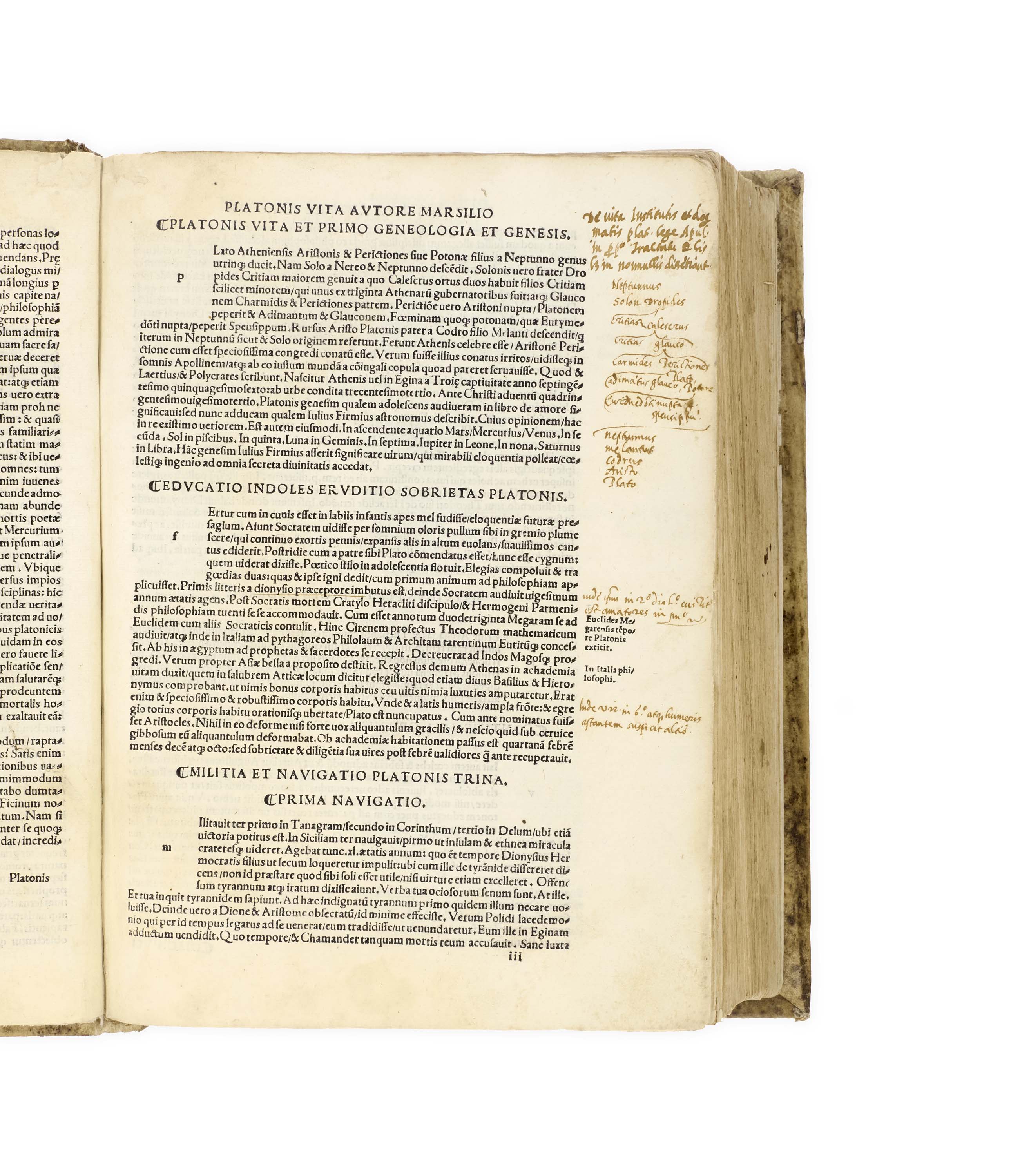
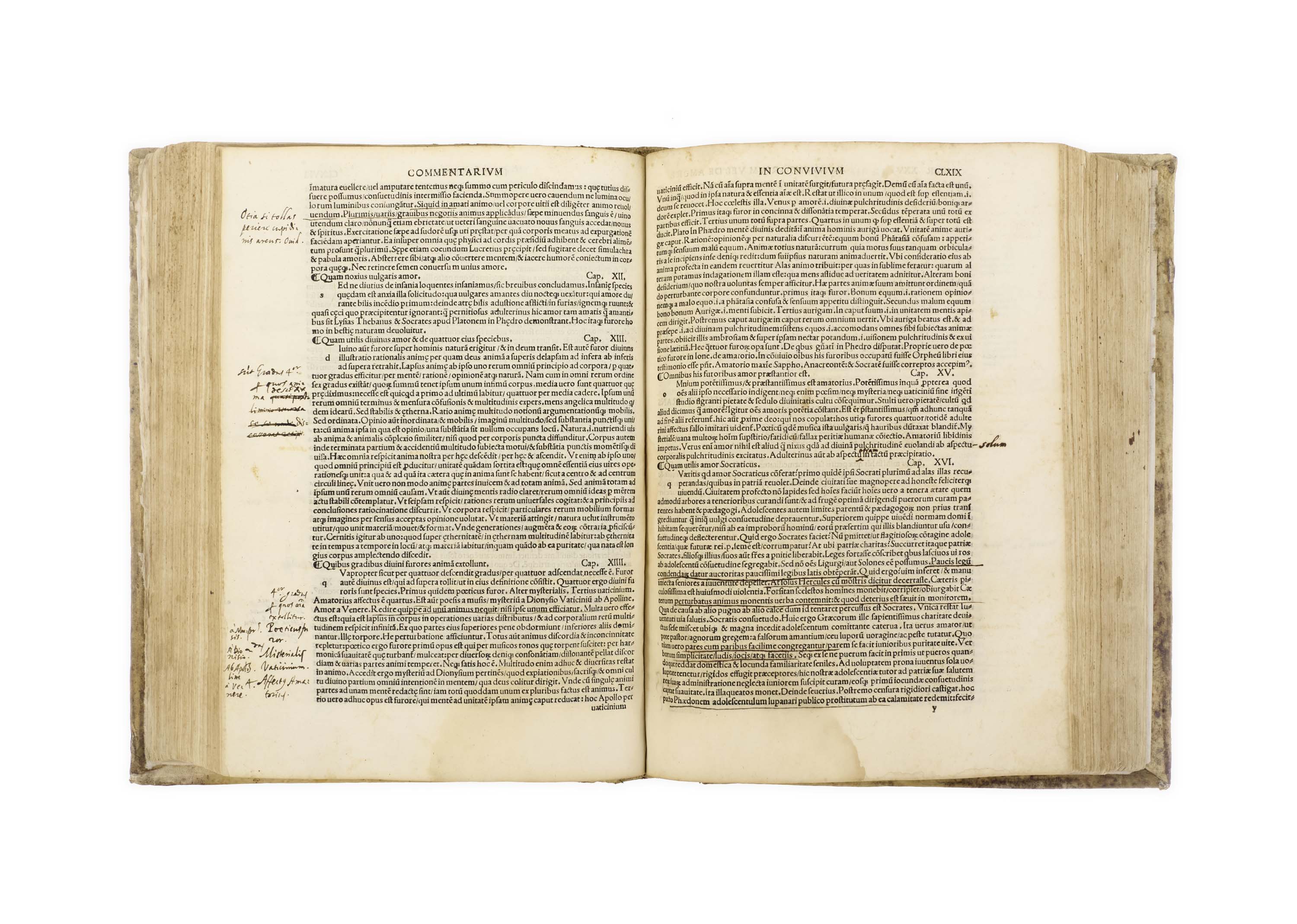
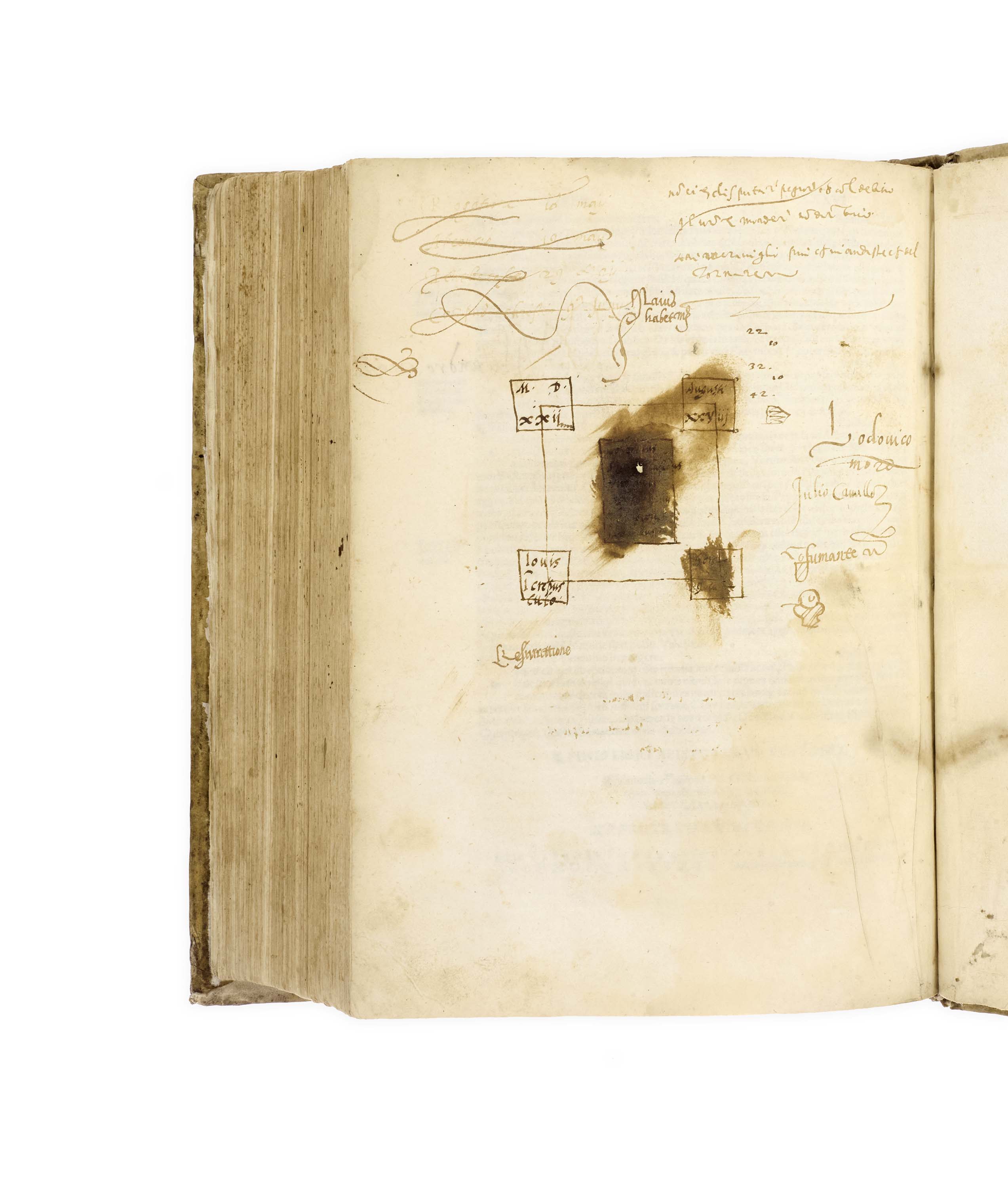
This copy contains marginalia in Latin and Italian in at least two sixteenth-century hands and one seventeenth-century hand, picking out keywords and providing summaries, in particular to Plato’s Protagoras, Cratylus, Gorgias, Symposium, Crito, Phaedo, Republic, and Laws. The soul and love emerge as subjects of evident interest to the volume’s early readers. A list of the Muses and planets associated with them appears in a note to Ion, while an annotation to Protagoras refers to gods and demons. The annotations are not uncritical: beside a passage in book X of the Republic appears, for example, ‘q[uest]a ragione e debole e forsi falsa’. References are made to other classical writers such as Aristophanes, Aristotle, Homer, and Virgil. Several names are written on the final blank leaf – ‘Alesandro Regi’, ‘Lodovico Moro’, ‘Julio Camillo’ – and there is what appears to be a horoscope diagram (partly obscured by ink) bearing the date 28 August 1522.
‘Julio Camillo’ may plausibly refer to Giulio Camillo, known as ‘Delminio’ (c. 1480–1544). While teaching at Bologna in the early 1520s he ‘began designing a wooden theatre to provide a setting for the orator practising the ancient art of memory. He believed that in contemplating the Hermetic and cabbalistic symbolism of his theatre the orator could master all knowledge by rising, perhaps through solar magic, to the eternal world of ideas’ (Contemporaries of Erasmus).
EDIT16 CNCE 34948; USTC 849833; Adams P 1442.