
Huguenot Machiavellianism
ROHAN, Henri, Duke of; [Henry HUNT, translator].
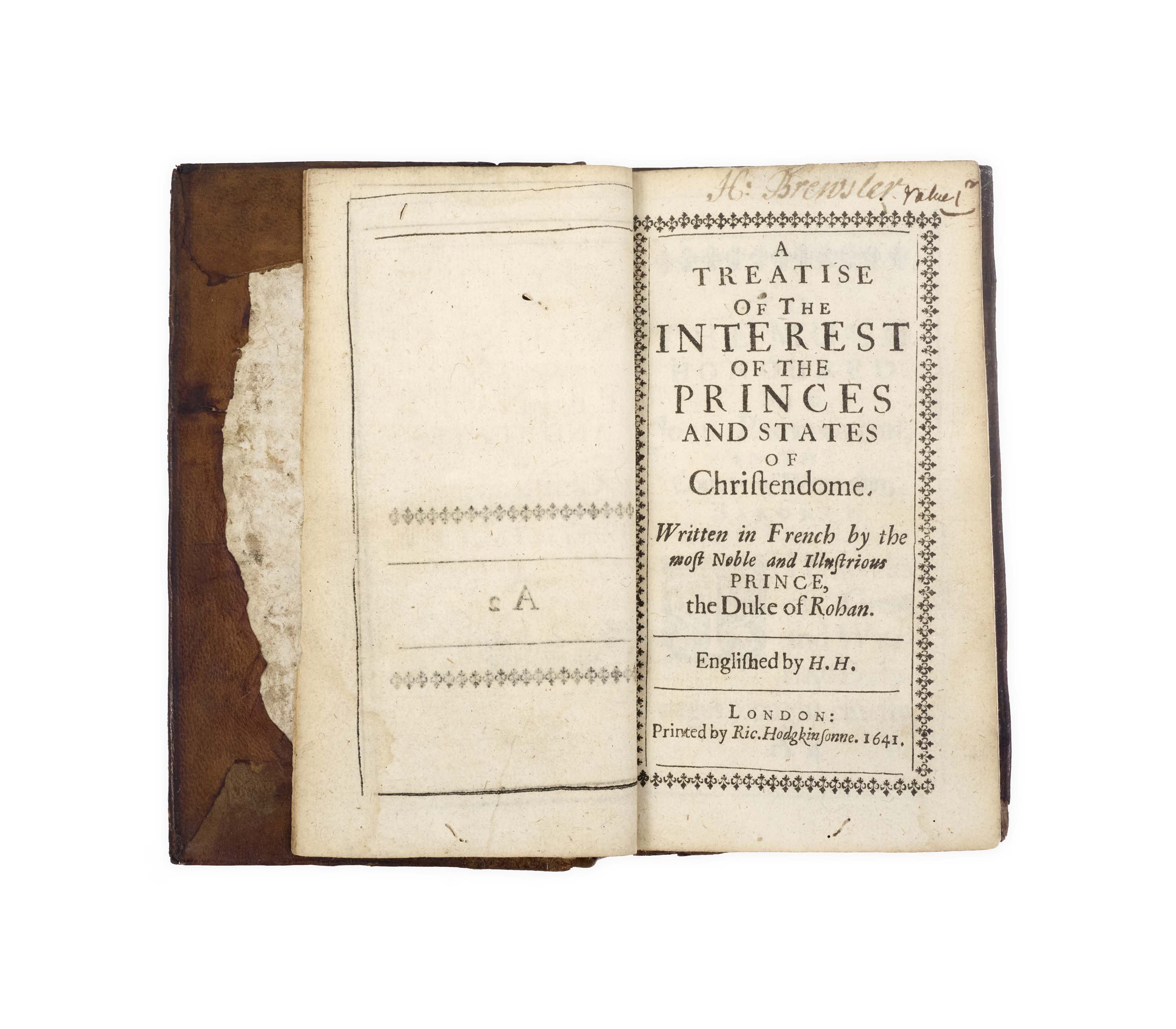
A Treatise of the Interest of the Princes and States of Christendome. Written in French by the most noble and illustrious prince, the Duke of Rohan. Englished by H. H. London, Richard Hodgkinson, 1641.
12mo, pp. [24], 59, [7], 146, [4]; ruled borders, woodcut initials and head- and tailpieces, and typographic ornaments throughout, woodcut device to title of second part; slight browning throughout, a few minor dampstains, some small wormtracks affecting a handful of words, final leaf trimmed short at fore-edge with ruled border shaved; else a good copy in contemporary sheep, covers tooled with a triple-fillet border in blind; rebacked in calf with old gilt lettering-piece laid down, repairs to leather at foot of each cover, a few scuffs and gouges; early ownership inscription of R. Darley to front free endpaper, later ownership inscription of H. Brewster to title, price inscriptions to title and last leaf.
Added to your basket:
A Treatise of the Interest of the Princes and States of Christendome. Written in French by the most noble and illustrious prince, the Duke of Rohan. Englished by H. H.
First edition in England (and second in English) of this groundbreaking work on political interest and the balance of power by the leader of the Huguenots, this copy with hitherto unnoticed printing variants.
Henri, Duke of Rohan (1579–1638) commanded the French Protestants in the wars of the 1610s and ’20s prior to his reconciliation with Richelieu in 1629; thereafter he led French campaigns against the Habsburgs in Switzerland and northern Italy. Written at the height of the Thirty Years’ War and first published in French in 1638, his treatise is a coolly Machiavellian analysis of the geopolitics of Europe. Starting with his ‘famous opening sentence’ (Hirschman, p. 34) – ‘The Princes command the People, & the Interest commands the Princes’ – Rohan lays out in realist terms the interests of each nation and how its rulers might achieve them. Espionage, fomenting rebellion, feigned piety, and playing Catholics and Protestants off against each other are among the methods prescribed.
‘There are sentences here which will make even the modern reader’s heart beat fast. One is faced with the spectacle of a man who has hit upon the supreme task of all historical speculation … His words exhale the passionate feeling of the statesman, who sees with equal clarity both the high fixed guiding star of conduct and the changeability of winds and currents’ (Meinecke, pp. 168–9).
England – ‘a little world apart’ but soon to be ‘a third Puissance in Christendome’ – gets a chapter to herself, and in this country the book was ‘particularly influential’. ‘It was rapidly translated and provoked much comment. One of Rohan’s pithy phrases in his opening paragraph – l’intérêt seul ne peut jamais manquer … is at the origin of the maxim “Interest Will Not Lie,” which gained considerable currency in seventeenth-century England’ (Hirschman, p. 36), supplying inter alia the title of an important pamphlet by Marchamont Nedham. The present translation was first published in a Paris quarto of 1640.
Quires B and C of our copy are in a variant state not noticed by Wing or ESTC. Aside from many differences in accidentals and signature and catchword placement, there is one substantive textual difference: in our copy ‘The Catholik Princes [of Germany] ought from henceforth to be well advised’ – rather than ‘to disabuse themselves’ in the British Library and Huntington copies and the 1640 edition – that ‘they serve the designe of the house of Austria, and forge by little and little the irons of their own bondage …’ (p. 44).
ESTC R24499; Wing R 1868. See Hirschman, The Passions and the Interests (1977); Meinecke, Machiavellism: the Doctrine of raison d’état and its Place in modern History (1957).