Dante Gabriel Rossetti’s Manifesto: ‘W. M. Rossetti From Gabriel’
ROSSETTI, Dante Gabriel.
Hand and Soul. [London, Strangeways & Walden, 1869.]
[bound with:]
TENNANT, Charles. Supplementary Chapter on Ireland. [London, 1871.][and with:]
BUCHANAN, Robert. The Fleshly School of Poetry. London, Strahan & Co., 1872.[and with:]
MONK, Henry Wentworth. Our Future. No. 1. New Discoveries relative to our solar System … London, for the author, by Catty and Dobson, [1872].[and with:]
TAYLOR, C[harles] Bell. On the forcible Introspection of Women by Governments … London, McGowan and Danks, 1870.[and with:]
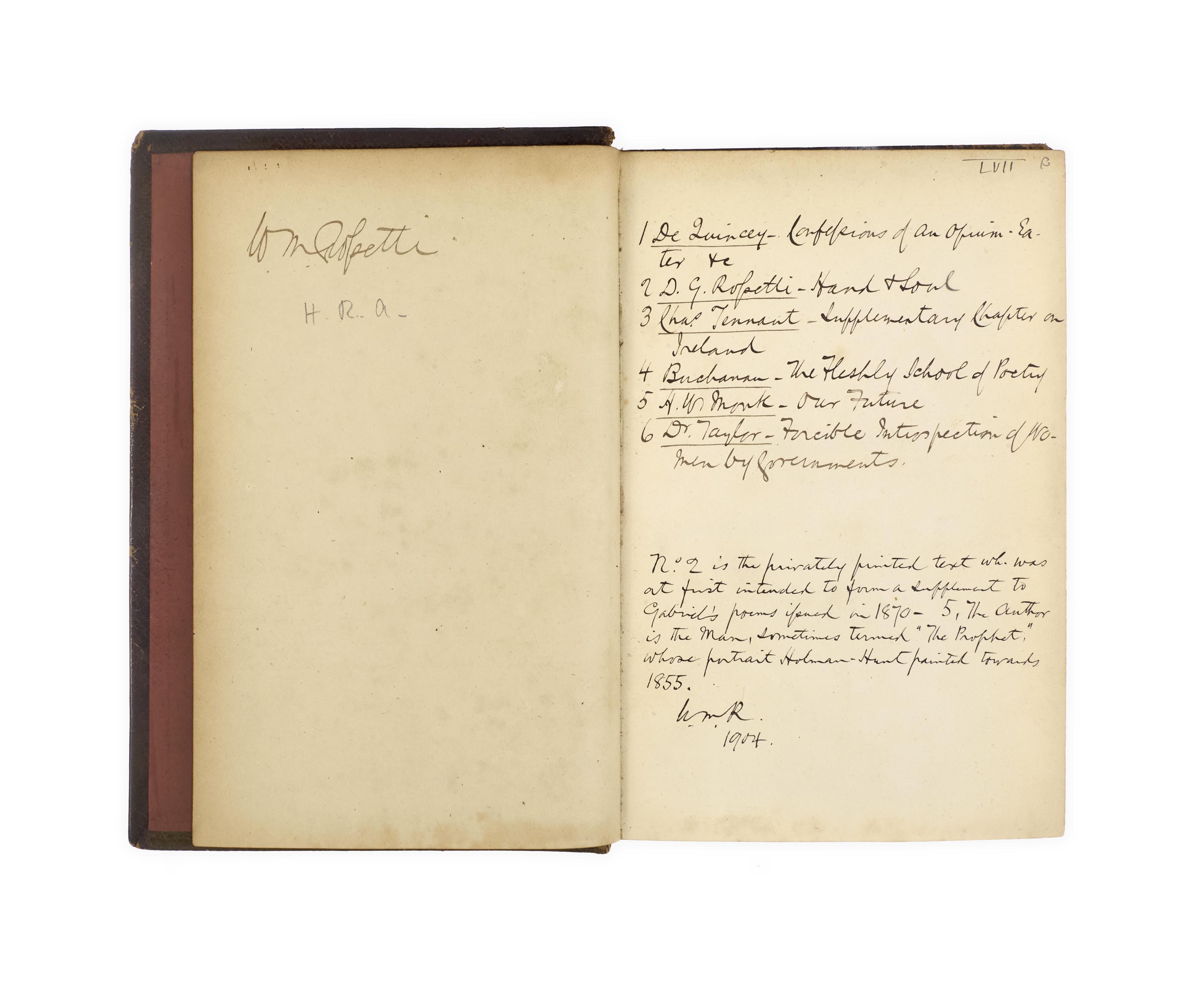
DE QUINCEY, Thomas. Confessions of an English Opium-Eater … New Edition … London and New York, George Routledge and Sons, [n.d.].Six works, small 8vo, Rossetti: pp. 22, without the terminal blank; Tennant: pp. 116; Buchanan: pp. ix, [1], 97, [1]; Monk: pp. 31, [1]; Taylor: pp. 16; De Quincey: pp. [3]–130; very good copies, bound together in late nineteenth-century green morocco, rubbed, spine browned and dry; manuscript index and ownership inscription of William Michael Rossetti, with an additional note at the foot dated 1904; ownership inscription of Helen Rossetti Angeli; numbered in pencil ‘LVII'.
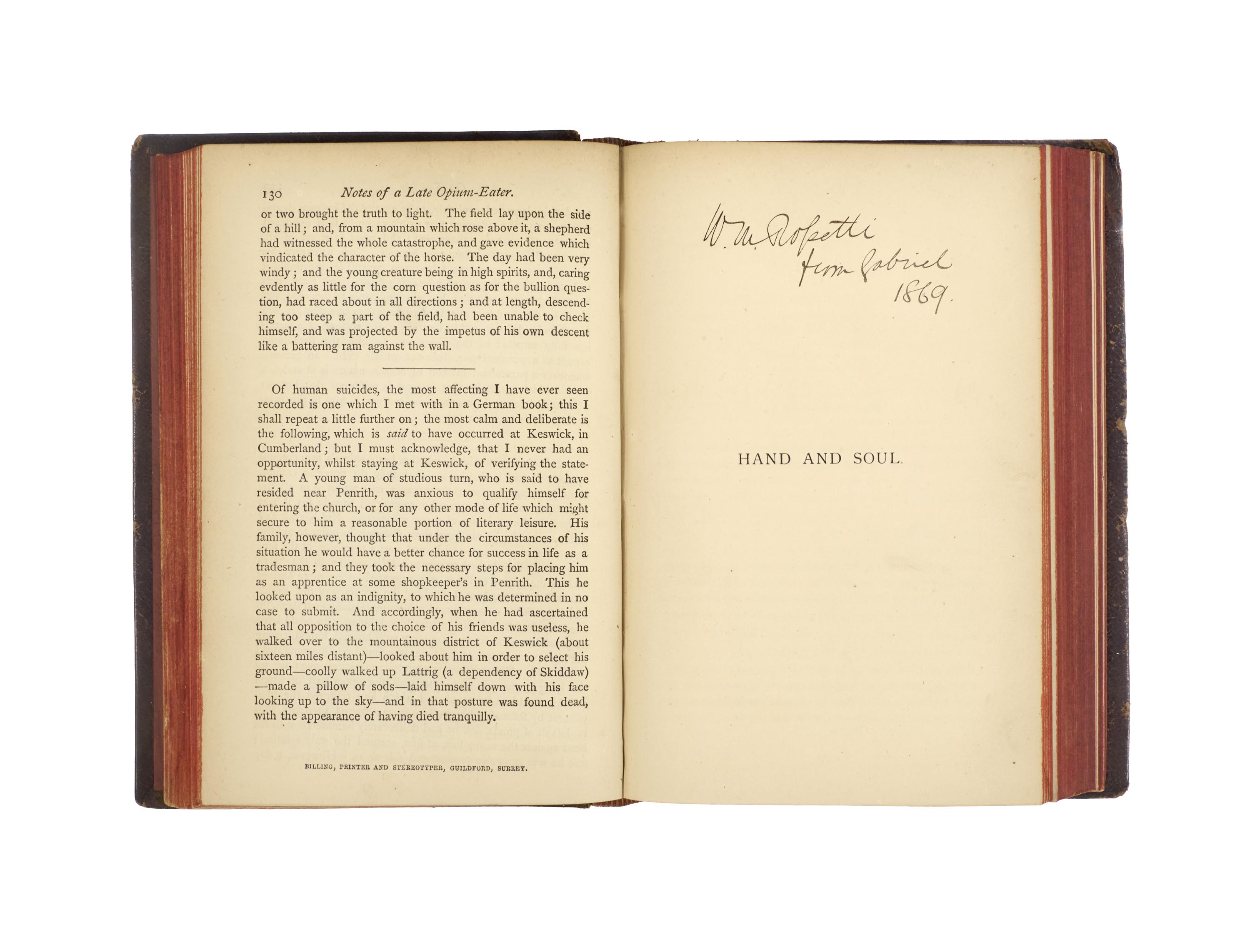
The ideal presentation copy of the very rare separate printing of Hand and Soul, the ‘key work of Pre-Raphaelite fiction’ (Lasner), with an inscription in the recipient’s hand ‘W.M.Rossetti from Gabriel 1869’.
Hand and Soul is often considered as Dante Gabriel Rossetti’s artistic manifesto, and its central protagonist, the artist Chiaro, as his alter ego. First published in the first issue of The Germ (1850), when William Michael Rossetti helped transcribe it for the printers, the story was much worked over by Dante Gabriel Rossetti in 1869 when he intended to include it in Poems 1870. Revisions made in September to October 1869 included a number made at William Michael Rossetti’s suggestion, and the story was included in the pre-trial ‘Penkill Proofs’ as well as the First Trial Book of October, but it was dropped before the Second Trial of November. At that time Dante Gabriel Rossetti repaginated the sheets of the First Trial and had a very small number of copies printed off, and bound in drab wrappers, of which he gave a few away but never sold any. Wise suggested 100 were printed, which Lasner thinks optimistic, noting that ‘most of the 25–30 distinct examples known – all but a handful in institutional collections – derive from a remainder found by William Rossetti after his brother’s death in 1882’; at that time he sold copies to, among others, Thomas Wise and Buxton Forman (who used it to prepare a forged ‘chimera’). Only two authorial presentation copies are known, inscribed to Thomas Dixon, and John B. Schott (husband of his housekeeper), and there is one other surviving presentation copy inscribed by the recipient (William Sharp), making the present exemplar by some measure the most important extant copy of the work. See Lasner, ‘A Bibliographical Essay on Hand and Soul’, 1997 (on the Rossetti Archive online).
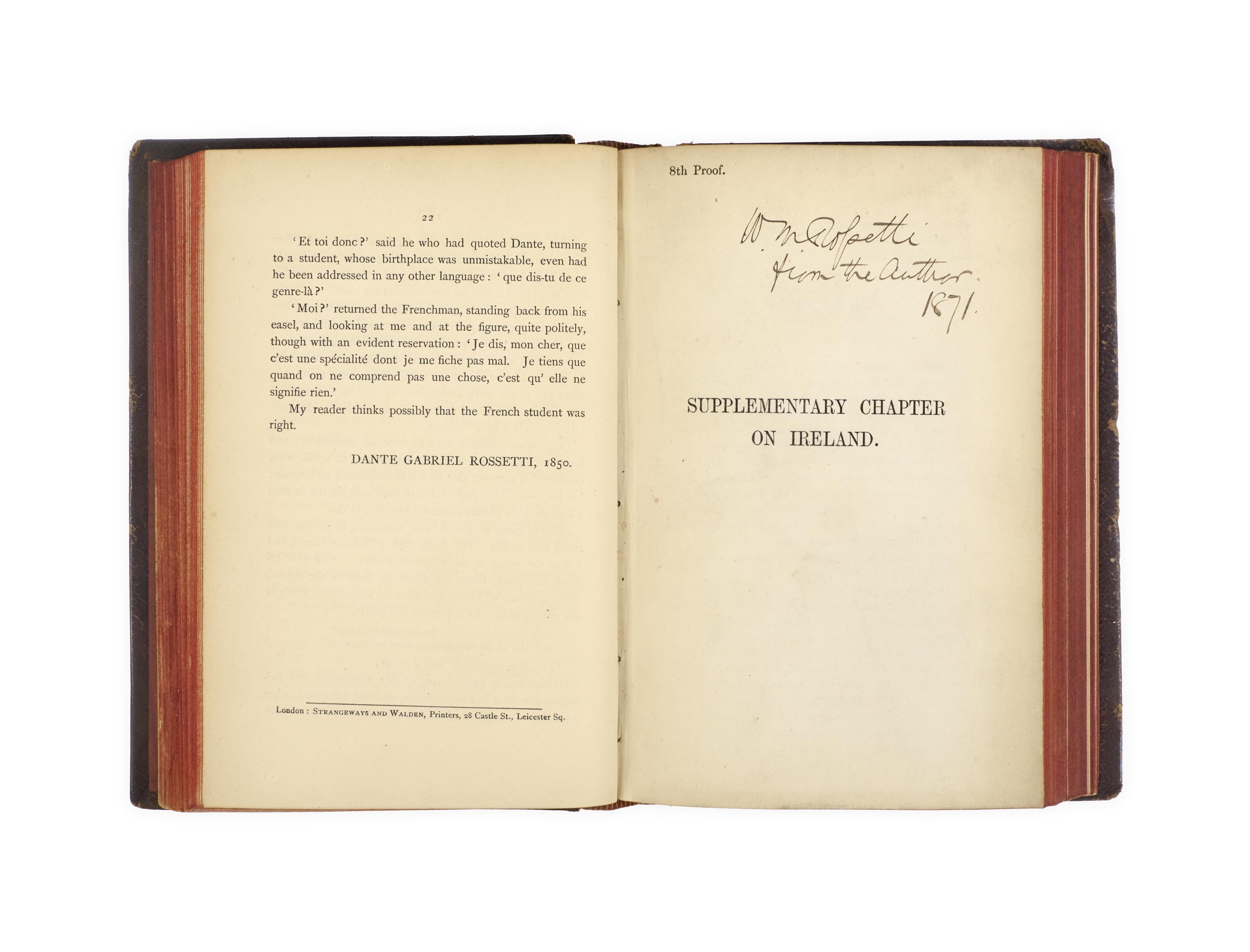
Hand and Soul is bound here with an ‘8th Proof’ of Charles Tennant’s ‘Supplementary Chapter on Ireland’, inscribed in the recipient’s hand ‘W.M.Rossetti from the author 1871’. The essay on the ‘Irish Question’ was to appear as an appendix to an enlarged edition of The People’s Blue Book: Taxation as it is, and as it ought to be (1872), which was written after an extended visit to Ireland in 1870. On p. 114, Tennant quotes Christina Rossetti’s ‘Does the road wind up-hill all the way?’, which is presumably the occasion of the presentation. The proof text of the Supplementary Chapter is different from that which was finally published in 1872. Library Hub records only two other proof printings: at Bristol (paginated as here), and Trinity College Cambridge (‘10th Proof’, pp. 130).
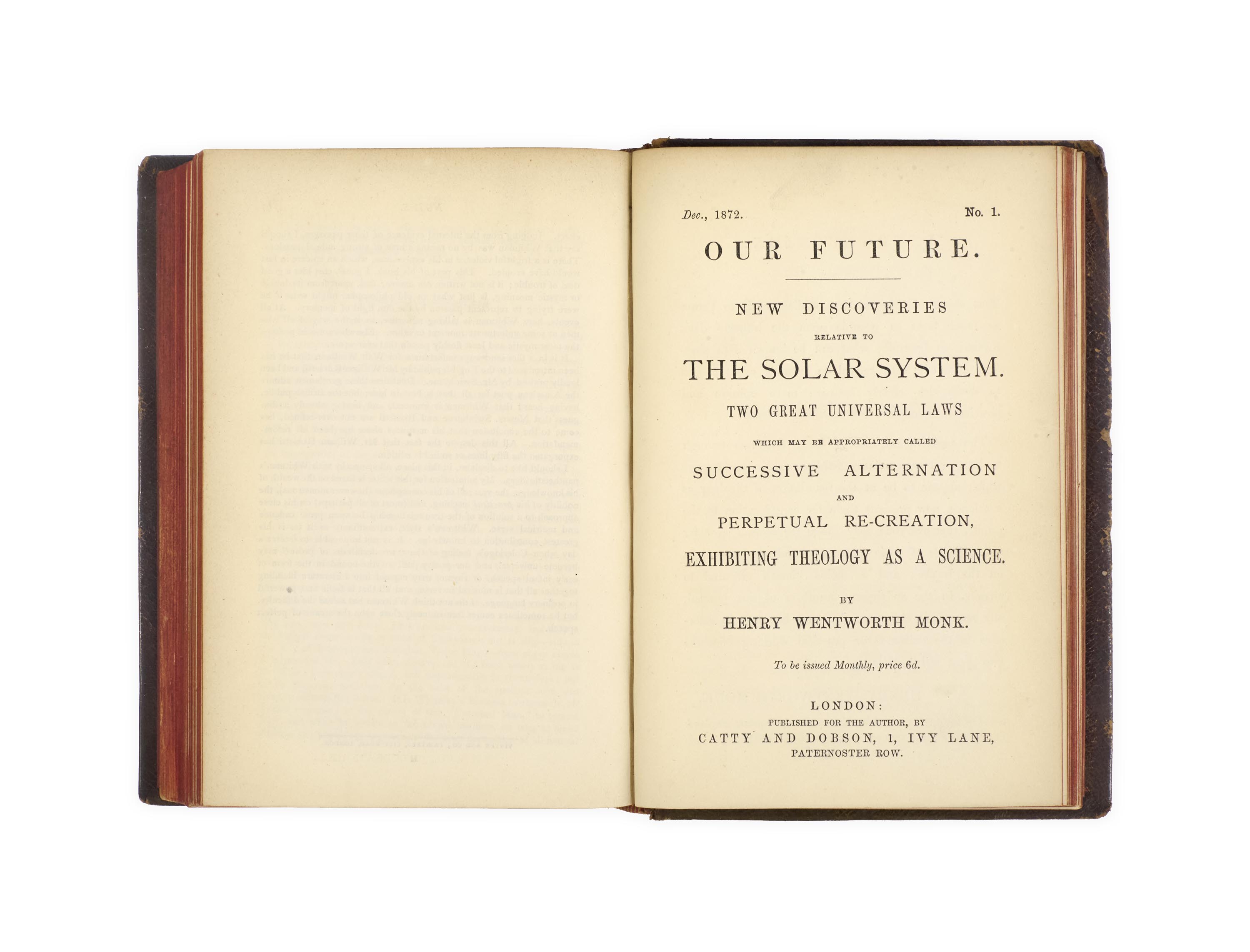
Also found here is the first and only issue of a very rare periodical by the Canadian Zionist and mystic Henry Wentworth Monk, ‘the man, sometimes termed “the Prophet”, whose portrait Holman-Hunt painted towards 1855’ (note by William Michael Rossetti here). In the Spring of 1871 Monk wrote to Hunt that ‘I want you to be prepared for the great Scientific Revolutions I am about to astonish the world with – I intend to visit London, England, early this summer; – I shall then see what prospect there is of getting my contemplated monthly Paper (“Our Future”) under weigh (sic) immediately’. In due course he published in London in December this issue No. 1, presenting his ‘discovery’ of ‘two great universal laws … at the foundation of theology and science’ – Successive Alternation and Perpetual Re-creation. No further issues followed. Library Hub and OCLC show copies at BL, Bodley, and TCD only.
In his very rare pamphlet On the forcible Introspection of Women (1870, Royal College of Surgeons only) the ophthalmic surgeon Charles Bell Taylor railed against moralistic, misogynistic legislation on venereal disease that legitimised physical intervention without the patient’s consent.