Florentine Tragedy and Comedy
RUCELLAI, Giovanni.
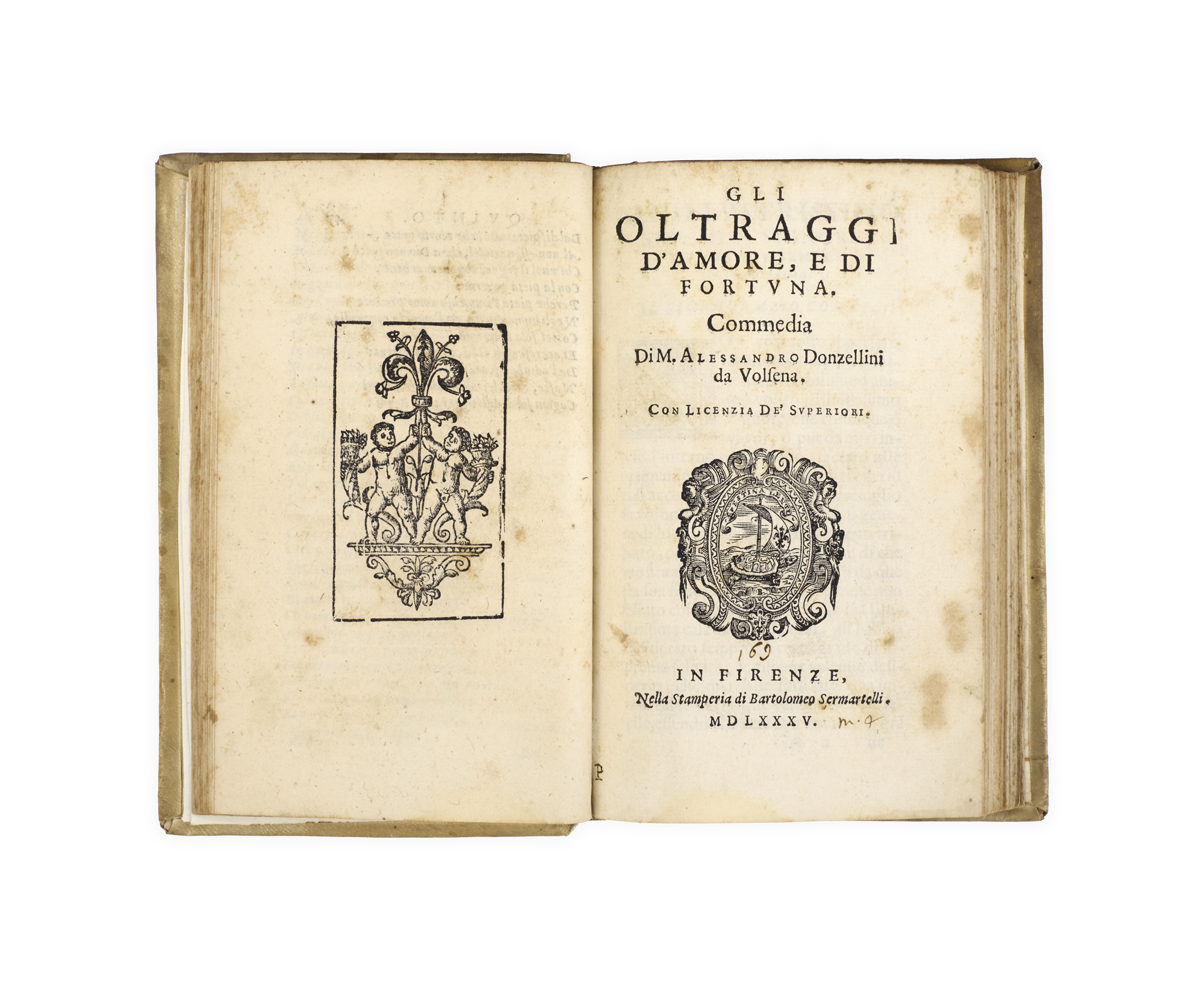
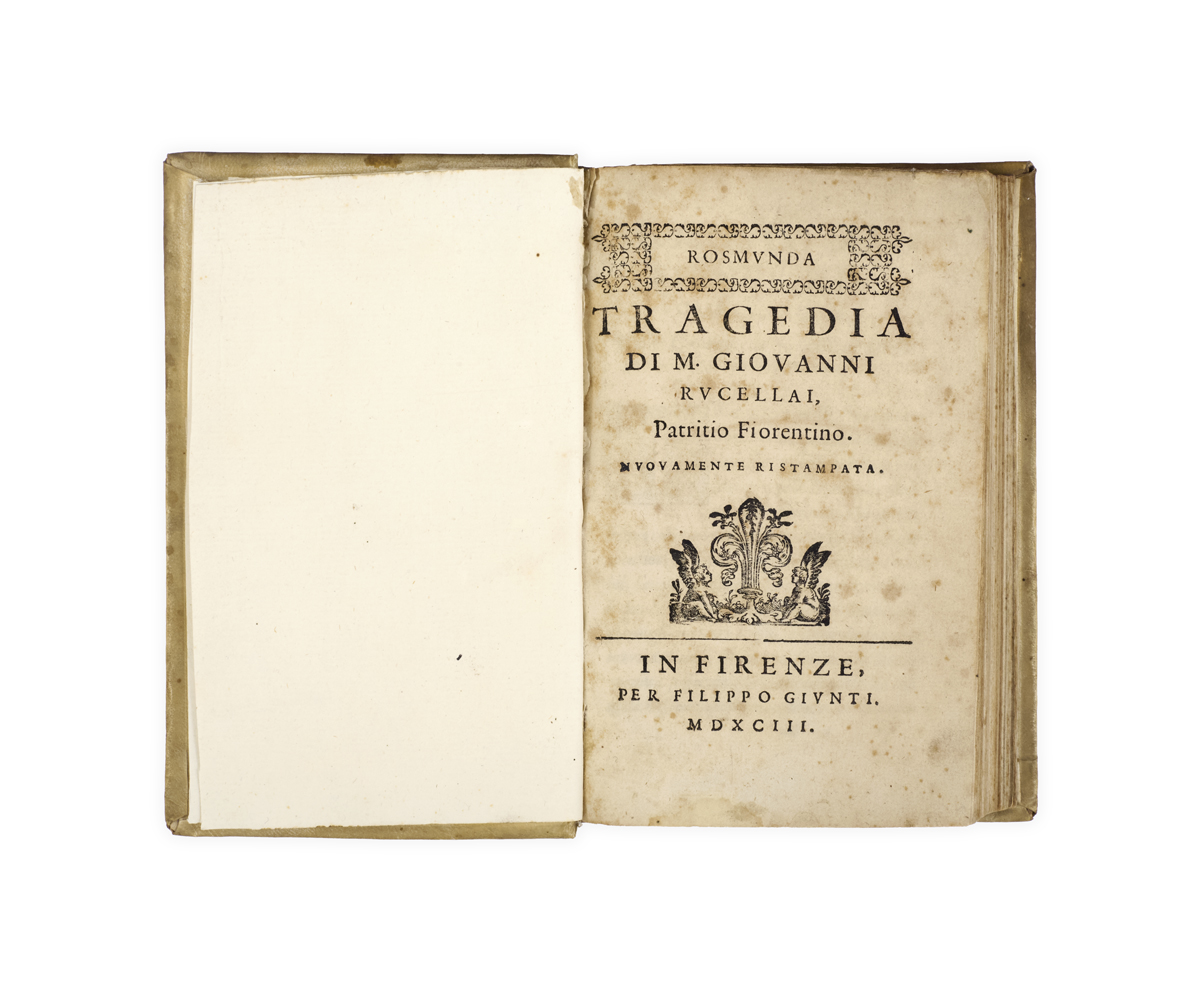
Rosmunda. Tragedia … nuovamente ristampata. Florence, Filippo Giunta, 1593.
[bound with:]
DONZELLINI, Alessandro. Gli Oltraggi d’amore, e di fortuna. Commedia. Florence, Bartolomeo Semartelli, 1585 (Colophon: 1586).8vo, Rosmunda: pp. 47, [1]; Oltraggi: pp. 149, [1, colophon], [2, blank]; woodcut printer’s devices to titles and final leaves, woodcut initials; first few leaves browned, sporadic foxing (particularly to first work and end of second), marginal dampstaining to second work, sporadic light toning; neatly recased in the original seventeenth-century vellum over boards, top-edge of second work stained purple, spine lettered in manuscript, slight staining to upper corners, front endpapers renewed (obscuring early shelfmark).
Uncommon first edition of Donzellini’s early comedy on the conflict between Love and Fortune, featuring a love triangle and an escape from slavery after the Battle of Lepanto in 1571, bound with the rare second Giunta edition of the first tragedy written by Giovanni Rucellai, author of Le api.
Rosmunda, based on Euripides’ Hecuba, was first staged in the Orti Oricellari – the magnificent gardens established in Florence by Ruccelai's father, Bernardo, where Machiavelli, Guicciardini, and members of the Accademia Platonica had held discussions – in 1516, to coincide with Pope Leo X’s sojourn in Florence; it was first printed in Siena nine years later. Rucellai is perhaps best known for his didactic blank verse poem Le api (The Bees), popular well into the eighteenth century and an important precursor to Luigi Alamanni’s La coltivazione, with which it was frequently issued.
Donzellini (c. 1542/5–1613) became a notary at the age of nineteen, was a member of the Sienese Accademia degli Intronati (under the pseudonym Stordito), and worked with numerous notable Roman families, including the Farnese, Colonna, and Conti; the present work, dedicated to Orazio Conti, evidently circulated in manuscript for several years (the Beinecke holds a manuscript dated 1572), but must have been written after 1571. ‘Reference is made to the liberation of one of the main characters in the story, Parthenius, who had been taken prisoner after the Battle of Lepanto … Set against the backdrop of Ottavio Farnese’s Roman palazzo, the story stages, through complex vicissitudes, the conflict between Love and Fortune … Olympia, known as Iphigenia, loves Cleander, who is in love with Amata, who in turn loves Parthenius, who is in love with Iphigenia … Around these main characters revolve a series of characters typical of the comic genre: a greedy old father, an unscrupulous courtesan, a loyal servant and a foolish one, a captain, and a cowardly braggard’ (Terroni, p. 216)
Rosmunda: Outside continental Europe, OCLC finds a single copy in the UK (CUL), to which Library Hub adds another (Bodley); no copies traced in the US. Oltraggi: Outside continental Europe, OCLC finds two copies in the UK (BL, CUL), and one in the US (Huntington).
Rosmunda: EDIT16 CNCE 28836; USTC 853741; Adams R-854; Gamba, p. 471 (described, with the Giunta edition of 1568, as ‘meglio corrette’ relative to earlier editions); BM STC Italian records the editions of 1528, 1550, and 1568 only. Oltraggi: BM STC Italian, p. 226; EDIT16 CNCE 17739; USTC 827663; not in Gamba or Adams. See Terroni, ‘Testi teatrali fra performance e lettura’, in Textual Cultures 16:2 (2023), pp. 209–230.