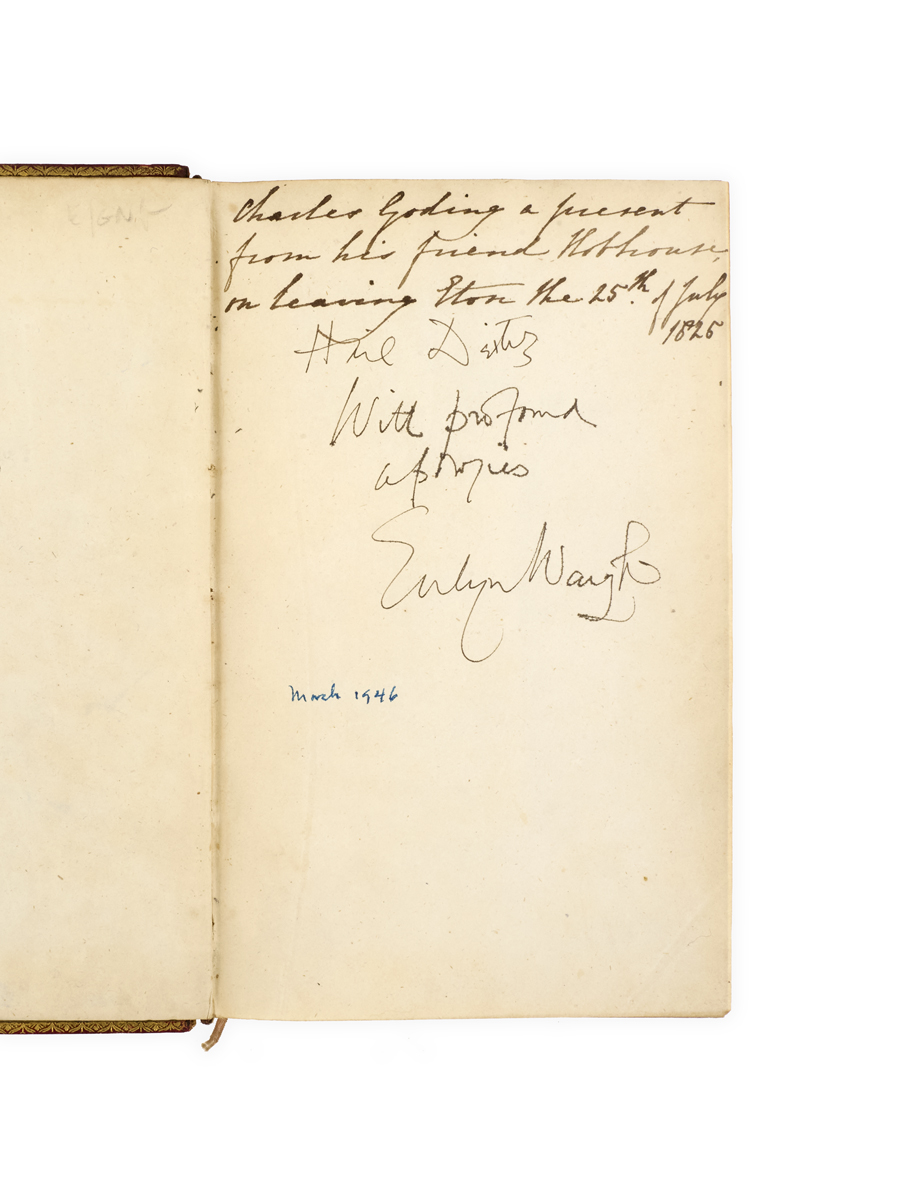
Inscribed by Evelyn Waugh ‘With Profound Apologies’
SCOTT, Walter, Sir.
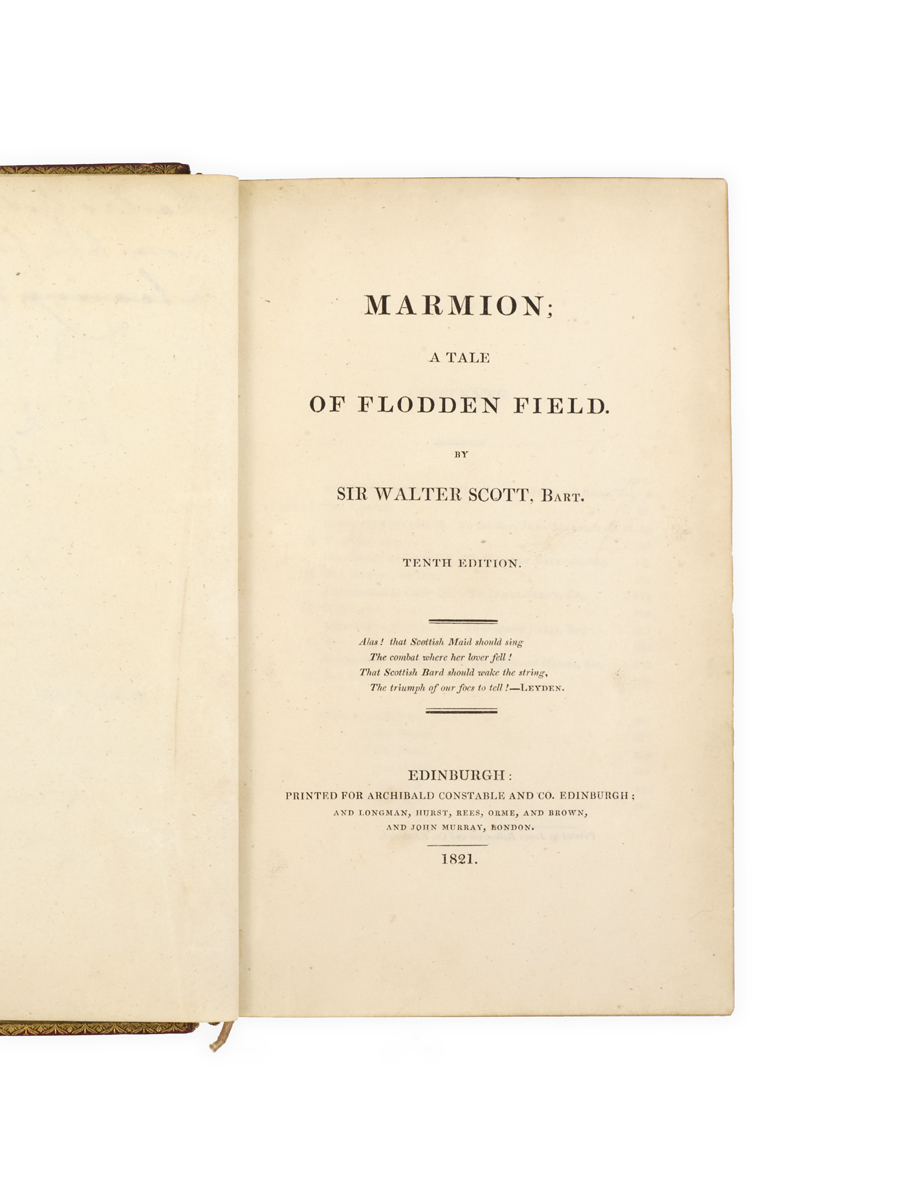
Marmion; a Tale of Flodden Field. Edinburgh, Archibald Constable; London, Longman, Hurst, Rees, Orme, and Brown, and John Murray, 1821.
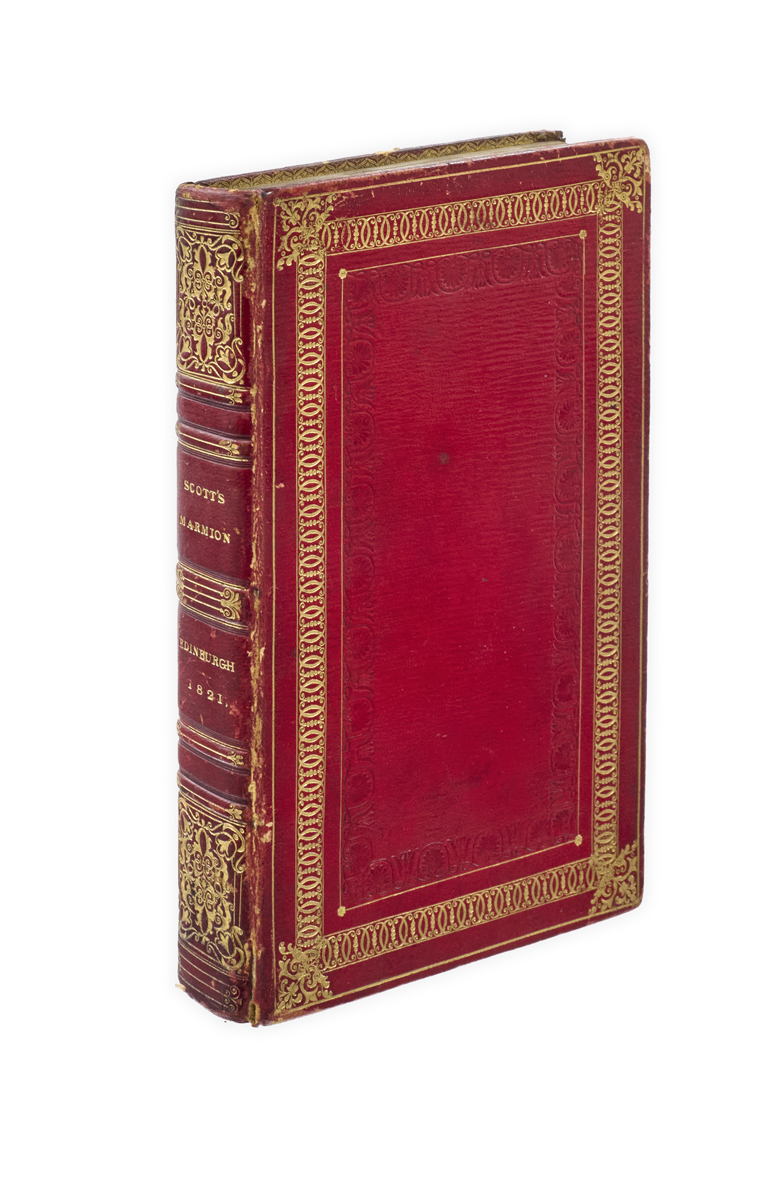
8vo, pp. [iv], 512; very light browning to edges, the odd minor spot; else a very good copy in contemporary red straight-grained morocco, covers roll-tooled in blind and gilt to a panel design, spine richly gilt in compartments and lettered directly in gilt, pink silk place-marker, edges gilt, marbled endpapers; front hinge neatly repaired, a little rubbed and scuffed, corners slightly bumped; presentation inscriptions to front flyleaf ‘Charles Goding a present from his friend Hobhouse on leaving Eton the 25th of July 1826’ and ‘H[oward] Deitz [sic] With profound apologies Evelyn Waugh’, ‘March 1946’ inscribed in a third (Dietz’s?) hand below.
Tenth edition of Scott’s historical verse romance, this copy presented by Evelyn Waugh as an apologetic gift to the Hollywood publicist and Broadway songwriter Howard Dietz, then at work on an ill-fated film adaptation of Brideshead Revisited.
Head of Publicity from 1924 and later Vice-President of Metro-Goldwyn-Meyer – whose iconic lion mascot and motto (Ars gratia artis) he devised – Howard Dietz (1915–1976) complemented his leading role in Hollywood’s Golden Age with a successful career on Broadway, working with composer Arthur Schwartz to write a series of hit revues including The Little Show, There’s a Crowd, and The Band Wagon. He was also, by coincidence, husband of the socialite Tanis Guinness, who in 1937 had jilted the Earl of Carnarvon, cousin both of Waugh’s current and of his former wife, on the eve of their wedding to marry Dietz instead.
Waugh inscribed the present copy of Scott’s Marmion to Dietz in March 1946, a significant point in their acquaintance: Brideshead had been published to acclaim the year before – proving an unexpected bestseller in America, which the Americophobic Waugh termed ‘my humiliating success in [the] U.S.A.’ (Letters, p. 224) – and MGM were now courting the author for a Hollywood adaptation. In February Waugh records meeting ‘Deats, whose name is spelt Deitz [sic]’, for pink champagne at the Ritz; the American came bearing a gift of Waugh’s beloved cigars (Diaries, p. 642). Waugh seems to have reciprocated with the gift of our volume the following month, misspelling Dietz’s name the same way, though the cause of his ‘profound apologies’ is unclear.
The following year Waugh and his wife accepted MGM’s offer of an all-expense trip to California to discuss the adaptation. America was not to his taste, however, and he was put off by the studio’s wish to adapt the novel as a simple romance shed of its theological themes as well as by restrictions under the Hays Code on portraying adultery, divorce, and (even hinted) homosexuality. The talks fell through, and Waugh’s sojourn on MGM’s dime went on to inspire his satire on Los Angeles, The Loved One (1948), in which ‘Megalopolitan Studios’ stands in for his Hollywood hosts.
Waugh’s signature evolved several times, most notably around the time his first marriage failed in 1929. Curiously the capital E in our copy is closer to his earlier signatures, but there is no evidence that he and Dietz were acquainted before 1946.
Ruff 71; Todd & Bowden 28Am.