Non Angli Sed Angeli – a Punning Pilgrimage
SPIZEL, Gottlieb.
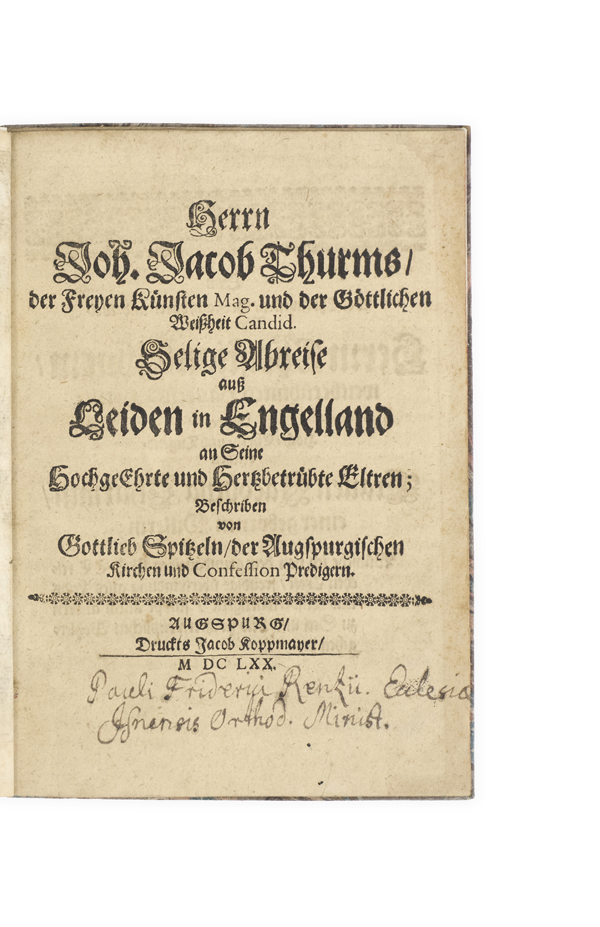
Herrn Joh. Jacob Thurms der freyen Künsten Mag. und der göttlichen Weißheit Candid. selige Abreise auß Leiden in Engelland, an seine hochgeehrte und hertzbetrübte Eltren … Augsburg, Jacob Koppmayer, 1670.
One part only (see below), 4to, pp. 32, [4], with two folding engraved plates; woodcut initials, woodcut and typographic head- and tailpieces; lightly toned, small damp-stain to upper outer corner of first leaves, nonetheless a very good copy; bound in modern marbled boards, gilt black paper label to spine, edges speckled red; early ink ownership inscription ‘Pauli Friderici Renzii. Ecclesiæ | Isnensis Orthod. Minist.’ to title.
Added to your basket:
Herrn Joh. Jacob Thurms der freyen Künsten Mag. und der göttlichen Weißheit Candid. selige Abreise auß Leiden in Engelland, an seine hochgeehrte und hertzbetrübte Eltren …
First and only edition, very rare, of this account of the travels and death of the young theologian Johann Jakob Thurm, whose death in Leiden en route to England is reinterpreted for pious puns by the theologian and philologist Theophil Gottlieb Spizel.
The son of a merchant from Augsburg, Thurm (1649–1669) studied theology at Leipzig before setting off on an academic tour of Europe, cut short by his death from fever eight days after arriving in Leiden en route to England. His death in Leiden (‘suffering’) is used as the basis for wordplay suggesting a journey from the hardships of earth on to the happiness of Heaven: Thurm is said to have travelled from this unfortunate lower kingdom (the Netherlands) through a wretched land of hunger (a play, no doubt, on Hungary), a strange land of rags (Lapland), a cold-hearted land of ice (no surprises), and a dangerous land of error (Ireland), into a heavenly and incomparable land of angels (England), being the New World and terra incognita of the next life.
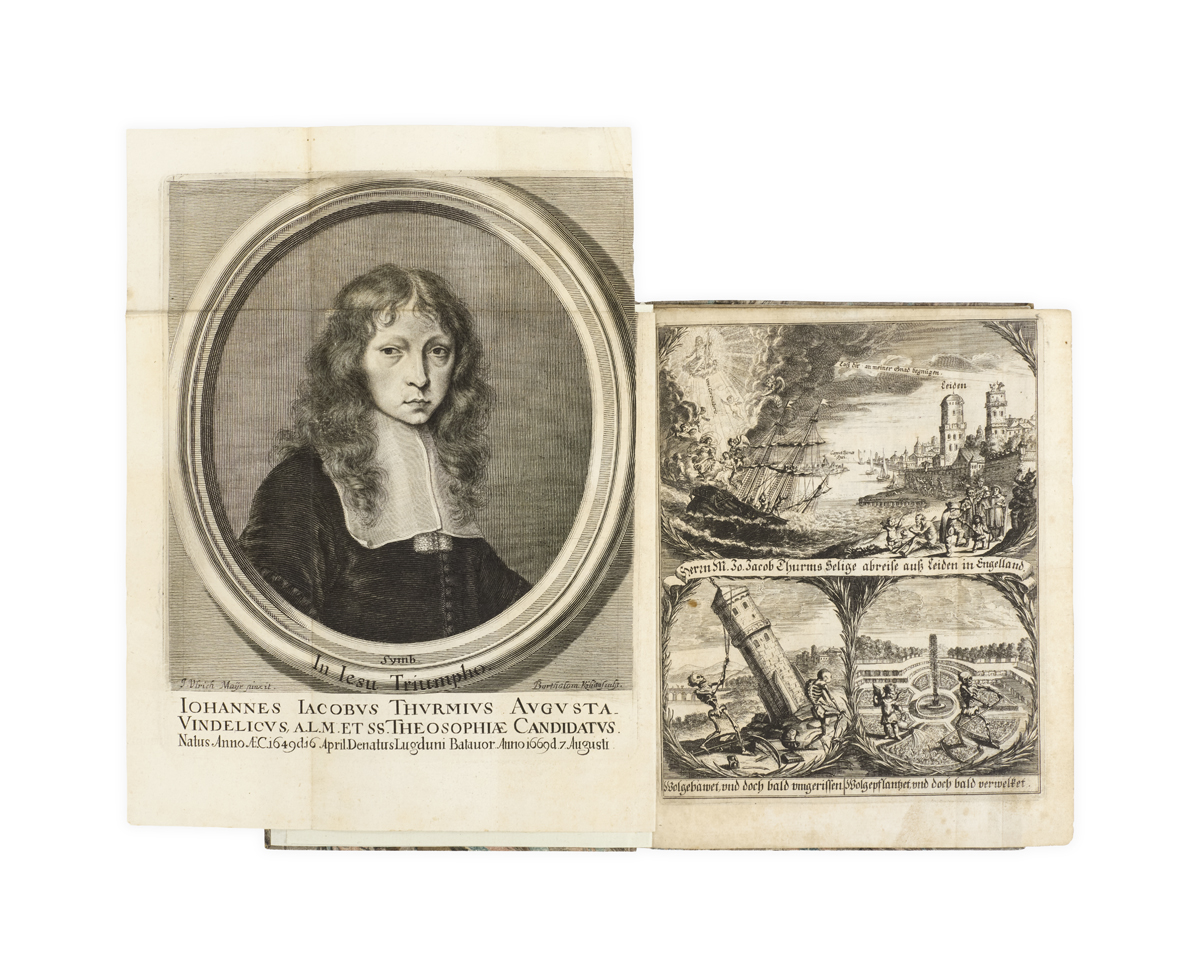
The text is accompanied by two copper-engraved plates: a masterfully executed portrait of Thurm, engraved by Bartholomäus Kilian after J. Ulrich Mayer, and an unsigned engraving showing Christ rescuing a soul from a ship being wrecked off Leiden, above two emblematic vignettes depicting skeletons destroying a tower and a tended garden, illustrating the motto below (‘Well built, and yet soon torn down; well planted, and yet soon withered’).
The author, Theophil Gottlieb Spizel (or Spitzel, 1639–1691), a pastor at the Jakobskirche in Thurm’s native Augsburg, published prolifically on subjects from theology and Church history to philology and Chinese philosophy; ‘none of the Lutheran clergymen from Augsburg in the second half of the seventeenth century has left behind a literary oeuvre of comparable scope’ (Blaufuß, p. 413 trans.). Among his wide circle of correspondents were his fellow polymath Gottfried Wilhelm Leibniz (also acquainted with Thurm at Leipzig) and the father of Pietism, Philipp Spener.
Provenance:
With the ownership inscription of Paul Friedrich Renz, a minister at Isny im Allgäu from 1696, having previously served as Rector of the Latin school at Biberach.
The work appears to have been issued with other works relating to Thurm, indicated by the catchword on the final leaf; these, however, had a different imprint, and all copies on VD17 are recorded as incomplete.
OCLC records only two copies outside Germany and Switzerland, at Harvard (this part only) and the National Library of Scotland.
VD17 12:148415Y. See Blaufuß, ‘Commercium epistolicum in der Reichsstadt: Gottlieb Spizel/Augsburg (1639–1691) und seine Briefwechsel-sammlung im Umkreis von Orthodoxie und Pietismus’, in Stadt und Literatur im deutschen Sprachraum der frühen Neuzeit (1998), pp. 411–424.