Jesuit Homage
[TANNER, Jan.]
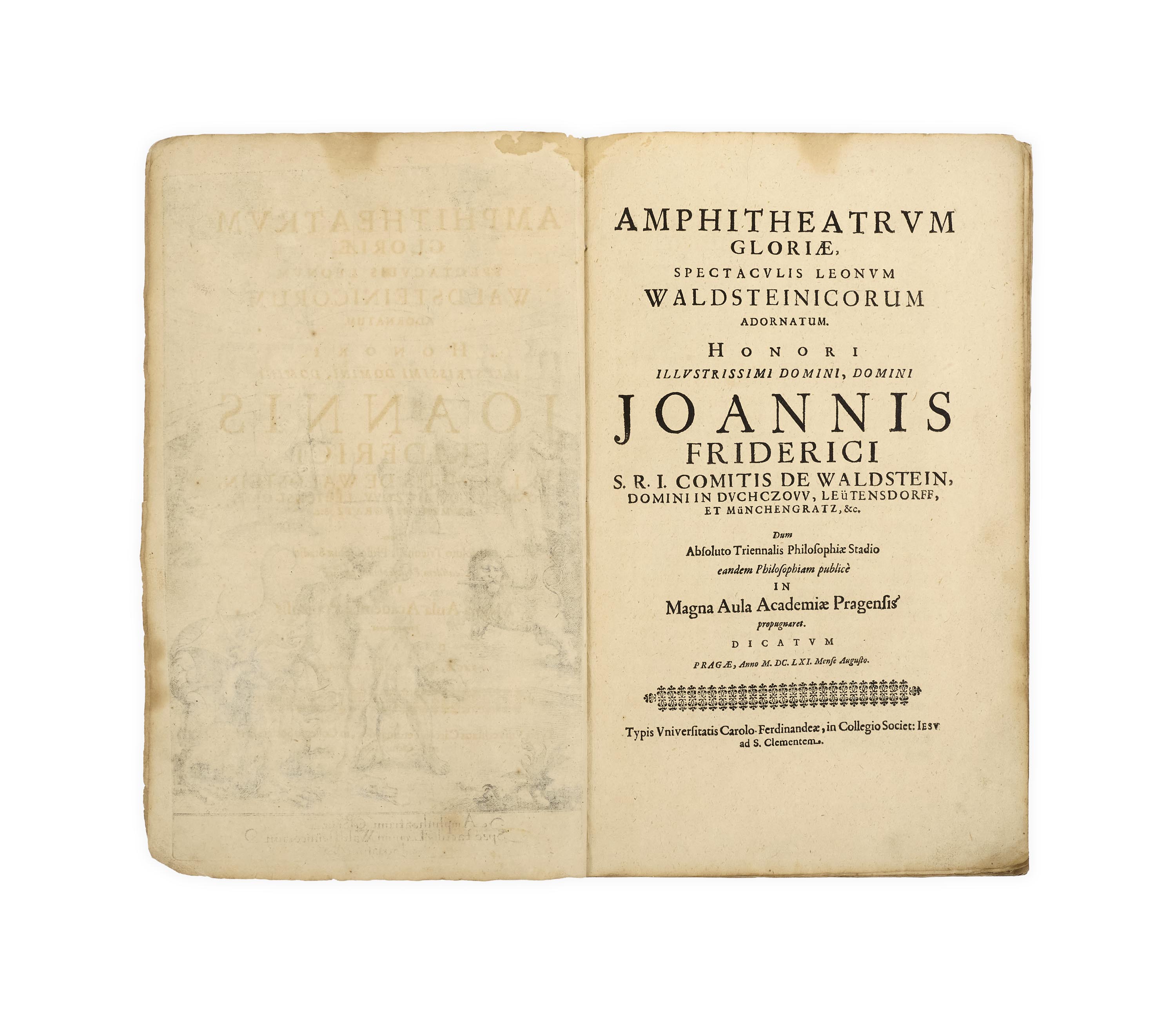
Amphitheatrum gloriae, spectaculis leonum Waldsteinicorum adornatum … Dicatum Pragae, anno M.DC.LXI mense Augusto. [Prague,] ‘typis universitatis Carolo Ferdinandeae, in collegio Societ: Iesu ad S. Clementem’, [1661].
Folio, pp. [42], with copper-engraved title-page and one double-page copper-engraved plate; woodcut initials and tail-pieces; toned, occasional spots, wormholes to lower margins of D2–F1 (touching foot of plate) and to outer margins of K1–L1 (not touching text), but a good copy; stab-stitched in contemporary red wrappers; worn and stained, spine and much of the stitching perished, losses to wrappers.
Added to your basket:
Amphitheatrum gloriae, spectaculis leonum Waldsteinicorum adornatum … Dicatum Pragae, anno M.DC.LXI mense Augusto.
Very rare first edition of this homage to the ancient Bohemian Waldstein family by the Czech Jesuit Jan Tanner, printed at the Jesuit college in the famous Clementinum in Prague.
Tanner (1623–1694) taught at the Jesuit colleges in Prague and Olomouc and served as confessor to Johann Friedrich von Waldstein (1642–1694), later Archbishop of Prague, to whom this work is dedicated. He carried out significant missionary work and constructed a network of chapels on the famous pilgrimage route from Prague to Stará Boleslav. His works encompassed theology, hagiography, and genealogy.
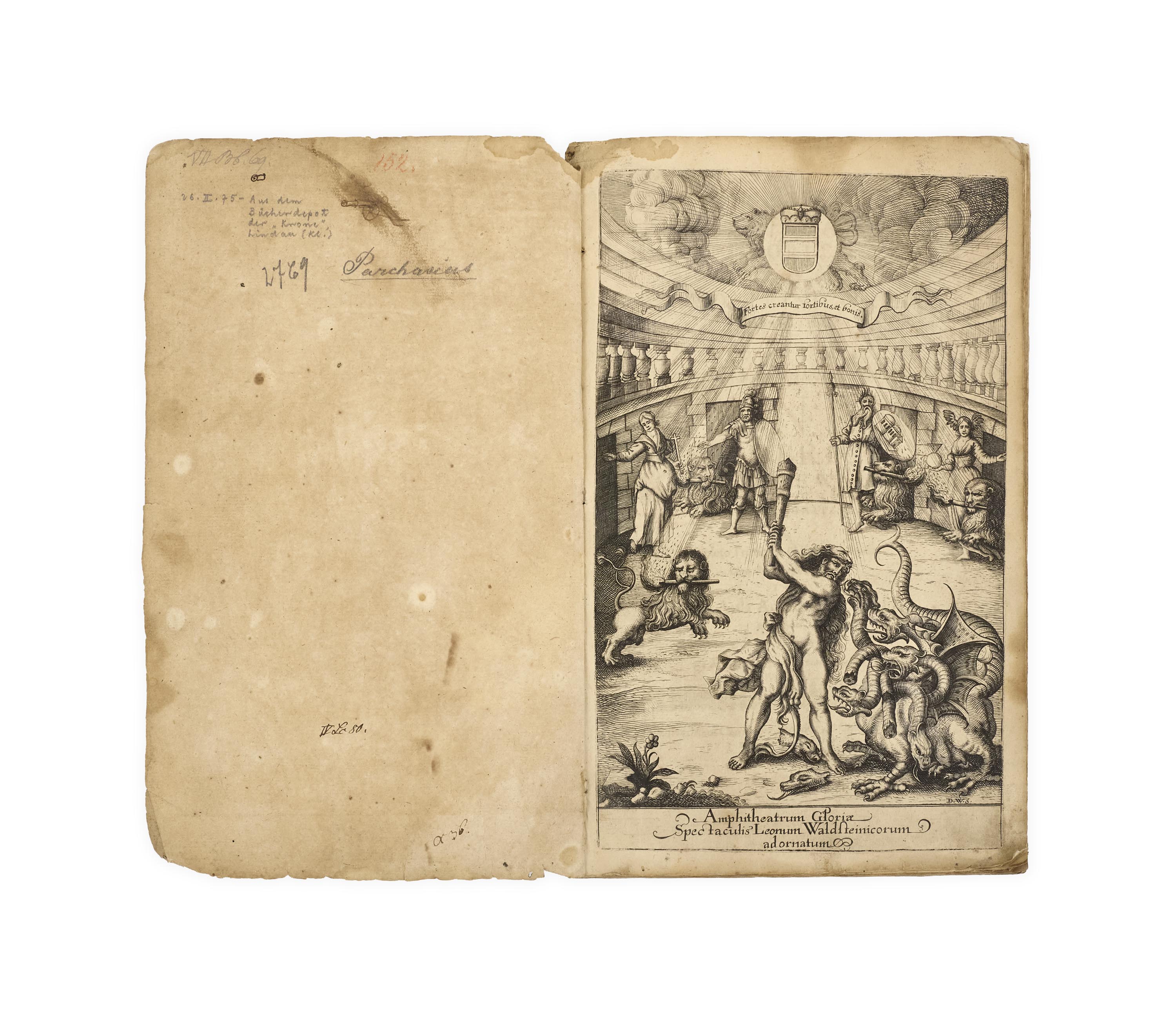
Founded in the thirteenth century and named after Valdštejn Castle, the house of Waldstein (or Wallenstein, as famously rendered in Schiller’s eponymous trilogy and Döblin’s novel) adopted a lion as its heraldic symbol. Making full creative use of the family’s leonine device, Tanner here presents four lions in the ‘amphitheatre of glory’ representing the family’s outstanding religious faith, bravery, wisdom, and dignity. His text, a combination of prose and verse, references numerous wonderful Waldsteins from the past, and looks forward to an equally glorious future under Johann Friedrich.
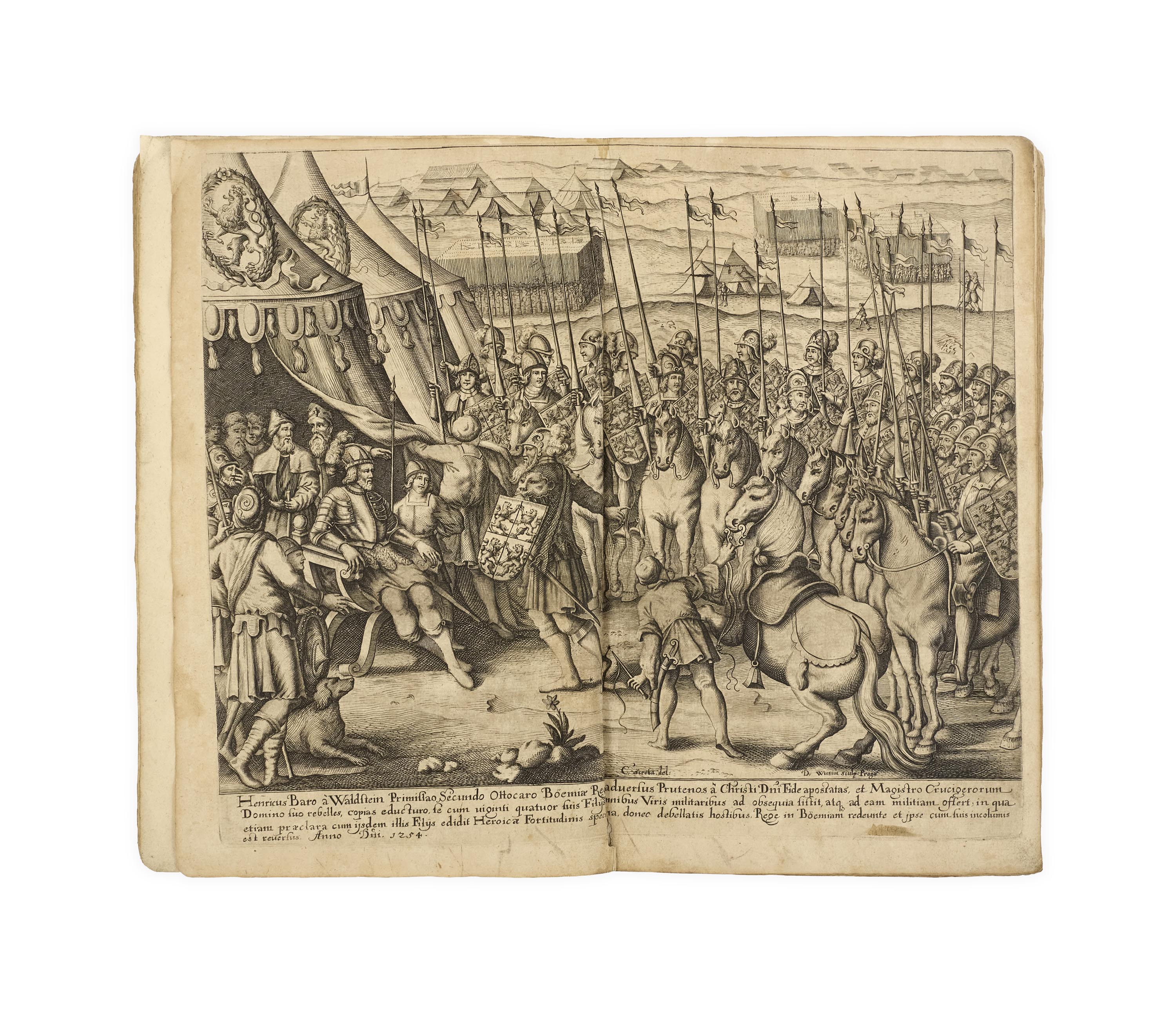
The frontispiece depicts Tanner’s four lions and their allegorical companions in an amphitheatre, with Hercules, decked in a lion skin, battling the Lernaean Hydra in the foreground. The double-page plate shows Henry of Waldstein with his twenty-four sons before Ottokar II of Bohemia in 1254, portraying them as models of heroic valour. Both plates are engraved by Daniel Wussin (1626–1691), the latter after Karel Skreta (1610–1674).
The magnificent Clementinum, a complex of buildings now housing the National Library of the Czech Republic, traces its origins to the eleventh century. A Jesuit college existed there from the mid-seventeenth century to the suppression of the Order in 1773. Charles University (the University of Prague) moved to the site in the 1620s.
OCLC records only one copy, at Olomouc Research Library.
Sommervogel VII, 1856.