On Taxing Tea — Presentation Copy to Staunton
TRAVERS, John.
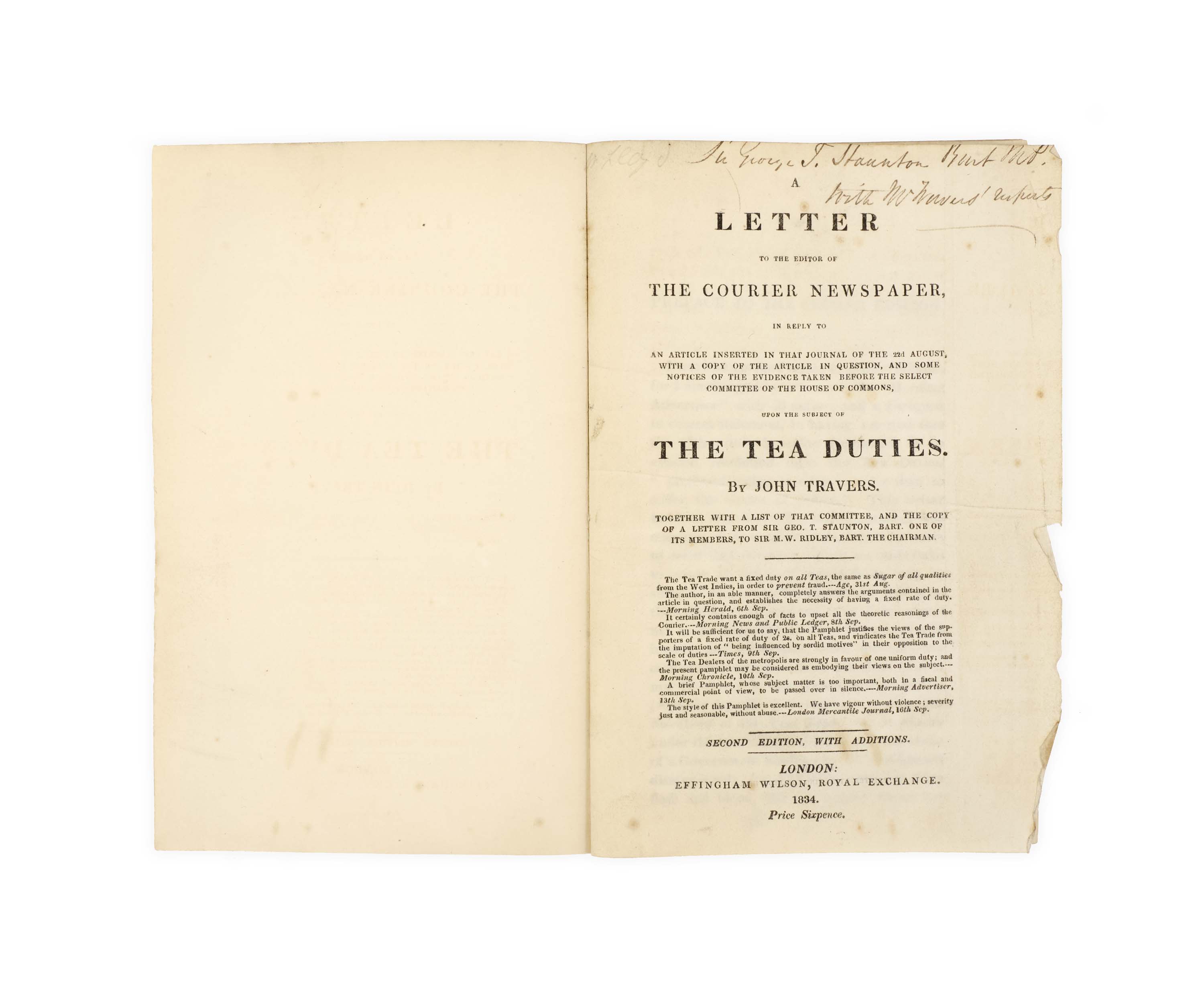
A Letter to the Editor of the Courier Newspaper, in Reply to an Article inserted in that Journal of the 22d August, with a Copy of the Article on Question, and some Notices of the Evidence taken before the Select Committee of the House of Commons, upon the Subject of the Tea Duties … Together with a List of that Committee, and the Copy of a Letter from Sir Geo. T. Staunton, Bart. one of its Members, to Sir M. W. Ridley, Bart. the Chairman … Second Edition, with Additions.
London, Effingham Wilson, 1834.
[bound with:]
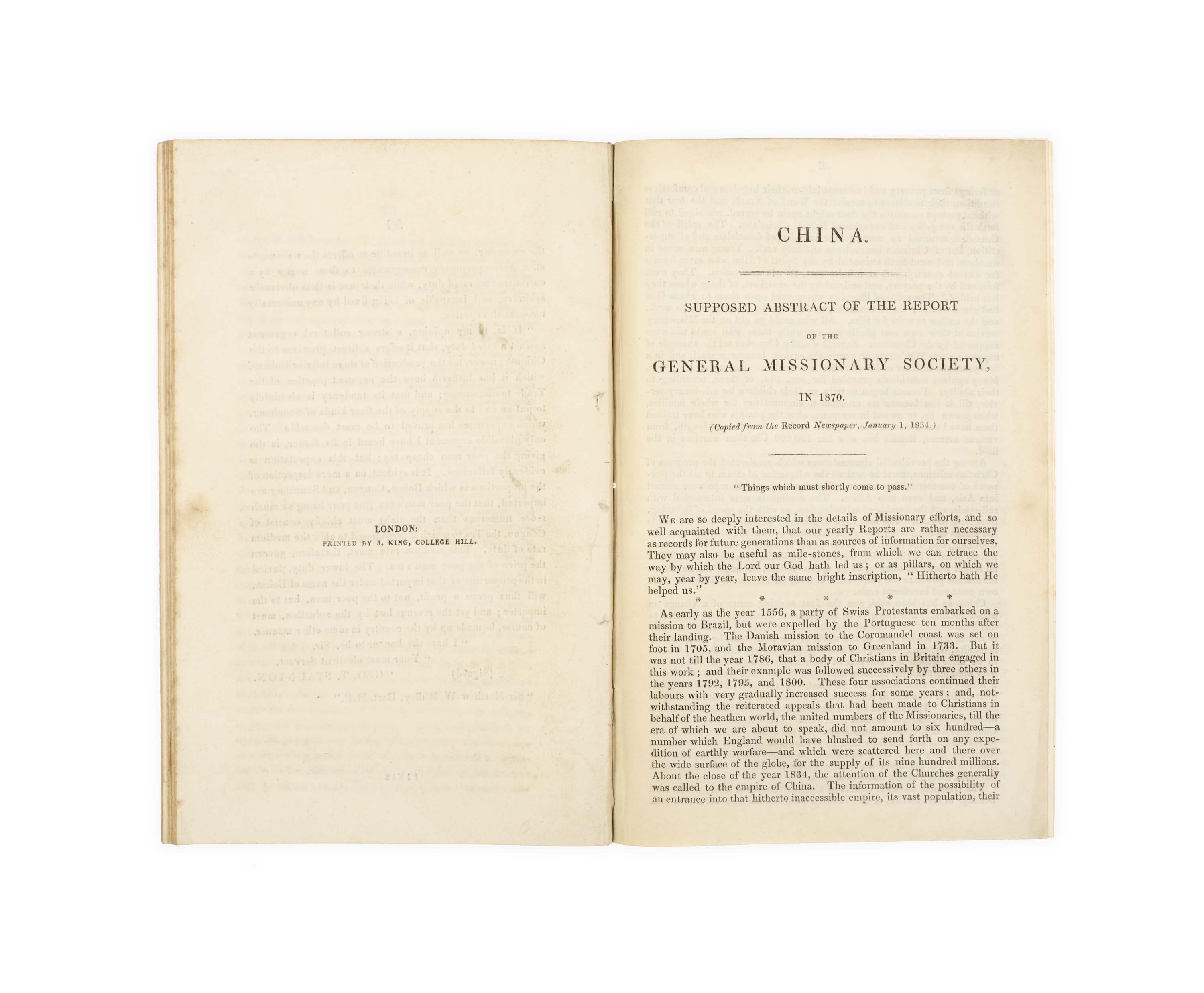
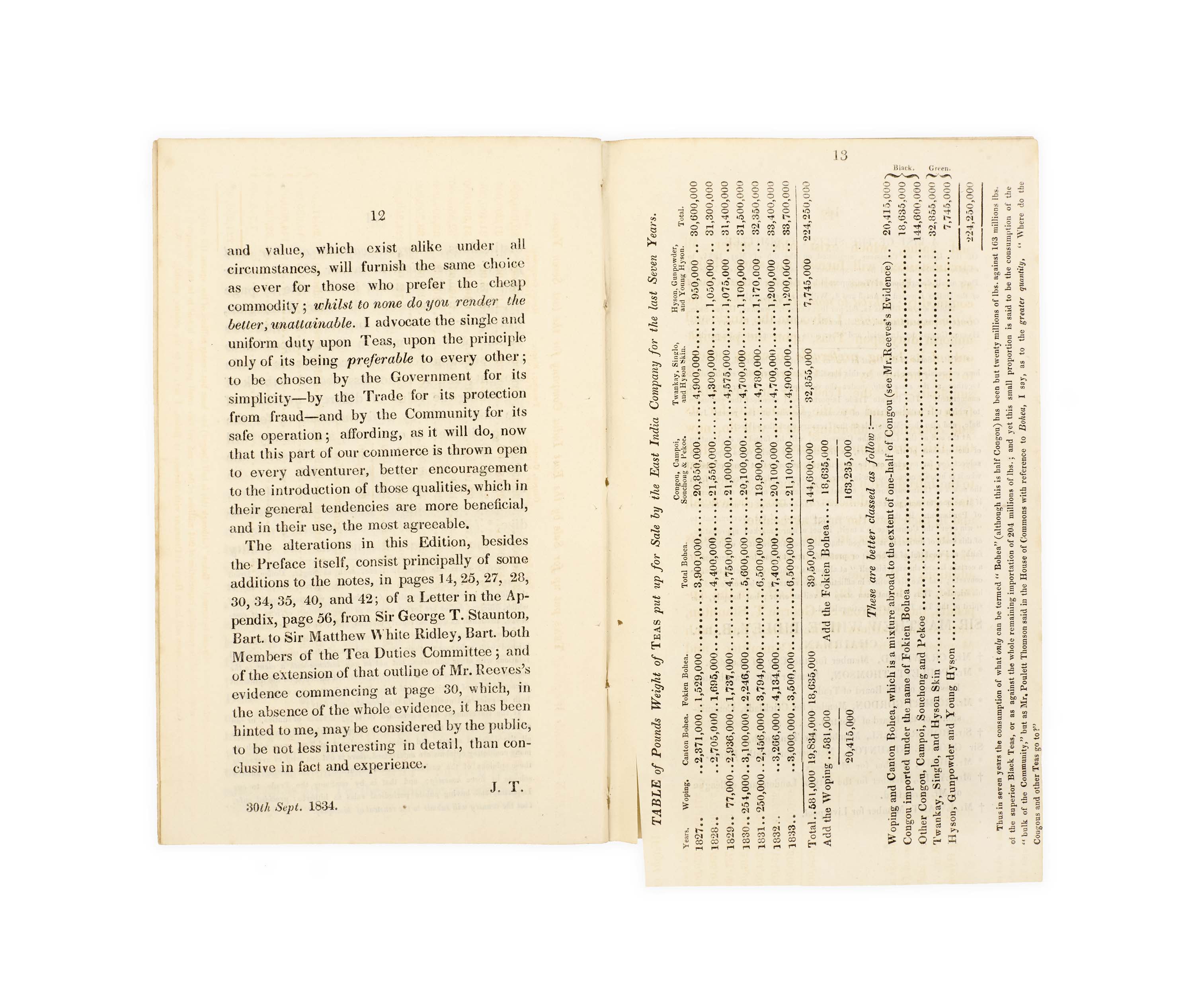
[CHINA.] [Drop-head title:] China. Supposed Abstract of the Report of the General Missionary Society in 1870 … The approaching Subjugation of China. [London], (colophon:) W. Tyler for Thomas Ward and Co., [1835].8vo, pp. Travers: 59, China: 8; table to p. 13; title long at fore-edge, A7 long at tail, both folded in; slightly browned with light foxing; else very good copies in modern wrappers; presentation inscription ‘Sir George T. Staunton Bart MP. With Mr Travers’ respects’ to title (slightly trimmed at head), pencil and ink annotations to a few pages.
Added to your basket:
A Letter to the Editor of the Courier Newspaper, in Reply to an Article inserted in that Journal of the 22d August, with a Copy of the Article on Question, and some Notices of the Evidence taken before the Select Committee of the House of Commons, upon the Subject of the Tea Duties … Together with a List of that Committee, and the Copy of a Letter from Sir Geo. T. Staunton, Bart. one of its Members, to Sir M. W. Ridley, Bart. the Chairman … Second Edition, with Additions.
Second, expanded edition of this tract on reforming the duties on tea imported from China to Britain, this copy presented to the Sinologist Sir George T. Staunton, member of the Select Committee on Tea Duties and author of the letter appended here, likely with his annotations and corrections; bound with a very rare pamphlet on the conversion of China.
The controversy arose when the East India Company was stripped of its monopoly on tea in 1833. A new system of duties, under which the tariff was rated in accordance with the quality of the tea, was brought in. The system proved complex to administer and gave significant discretion to customs officials in the classification of teas (and therefore in choosing which duty to impose). The tea merchants protested, and a select committee was appointed. They concluded that a fixed rate would be preferable, a position vociferously supposed by Travers in his pamphlet, and the system was repealed.
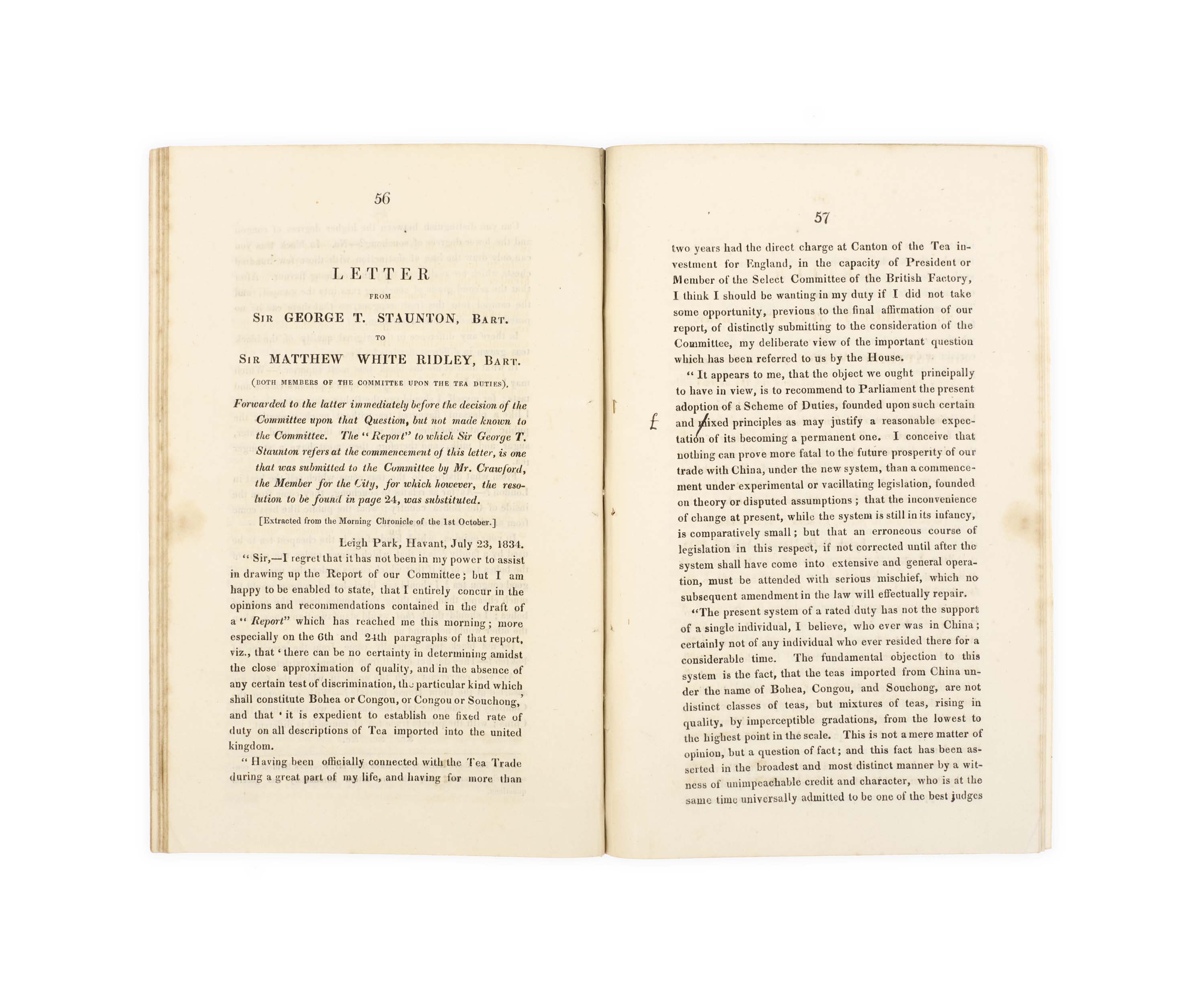
Among the committee’s members was Sir George T. Staunton, the recipient of our copy. Son of Sir George Leonard Staunton – diplomat and author of the Authentic Account of the Macartney Embassy – the younger Staunton had as a boy accompanied his father to China in 1792–4, learning Chinese on the way from two native missionaries and becoming, aged twelve, the only member of the embassy able to converse directly with the emperor. He returned to China in 1799 to work at the East India Company’s factory at Canton – ‘the first Englishman at the factory to have studied Chinese’ (ODNB) – and rose to become its chief. ‘He was disappointed when his proposed appointment as ambassador to Peking (Beijing) was abandoned in 1809’ (ibid.), though he later served on Lord Amherst’s embassy. While at Canton he translated George Pearson’s treatise on vaccination into Chinese and published an English edition of the Chinese penal code.
As a leading Sinologist Staunton was appointed to the Tea Duties Committee in 1834, expressing his thoughts on the question in a letter to the committee’s chairman appended to the present pamphlet: ‘The present system of a rated duty has not the support of a single individual, I believe, who ever was in China … the teas imported from China under the name of Bohea, Congou, and Souchong, are not distinct classes of teas, but mixtures of teas, rising in quality, by imperceptible gradations … in point of fact, there is no distinction at all’ (pp. 57–8). It was only natural, then, for Travers to inscribe the present copy to Staunton, who appears to have corrected by hand an erratum in his letter as printed here and made marginal notes on other passages.
Bound with Travers’s tract is the sole edition, very rare, of a contemporary pamphlet reprinting two newspaper articles urging the missionary conversion of China. This would answer, it is argued, the Chinese population’s ‘sufferings from poverty and incessant labour, their hopeless and comfortless condition, their readiness to receive the Word of Truth’. Of this pamphlet OCLC and Library Hub find copies at only two institutions worldwide (SOAS, Yale).
Travers: Goldsmiths’ 28520; Kress C.3882 (first edition).