St Mark Breaks His Sandal
BREVIARY,
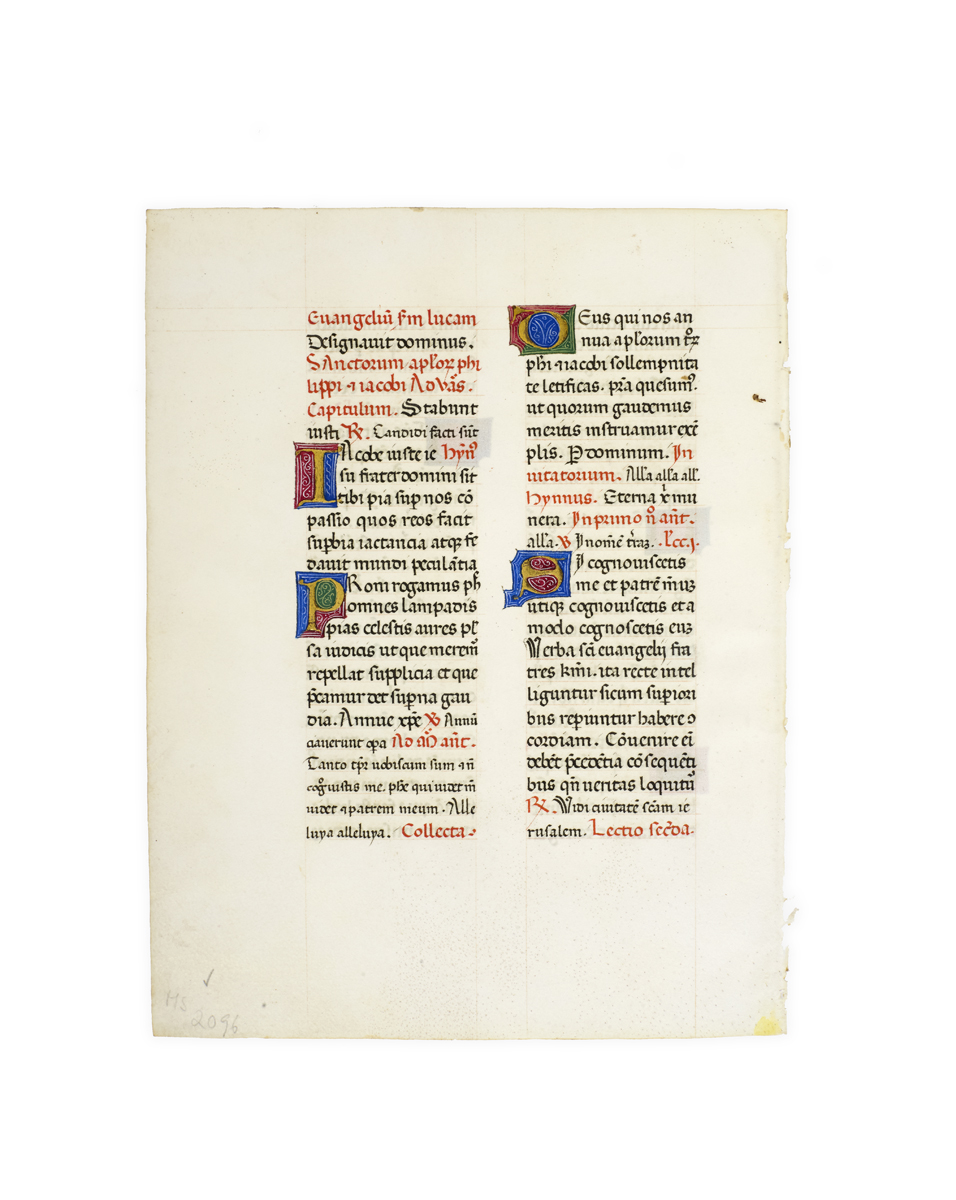
in Latin, from the Sanctorale, with text for the feasts of Saint Mark and Saints Philip and James. Northern Italy, late 15th century.
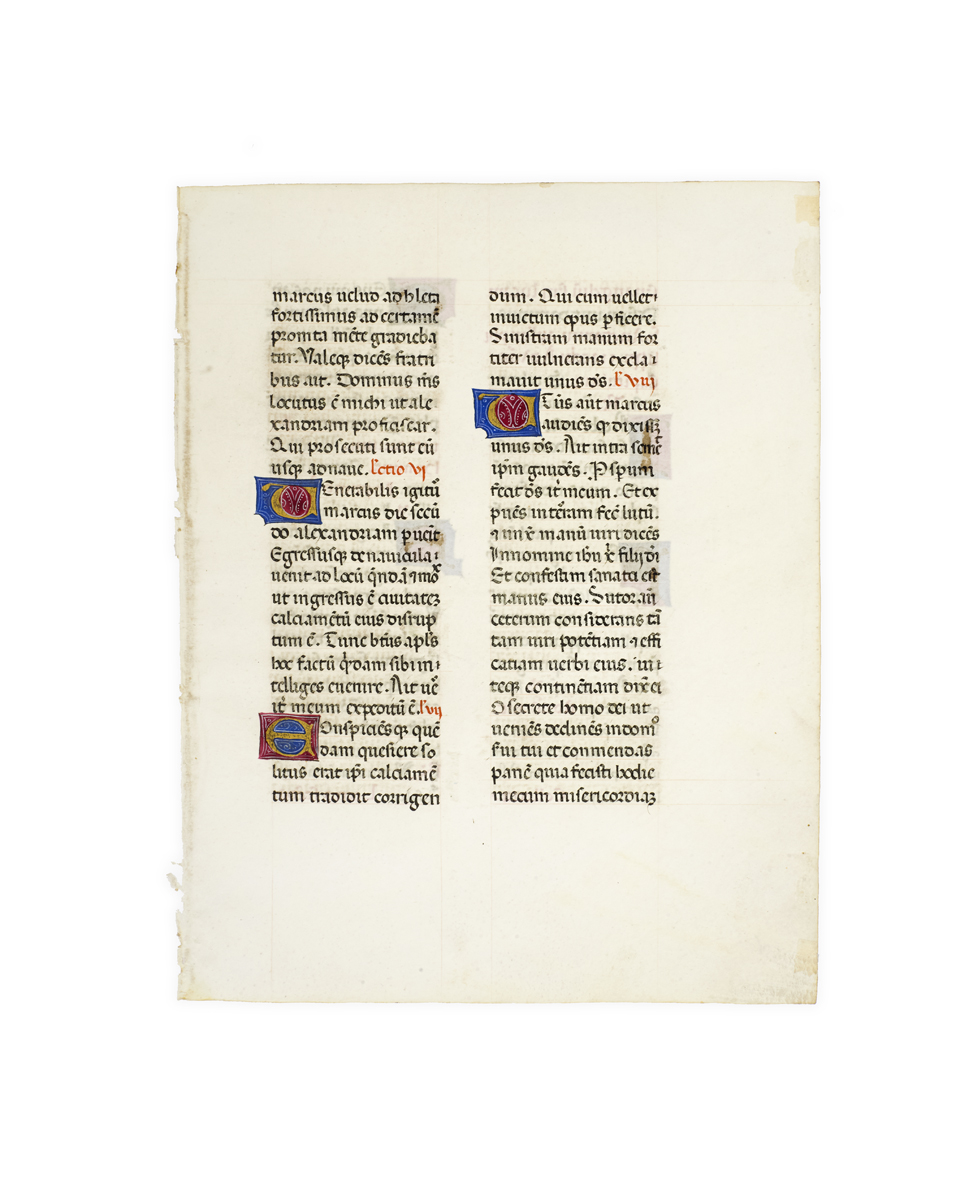
Complete vellum leaf (c. 200 x 155 mm, text area c. 130 x 100 mm), double columns of 24 lines written in two sizes of a rounded gothic bookhand in dark brown and red ink, ruled in pale red ink, two three-line and five two-line initials in burnished gold against blue, green, and red grounds highlighted in white; a few very small marks and slight rubbing to recto, small traces of adhesive to fore-edge of recto from mounting; collector’s pencilled manuscript no. to corner of verso; in excellent condition preserving pricking in outer margins.
Added to your basket:
in Latin, from the Sanctorale, with text for the feasts of Saint Mark and Saints Philip and James.
A well-preserved leaf from an attractive Italian breviary with several readings for the feast of St Mark (25 April) followed by hymns, prayers, and readings for the feast of St Philip and St James (3 May).
The lections for St Mark come from the Passio Sancti Marci and relate how the Evangelist set off for Alexandria ‘like a strong athlete’, only to break a sandal upon arrival. Mark takes it to a shoemaker who wounds his left hand while repairing it, which Mark then miraculously heals, the shoemaker offering the Evangelist bread in return for his merciful act.
There are a number of scribal errors: two out of the three decorative initials in the readings are wrong, and in the body of the text we find, for example, ‘quesiere solitus erat’ for ‘qui suere solitus erat’, and ‘O secrete homo dei’ for ‘Obsecro te homo dei’.
Italian features of the script include the uncrossed ‘et’ sign resembling a small ‘q’, the horizontal ascender of ‘d’, the use of ‘tia’ rather than ‘cia’, and the superscript ‘9’ for ‘us’. There are some distinctive spellings, such as ‘velud adhleta’ for ‘velut athleta’ in the first line to the recto, and ‘promta’ for ‘prompta’ two lines below.