Value as Compound of Utility and Scarcity
LAUDERDALE, James Maitland.
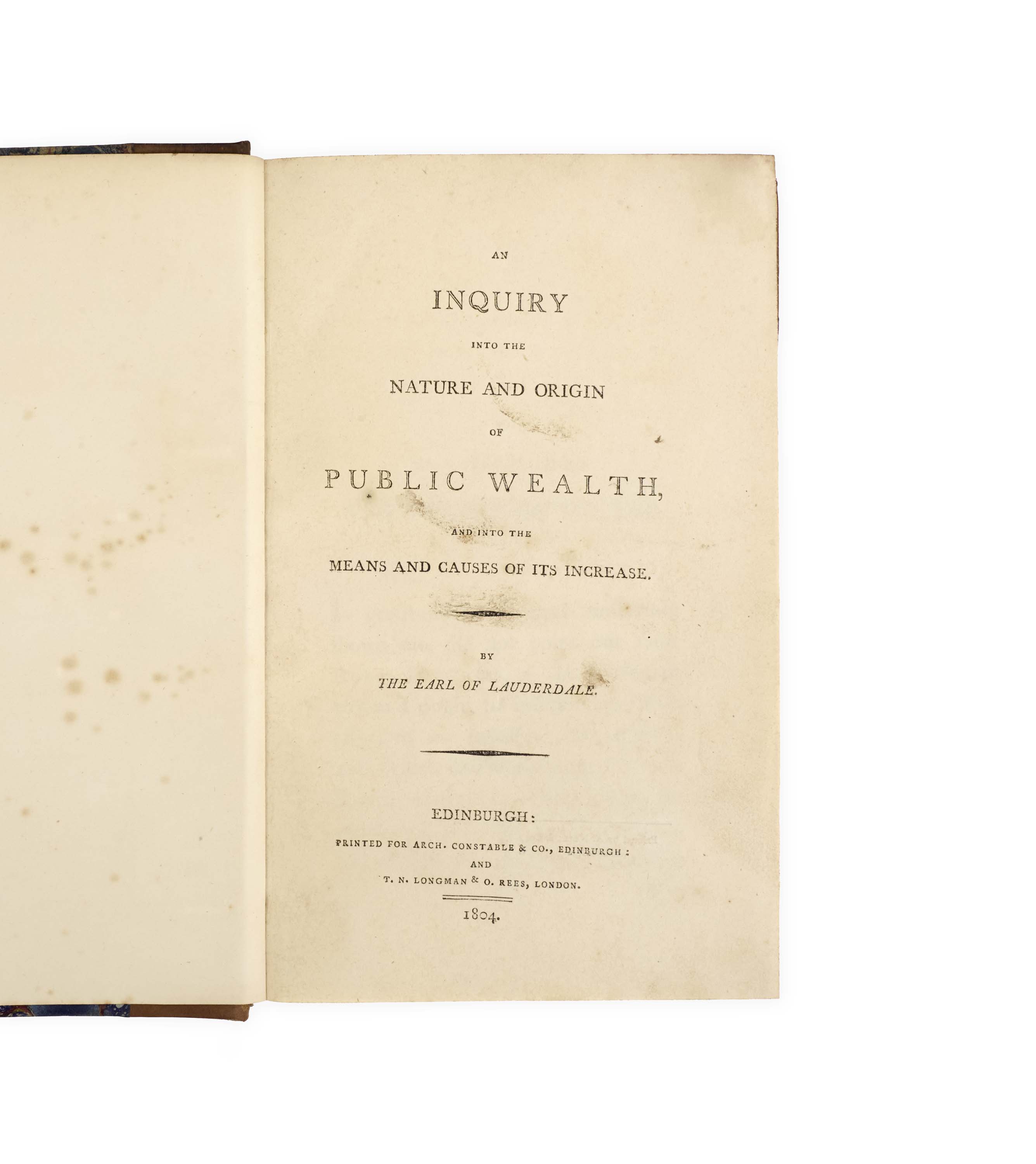
An Inquiry into the Nature and Origin of Public Wealth, and into the Means and Causes of its Increase. Edinburgh, Arch. Constable & Co., and London, T.N. Longman & O. Rees, 1804.
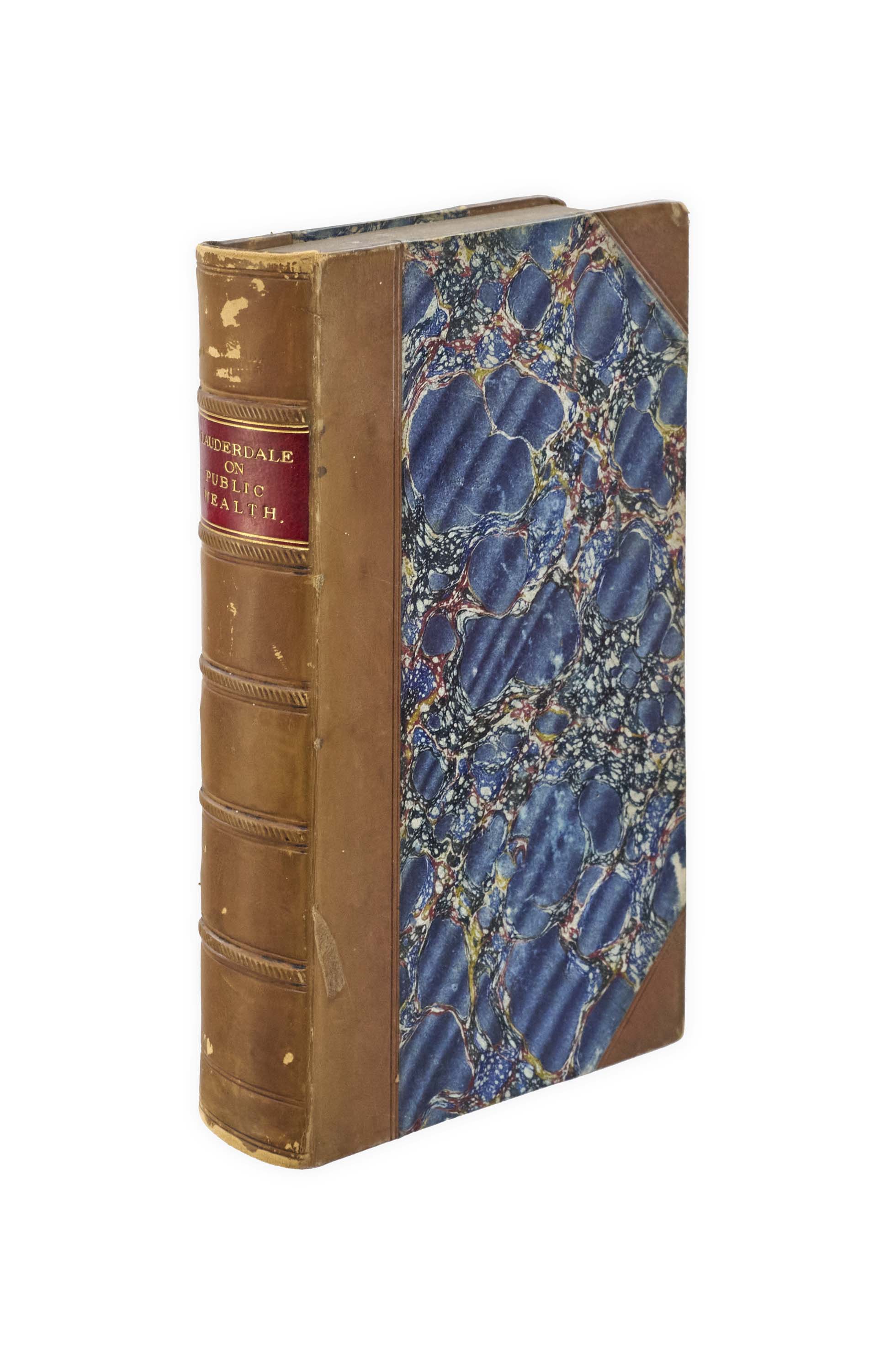
8vo, pp. [viii], 482, with folding letterpress table bound at end; bound without the half title; light foxing to endpapers and light browning to last quire and table, but a very good copy in in early twentieth-century polished half calf, sides and corners filleted in blind, spine with half raised bands, gilt red morocco lettering-piece, boards covered with marbled papers, sprinkled edges; hinges cracked but holding firmly, light rubbing to extremities, very minor abrasion to spine; armorial bookplate of Kilberry (motto ‘Remember well’) to front pastedown.
Added to your basket:
An Inquiry into the Nature and Origin of Public Wealth, and into the Means and Causes of its Increase. Edinburgh, Arch. Constable & Co.,
First edition. Lauderdale ‘was the first in England to consider systematically the fundamental conceptions on which the science is based. In this respect alone he is in advance of Adam Smith’ (Palgrave II, p. 574). He has been described as a forerunner of Keynes, arguing ‘that over-saving was a distinct possibility and that public spending was required to offset private thrift if stagnation was to be asserted’ (Blaug).
Here Lauderdale offers a critical reading of Adam Smith’s Wealth of Nations, around the notion of value and its relation to labour. He describes value was a compound of utility and scarcity, and wealth as a compound of labour, land, and capital. Only in an environment free from institutional restraints can capital successfully employ labour to meet demand and thus create profit.
Goldsmiths’ 8801; Kress B.4816; Einaudi 3628; Sraffa 3233; McCulloch, pp. 15f.