Thirty-Three Ways to Abuse the Taxman
POLLUX, Julius.
Ονομαστικον … Vocabularium. [(Colophon:) Venice, Aldus, April 1502.]
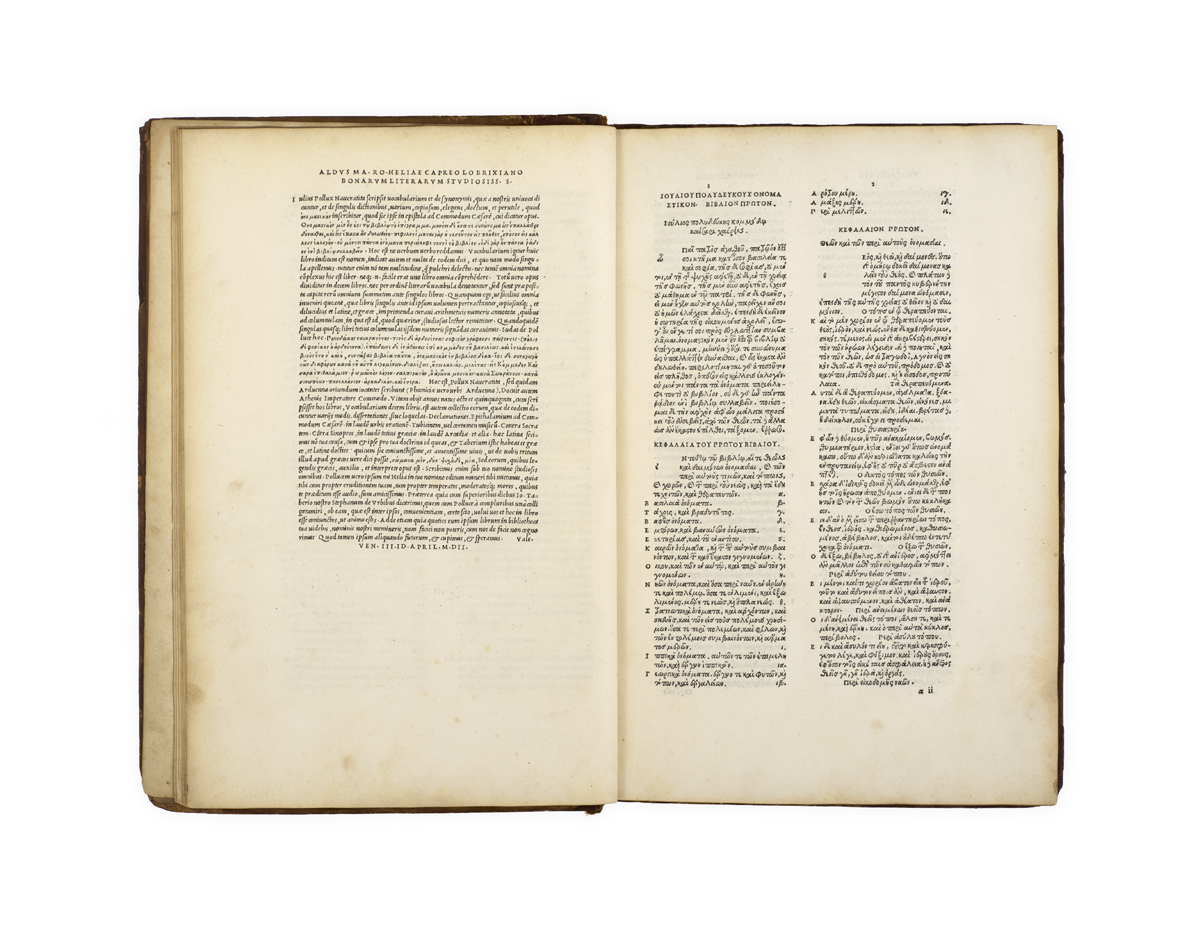
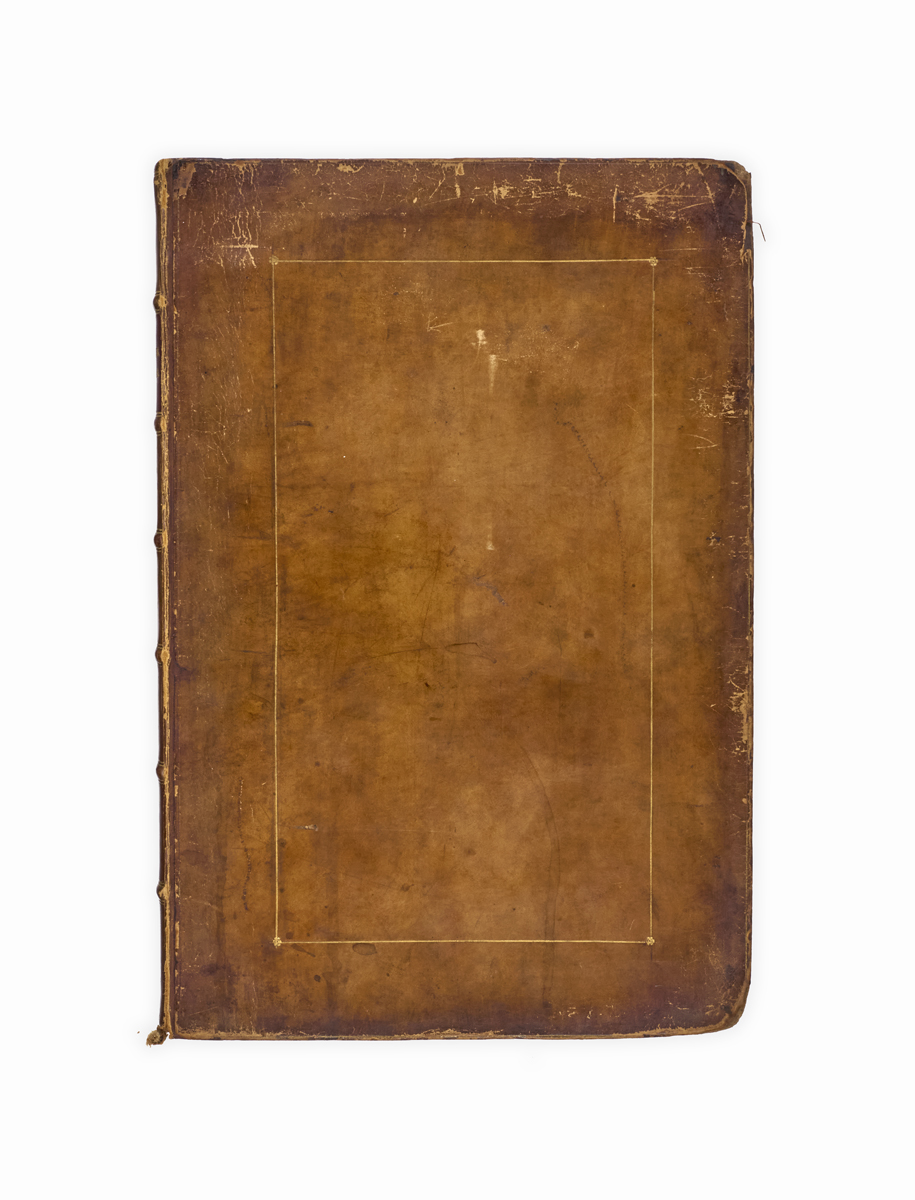
Folio, ff. [4, Latin table of contents], [4, Greek table of contents], [1, title and preface], [102, cols 1–408], [1, colophon]; first leaf a little dusty, very light marginal stain to λl4v (a printer’s inky fingers?), a very good copy; bound in late eighteenth-century calf, boards ruled in gilt to a panel design, edges gilt; somewhat rubbed, corners worn, neatly rebacked with gilt red morocco lettering-piece; late seventeenth-century annotations in an English hand to c. 17 pp. (some very slightly shaved), remains of an extract from an old sale catalogue to front pastedown, typescript description by Bernard M. Rosenthal loosely inserted, modern private collector’s bookplate to front pastedown.
Editio princeps of the oldest encyclopaedia from antiquity, with variant readings added in an English hand.
Julius Pollux was appointed to the chair of rhetoric at Athens in 178 AD by the Emperor Commodus, to whom the work is dedicated. Pollux made use of a wide variety of texts for his dictionary, from a now-lost work on equestrianism to musical instruments, as well as more familiar authors such as Homer and Isocrates. The text that survives is an abridgement, and it circulated widely in manuscript in fifteenth-century Italy.
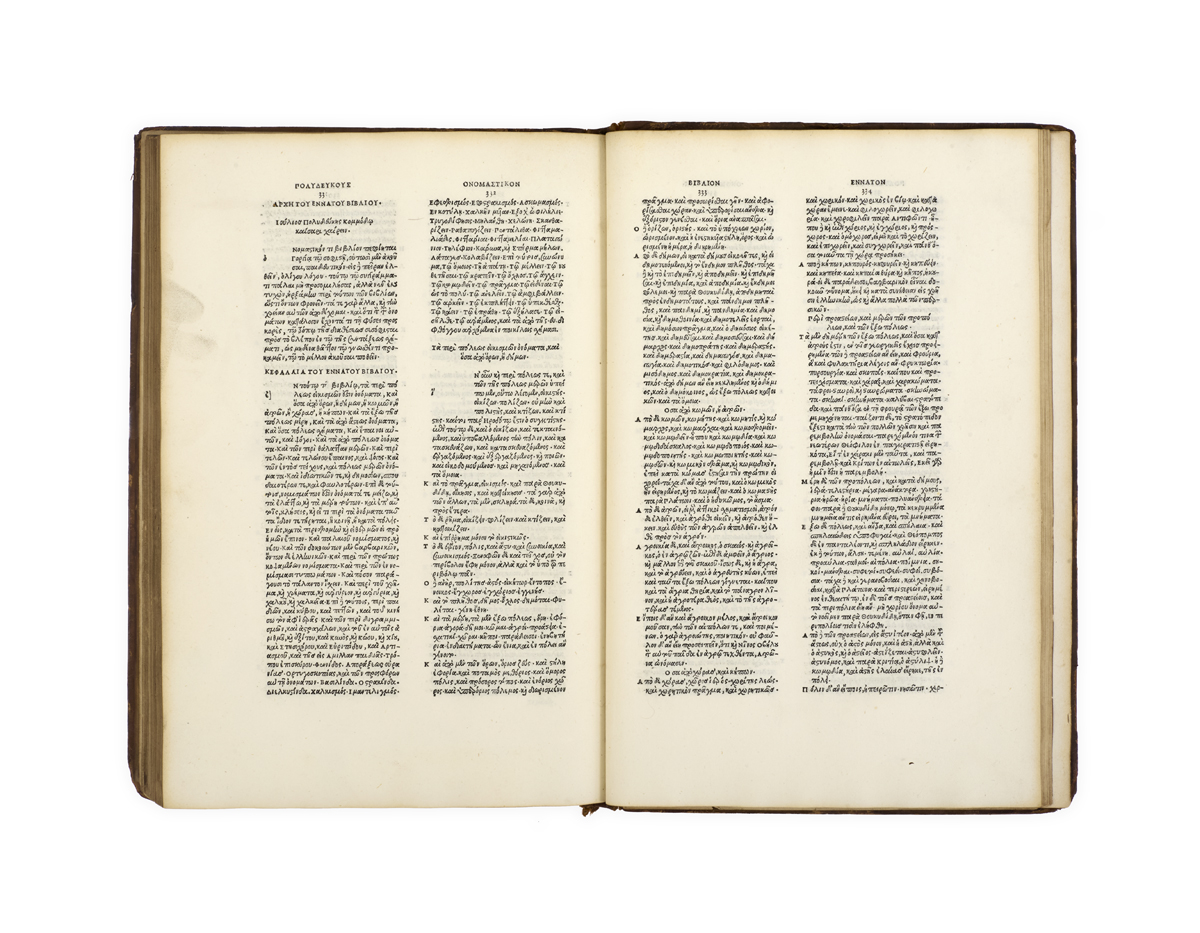
Arranged by topic rather than alphabetically, ‘the work partly resembles a rhetorical handbook, e.g. in its collections of synonyms and subject-vocabularies, in collections of compounds […], in the fifty-two terms for use in praising a king, or the thirty-three terms of abuse to apply to a tax-collector’ (OCD).
The lines of Greek text quoted within the preface are an early appearance of Aldus’s final and smallest Greek typeface, which would be used fully for the first time in the small format editio princeps of Sophocles in August of the same year. While the editor of the text is not recorded, at the end is a note by Scipione Forteguerri (Carteromachus), student of Poliziano and one of Aldus’s fellow founders of his Greek Academy. The preface by Aldus is addressed to Elia Caprioli (Cavrioli) of Brescia, jurist and historian.
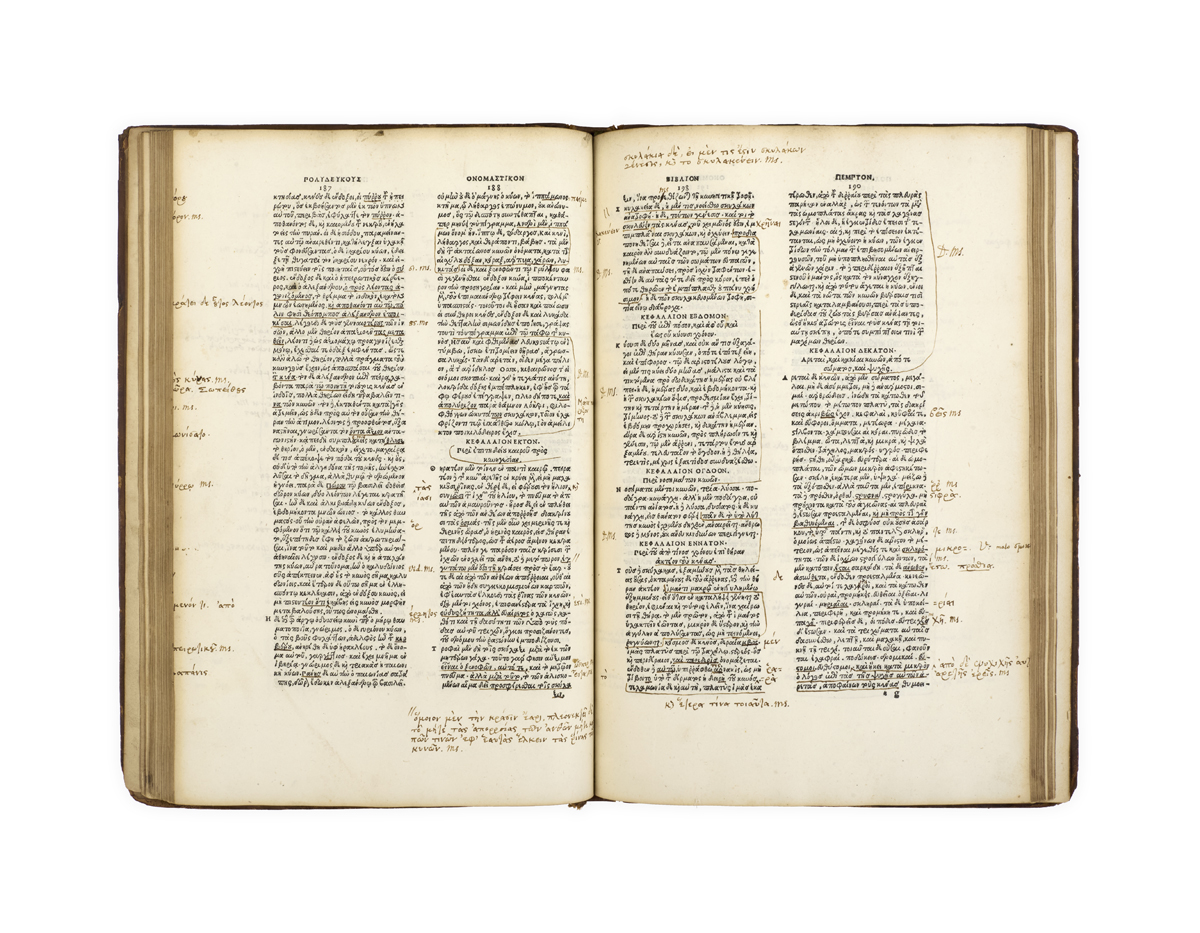
The annotations, predominantly in Greek, focus on book five, about hunting and animals, and for the most part provide alternative readings from a defective manuscript (labelled ‘ms’), along with a few notes in Latin. Some larger chunks of text are bracketed and marked ‘D. MS.’, perhaps standing for ‘desunt’, indicating where substantial sections are missing from the manuscript in question. A few of the annotations mention a reading from ‘Voss.’ or ‘Vos.’, i.e. Isaac Vossius (1618–1689), whose manuscripts were purchased in 1690 by the University of Leiden (his manuscript of Pollux dates from the early sixteenth century). Samuel Bochart (1599–1667), the author of a work on sacred geography, is mentioned twice.
A loosely inserted note attributes to Schreiber the suggestion that these annotations are the work of the German scholar Wolfgang Seber (1573–1634), who produced a parallel text edition of Pollux in 1608 (VD17 3:300230U); the references to Vossius and Bochart, however, are too late in date for this to be the case.
USTC 850213; EDIT16 CNCE 36138; Aldo Manuzio tipografo 57; Renouard 32/1; UCLA 54.